EVERGLADES RESTORATION TOUR

On Friday, March 23 the Everglades Restoration foundation presents the Everglades Restoration Tour: Shark Valley and the River of Grass.  Shark Valley is the northernmost entrance to Everglades National Park and lies at the heart of this historic ecosystem. Join the foundation at 9:00 to depart from Miami to Shark Valley, where you will travel by tram throughout the park. There will be several scenic and educational stops along the way, including the observation tower which offers a spectacular overlook of the Everglades. After the tour of Shark Valley, the group will stop for lunch before departing on airboats to ride across the River of Grass. Cost is $50.00 per person and included tram tour, airboat fare and a boxes lunch. Space is limited.

Contact Brittnie Bassat at bbassant@evergladesfoundation.org or 305-251-0001

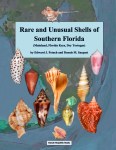
PETUCH & SARGENT PUBLISH “RARE AND UNUSUAL SHELLS OF SOUTH FLORIDA”

Just released, hot off the press. You can purchase your copy of this beautiful book with full page color photograps direct from the publishers, Conch Republic Books. The price for Individual books is 39.95 plus postage about $2.85 each and Florida sales tax from your county. You can email dsargent10@comcast.net or phone to order 352-516-7821. My copy has been ordered and will review in the near future.

SANIBEL TRIP

Sanibel will be celebrating its 75th annual Shell Show this coming March and we will be there to help them celebrate. On Saturday, March 3rd the club will have its annual field trip to that show. We will leave at 7:30 AM from the Coral Ridge Mall parking lot (under the AMC Theater sign located at the corner of Federal Highway and Oakland Park Blvd.) and return about 9:30 PM, so it will be a day-long affair. We will see the show, have some lunch, stop at a shell shop or two and possibly get in some shelling if time allows. The cost will be $30 per person which includes the rental fees/taxes, gas and such. The van holds a maximum of 12, but if we have enough interest we will rent an additional van….BUT I will then need someone to designate as a driver. I will be driving the first van (as usual). Please see me at the February meetings or call/email me at 954-296-5633 / sedlaki1@comcast.net. Checks are to be made out to The Broward Shell Club, but at least some cash payments would be nice to use for the fuel, etc. All I ask is that if you commit to go, then PLEASE do so. If there is a remote possibility that you might not be able to go then please do not sign up as any cancellations will end up having to be paid for by the club. It REALLY is a fun day and I encourage all of you new members to take advantage of this great day.

SHELL OF THE MONTH – FEBRUARY 2012

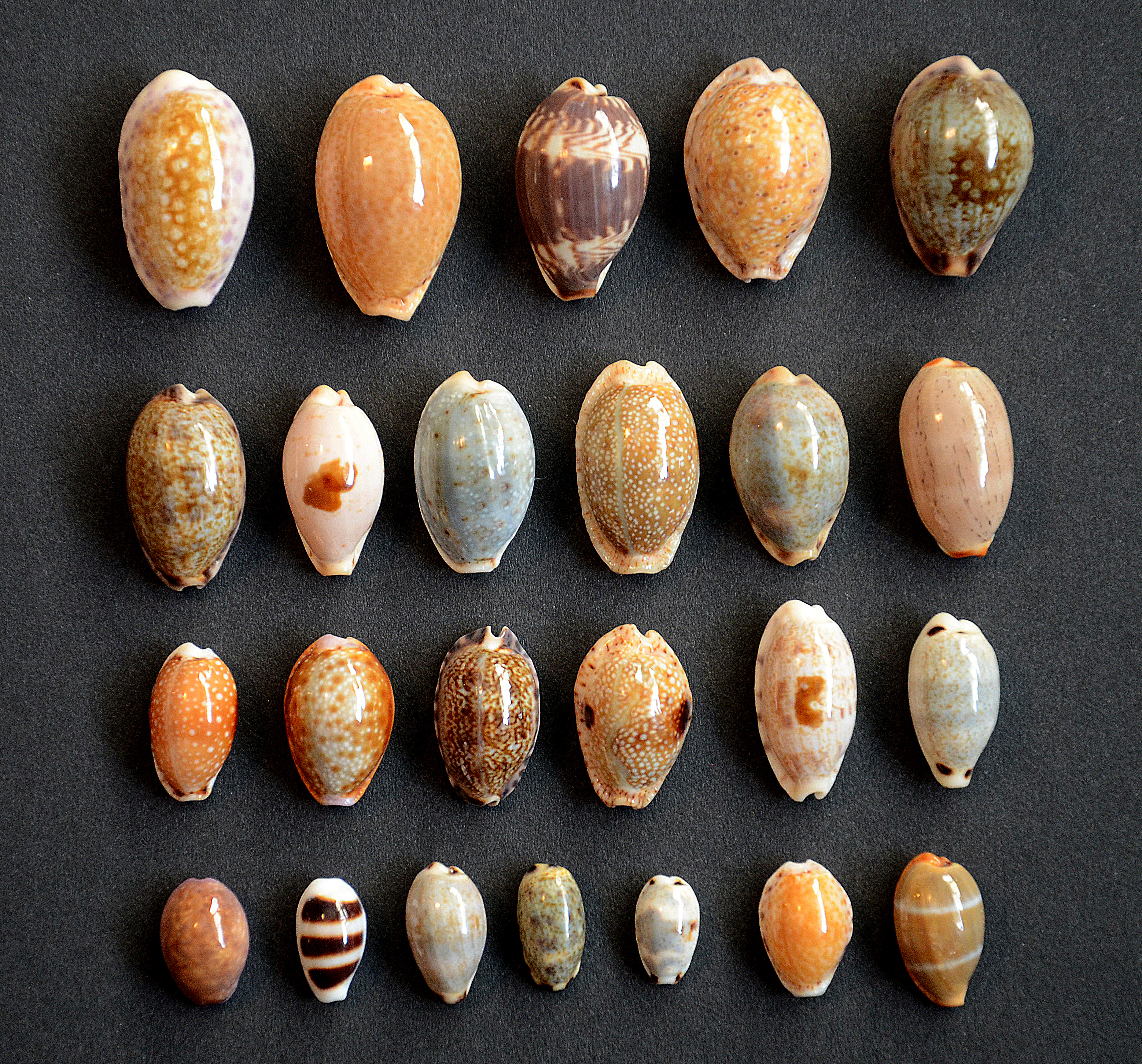
The cowries have always been a collectors favorite. No other family of shells comes close in popularity. It is no wonder since they are shiny, colorful, elegantly shaped, and come in a myriad variety of colors and patterns. The French call them by the beautiful name, porcellaines. The cowries are true works of art.

The cypraea are dwellers of the tropical seas (with some exception) with the largest concentration and variety of species in the Philippine islands. Most are nocturnal and are reef dwellers. Their mantle envelops the shell thus preserving the glossy surface. The color pattern varies and may be mottled, blotched, spotted, freckled, banded, striped, ringed, or various combinations or even solid. In size they range from several millimeters to our own giant Cypraea cervus that can grow up to six inches.

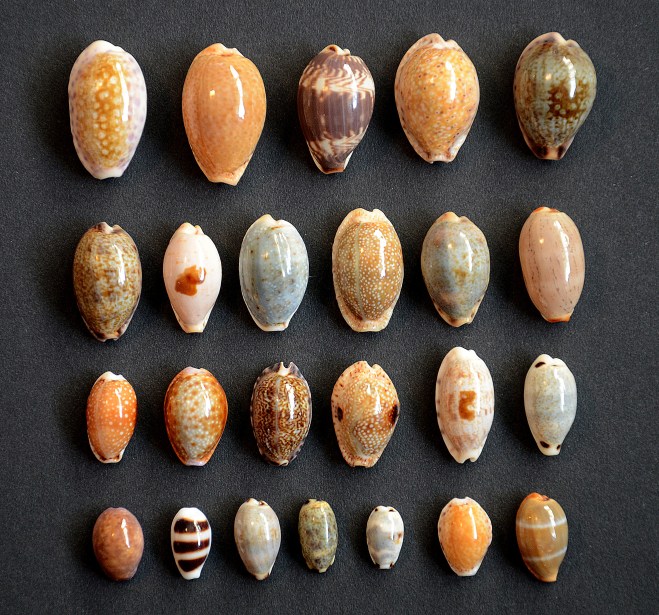
Twenty-four different specie of the smaller sized cypraea are included as our February Shell of the Month. Although this selection is intended as an introduction of the collecting of cowries, the is plenty here to interest even the more advanced collector such as the giant Cypraea spurca from Turkey and the unusual blue Cypraea robertsi from Ecuador. How many of our members posses a shell collected in Turkey? Anyone? The rarest shell in this collection is the very difficult to obtain Cypraea vrendenburgi that comes only from Indonesia.

All the shells come with complete data. They are donated by shell club member Richard Kent

Cypraea acicularis, Gmelin 1791, Brasil

Cypraea asellus, Linne 1758, Philippines

Cypraea arabicula, Lamarck 1810, Panama

Cypraea bovinii, Kiener 1843, Indonesia

Cypraea chinesis, Gmelin 1791, Philippines

Cypraea diluculum, Reeve 1845, Zanzibar

Cypraea erosa, Linne 1758, Micronesia

Cypraea gracilus, Gaskoin 1849, Okinawa

Cypraea helovla argella, Melvill 1889, Tanzania

Cypraea isabella, Linne 1758, New Caledonia

Cypraea kieneri depriesteri, Schilder 1933 Solomon Islands

Cypraea labrolineata, Gaskoin 1849, Indonesia

Cypraea listeri, Gray 1824, Australia

Cypraea lutea, Gmelin 1791, Philippines

Cypraea nebrites, Melville 1888, UAE

Cypraea ocellata, Linne 1758, India

Cypraea poraria, Linne 1758, Viet-Nam

Cypraea quadrimaculata, Gray 1824, Philippines

Cypraea robertsi, Hidalgo 1906, Ecuador

Cypraea saulae, Gaskoin 1843, Philippines

Cypraea spurca, Linne 1758, Turkey

Cypraea teres, Gmelin 1791, Hawaii

Cypraea vrenderburgi, Schilder 1927, Indonesia

Cypraea zonaria, Gmelin 1791, Senegal
PAUL CALLOMON TO BE SPEAKER AT FEBRUARY MEETING

At this month’s meeting, Wednesday, February 8, the Broward Shell club will be having a program given by Paul Callomon.  Paul Callomon is Collections Manager in the Department of Malacology at the Academy of Natural Sciences in Philadelphia. He is the author of two books and several papers focusing on the mollusks of Japan, where he lived for many years. His talk recalls collecting trips in various areas of the country, and especially the Amami Islands. This island group is not well known to travelers from outside Japan. Despite a long history of human settlement it still boasts some of the best surviving coral habitats in the northwestern Pacific region and a very rich molluscan fauna.

SHELL CLASS AT THE MUSEUM

“Shell Class” at the Museum of Discovery and Science, Ft. Lauderdale 1/14/12
by Richard Sedlak

The Broward Shell Club made one of its first forays into a cooperative association with the Museum of Discovery and Science in Fort Lauderdale. A “Shell Class” took place on Saturday, January 14th from Noon to 4 PM and was presided over by club members Richard Sedlak and Jonathan Galka. The first class was held at 12:30 and the majority of participants were youngsters with a few parents. Working in tandem, Richard and Jonathan first did a general overview discussing shells. They brought a large array of seashells to display and the children were really fascinated with them. They described the various shell families, giving more detailed information, and the children asked quite a few questions afterward. The second class was considerably smaller, and primarily adults, but there was just as much enthusiasm from the adult audience as from the youngsters.
The Museum of Discovery and Science facility is perfect for giving programs! They have computerized projection systems, are well supplied, the staff was very helpful and pleasant and they have invited us back for additional programs. As a matter of fact, there is another event coming up in June (Ocean’s Day) and they have offered us the use of one of theaters on the first floor!! It is exciting that we can partner with the Museum of Discovery and Science and Richard believes we will have many years of cooperation with them. Richard thanks Jesse Zito of the Museum for the kind assistance he gave us and Michael Galka (Jonathan’s dad) for the wonderful lunch he treated them to.

FOSSIL TRIP A BIG SUCCESS

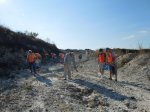
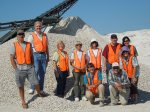
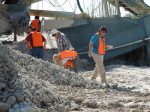
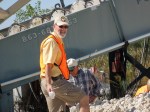
Fifteen people attended the Immokalee fossil trip Saturday January 7, 2012. Organized by Doug Fisher, Field Trip Chairman and led by Gary Schmelz PHD, past president of the Bailey Matthews Sanibel Shell Museum it was an educational adventure. We met briefly at a local shopping center for a Safety Meeting and to collect hand outs that we used to identify shells then followed Gary in a caravan to the excavating site. This is a working quarry that Gary arranges access to on off hours, otherwise the public is not allowed. A gate is opened to let us in, and then locked behind us.

Gary took us to the first collection site and explained to us that there are over 600 species of shells that are over 500,000 years old in this quarry! At one time there were more than 100 working excavating sites in Florida and now there are only 37 working quarries left. These fossilized shells are in good condition as they have been preserved by the soil.

During the 2+ hours we were at the quarry Gary took us to 3 different collection sites. Some members concentrated on big shells and filed their buckets several times over, while others concentrated on small shells. The 3rd and last site Gary took us to with the quarry was a huge shell mound that we sifted through to find our treasures. The most common finds were Oliva sayana (Olives), Conus spurious (cones) and Stronbus pugilis (fighting conchs).

11 people continued on to lunch at the Long Horn Steakhouse in Naples, where Gary gave away prize specimens to club members, including a fossilized whale bone.  Gary provided appetizers for the group and the meal and camaraderie were excellent. For some members this was a repeat trip and everyone agreed it was well worth the effort.

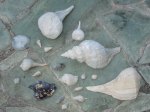
Pictured below include our group in front of a giant shell mound with Gary kneeling in front and an example of the shells we collected.

JANUARY MEETING PROGRAM BY DR. MARVIN GLICKSTEIN

Dr. Marvin Glickstein spent his working career as an engineer at Pratt Whitney where he patented several new cooling concepts for aircraft engines. As a hobby, he started SCUBA diving, when it was in its early stages. He also owned a boat he named the Lucky Stone which is his name Glickstein translated.

From SCUBA, he wanted to try his hand at dredging and with his close friend John Root, fitted his boat and dredged through the waters of the SE coast from Stuart to Key West and some near Ft. Myers, Florida.

Marvin was a prominent member of the Palm Beach County Shell Club, running field trips and holding several positions including President. He was also a founding member of the Palm Beach Aquarium Club.

Marvin has had several of the shells he dredged up named for himself and his wife Pat and also had several of his dredged shells later named as type specimens.
Marvin will talk about his experiences dredging and will describe some of the trials and experiences he had.

SHELL OF THE MONTH – JANUARY 2012

The harps are among the most elegant and beautiful of all sea shells. They have a natural gloss, are finely sculptured, have detailed patterns and colored in a palette of color coordinated shades. The harps are also among the most difficult of shells to distinguish, they all look very much the same. Even the scientists who described them had trouble in recognizing them resulting in multiple names. To this day collectors and dealers remained confused as what the proper nomenclature is.

At first glance the only difference one will see is small, medium and large size, but look closer and study the details to see all that three are distinct.  The large shell is Harps major, Roding, 1798. The middle shell is Harpa harpa, Linne 1758 and the small one is a Harpa amouretta, Roding 1798.

The harps are tropical sand dwellers usually found in fairly shallow water. Most species are Indo-Pacific though one inhabits the west cost of Central America and a second the east coast of Africa.  Our three specimens come from Viet-Nam, the Philippines and Micronesia respectively. The first two are average size while the amouretta is from a dwarf population. The Harpa harpa is 60mm.

HOLIDAY PARTY – ALL YOU NEED TO KNOW

Yes, it actually that time of year again. And the date will be our regular December meeting date which is December 14th.  The Fishers had a sign-up sheet at the November meeting so you can let the committee know which of your delicious recipes you will honor us with.  We do ask two things of you:  when you bring your dish PLEASE bring a serving utensil for it, and if you are bringing an appetizer be there by 6:00 PM.  If you were unable to attend the November meeting and have not been called by the Committee, please call the Fishers at 561-306-4998 or email them at tonifisher2004@yahoo.com. The club will supply the meat as usual.  Also we will have the fun part – the gift exchange / Chinese auction.  Please keep the value of your gift from between $15 – $20 and DO NOT WRAP THEM.  Place them in a gift bag which you can cover over with tissue of a single piece of tape.  This will greatly speed up the “process”. Shells and shell related items are what the items should be, although bottled beverages are acceptable.  Basic rule:  bring something that YOU would like if you won it.  This is and always has been one of the best ways to get to know your fellow members so everyone is encouraged to attend…..you would be foolish not to!