New Posts

DR. PETUCH MAKES DONATION TO SHELL CLUB LIBRARY

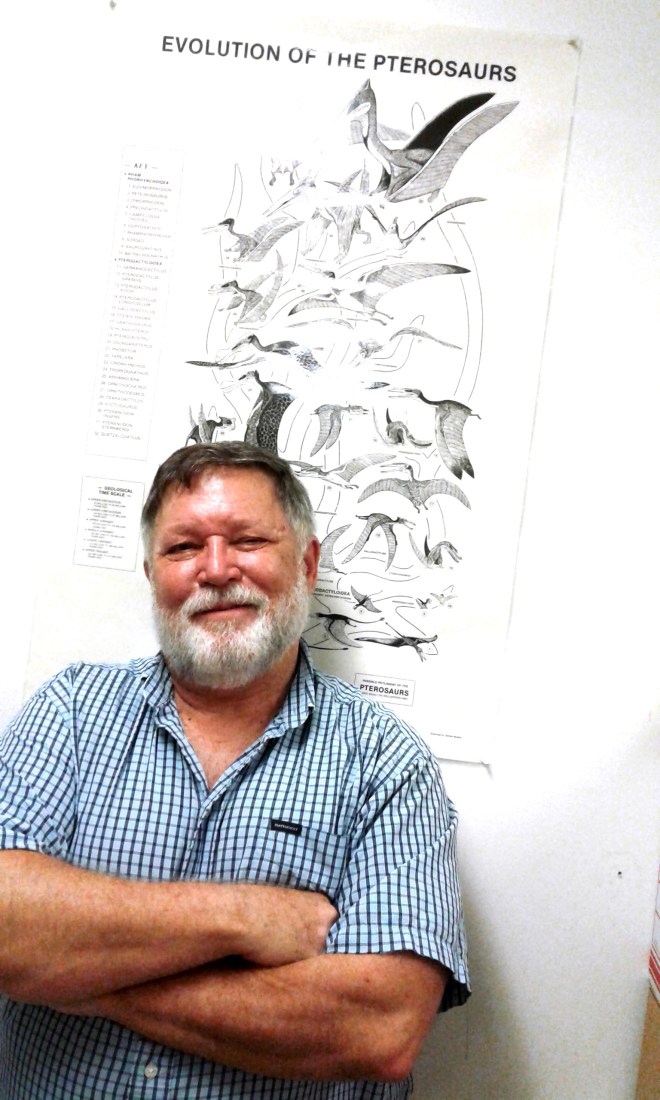
Dr. Edward Petuch, has donated many books from his library to the Broward Shell Club. Ed recently retired from Florida Atlantic University, where he was a professor of Geology in the Department of Geosciences. Being the vibrant speaker Ed is, his students will miss him. While I was picking up the books, one of his former students told me the department will not be the same without him.

Long known by many of the members of the Broward Shell Club, since he was a graduate student at the University of Miami, Ed has named over 1200 species of Recent and Fossil mollusks and written 17 books. Ed has had a close relationship to many of our club members, naming many species of shells for both Alice and Bob Pace, Kevan and Linda Sunderland, Lynda Zylman and myself including others.

Many thanks to Ed for his generous donation to our club. Some are already ready for check out in our library.

Submitted by Carol Marshall20161031_134433
SHELL OF THE MONTH – NOVEMBER 2016

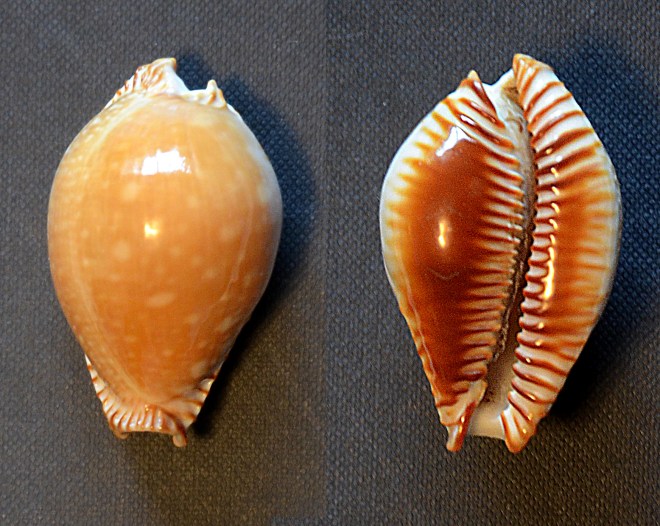
dsc_6650-copyCypraea guttata azumai, Schilder 1960

Cypraea guttata, Gmelin 1791 is one of the most exquisite of all shells. Until recently it was also one of the rarest. When Burgess wrote his monumental book “The Living Cowries” in 1970, he stated that there were fewer than 20 known specimens. Today due to the Asian commercial fishing fleets trawling in deep water, specimens consistently come to the market. Cypraea guttata has an orange dorsum with white “drops”; The extremities are rostrate and spiny. The prominent teeth extend the width of the base and are deep brown stained contrasting to a white base.

The variety Erosaria guttata azumai was not known until Schilder described two dead collected specimens from off the coast of Japan in 1960. Today specimens collected in the East and South China Seas are the ones most likely to be offered by dealers. Cypraea guttata guttata, Gmelin 1791, the Philippine variety and first described is the hardest to acquire. They grow to the largest size and these big specimens are incredibly striking (and super expensive too!) Cypraea guttata surinensis, Raybaudi 1978 which comes from the Andaman Sea is the most vibrant with a richer color and almost black teeth. It also tends to bring the highest prices. Because most specimens come from commercial trawling, too many substandard and immature specimens reach the market. This specimen though is in gem condition, average in size, and exemplifies the reduced spotting that is typical of the azumai variety. It was trawled in 2008 at 200 meters deep off the coast of Zhejang Province near Ningbo City in the East China Sea. The shell was purchased direct from China and donated by Richard Kent.

SHELL OF THE MONTH – OCTOBER 2016

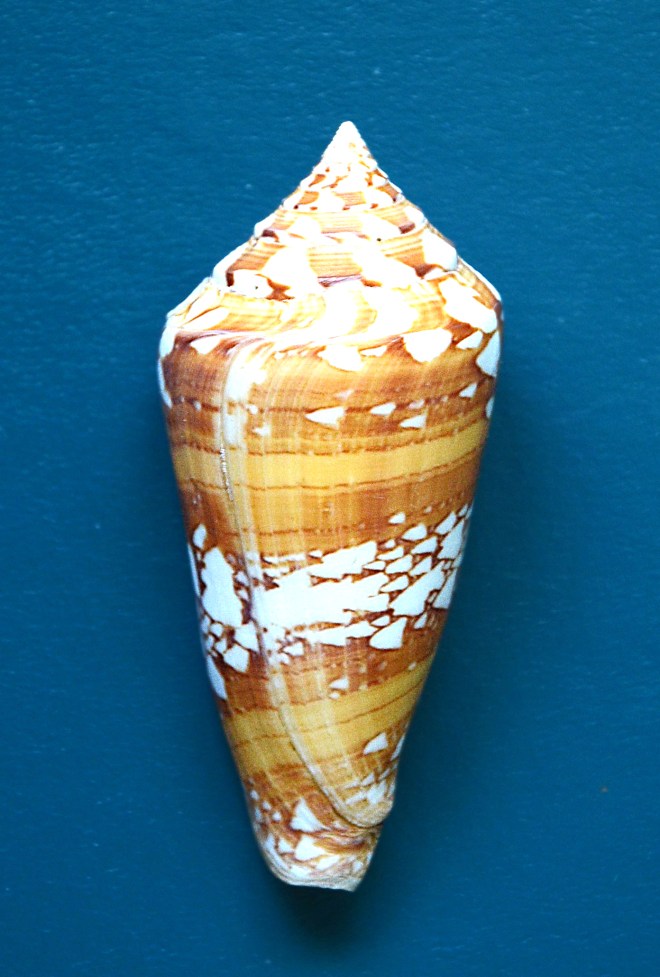
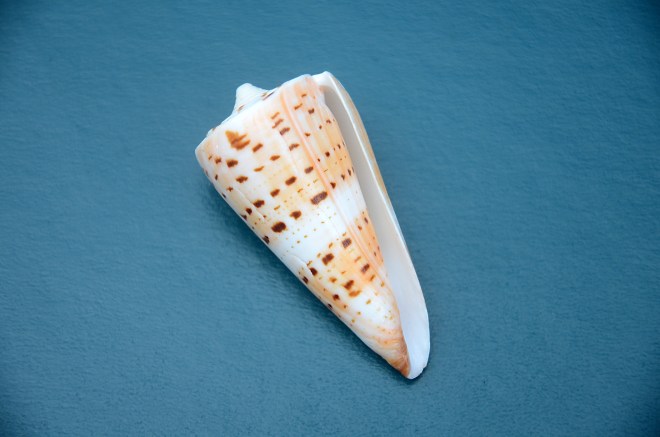
dsc_6486Conus amadis castaneofasciata Dautzenberg, 1937 is an attractive and highly desirable subspecies of Conus amadis Gmelin, 1791, One could easily say it is its own species as it is collected off the coast of Myanmar and Southern Thailand while Conus amadis is found in India. The differences are many, Conus amadis castaneofasciata has a higher gloss, a taller spire, lighter in weight, more erratic tenting, different coloration, and pronounced banding.
Conus amadis is a mid-sized cone typically about 75mm though they do come much larger. Evidently they grow in rapid spurts, then rest, as virtually all specimens have pronounced growth lines.
Conus amadis castaneofasciata is quite variable. Deep water populations have very tall spires, some populations are al golden in color while another is chocolate brown with minimal tenting.
This specimen, donated by Richard Kent, was trawled off the Andaman Islands in Myanmar.

HARRY HARRIS PARK FIELD TRIP

Another field trip… yeah!

This time we will be going to Harry Harris Park in Tavernier (just south of Key Largo). The date will be Sunday, October 23rd and the low tide is a 0.7 at 9:50 AM. Now this is mainly a wading/snorkeling type of venue as except for the rocky breakwater there is not really a beach per se….but the goodies you can nd in the coral rubble and sandy eel grass beds makes it worthwhile. I will have a sign-up sheet at the September and October meetings and will have more details then such as how to get to the park and such. Also, I will need your feedback on one item: Lunch.

Does everyone want to go to a local restaurant (most are very casual in their dress code) or bring a picnic lunch? And who knows…..we just might have some trophies for various shell categories! In the meantime feel free to contact me, Richard Sedlak at 954-296- 5633 / sedlaki1@comcast.net.

I also want to give credit again to Gina (J.J.) Dotson for supplying the photos on our club trip to Peanut Island. They were most appreciated! More info about our great trip to Peanut Island next issue.

I am happy to mention that those of us who went to the “Lunch and a Movie” outing last month enjoyed a wonderful showing of “Our National Parks” at the IMAX and then a superb lunch at the Tarpon Bend restaurant. A great way to beat the summer heat! Join us next time!

SHELL OF THE MONTH – SEPTEMBER 2016

DSC_6243
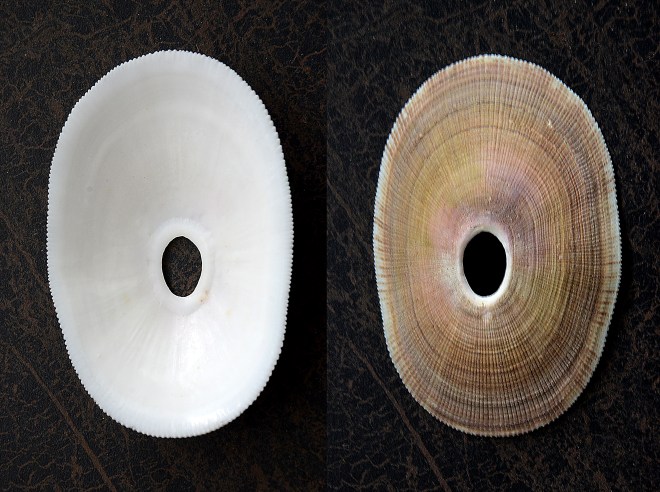
Megathura crenulata Sowerby, 1825 by Scuba diving at 35’ on side of large rock pinnacle, Monterey, California

Keyhole limpets are a primitive type of gastropod that live fastened on rocks. They have a slimy grey skin that covers the shell and have a central hole which is used to expel waste away from the gills and mouth. Limpets feed off of algae with a radula that scrapes the algae into their mouths. By using the muscular foot, the limpets are able to form such a tight bond to their home rocks that it makes it very dif cult to pry them off, offering protection against predators and collectors. The at shell protects it from crashing waves and coastal currents.

Megathura crenulata Sowerby, 1825, known at the Giant Keyhole Limpet, is found on the west coast of California in temperate waters. In the past, keyhole limpet shells were used as currency and decoration by Native Americans. This shell, about 4.5″ in size, was donated by Richard Kent.

SHELL OF THE MONTH – JULY 2016

DSC_6235SConus monile Hwass 1792
Trawled, Mergui Archipelago
Myanmar (Burma)

The Necklace Cone is a very attractive shell. It has the classic “ice cream cone” shape. It has a nice gloss and an interesting variable pattern. Typical specimens are white with a rows of brown necklaces. Certain populations especially those from the south of Burma are suffused with salmon.
Adult specimens range are typically 2-2.5″ in size, though they do grow larger. As typical with cones the spire suffers from erosion, especially in the biggest specimens. This specimen is 2.5″.
Conus monile is an Indian Ocean specie restricted to the Bay of Bengal and Andaman Sea. Most specimens come from either the southern tip of India or the west coast of Burma and Thailand. Although a shallow water specie, mosts pecimens come from the fishing boats. Its habitat is reported as “on sand with clay and shell rubble.”

SHELL OF THE MONTH – MAY 2016


DSC_5597

Homalocantha pele (Pilsbry, 1918) Taken by diver on ledges at 80 feet North coast, Oahu, Hawaii

Homalocantha pele (Pilsbry, 1918) will never win a beauty contest, that’s for sure! It is however a very popular shell to collect to do it’s extreme variety in size, shape and color. Typical specimens are an off white in color and rather bland, but there are those that exhibit, lavender, purple, yellow, and most desirable bright orange or red. The shape of the fronds are much wider and more developed in the better specimens. Sometimes there is even a double row of fronds.

Homalocantha pele (Pilsbry, 1918) is a reef dweller, well camou aged in life. It is a member of the Muricidae family and a fairly small genus called Homalocantha. It has a very close relative in Homalocantha anatomica (Perry, 1811) and for years they were considered one and the same. H. anatomica is found in the Philippines and H. pele is indigenous to Hawaii. Side by side they are recognizably different and even amateur collectors will have no trouble distinguishing the two.

Our specimen, donated by Richard Kent, is typical in size and color. Collectors looking to acquire the most exotic colored pele need to be prepared to pay outrageous prices as a bright red and white specimen can bring up ten times the price as an ordinary one in auction.


APRIL 2016 PROGRAM

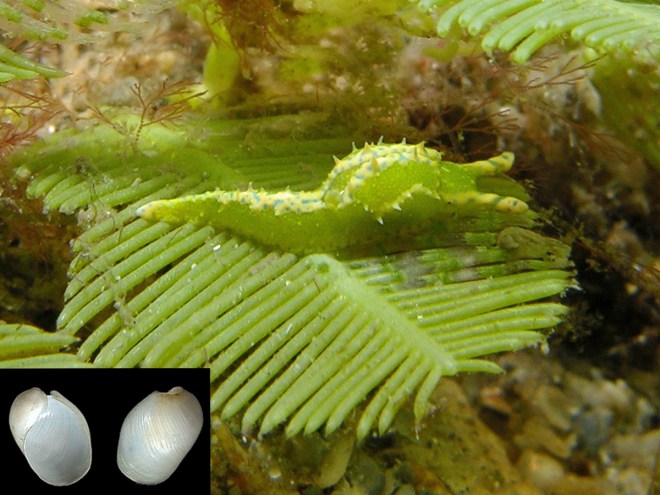
OxnoeantillarumshellcollageAnneDSCN60412webThe Subject of our April Program will be: “Shelled Opisthobranchs” presented by Anne DuPont.
Anne’s Presentation will cover some of the Opisthobranch snails that still possess a shell:
bubble snails, sea hares, solar-powered slugs, side-gill slugs and the umbrella slug.
The program includes her underwater photos of these sea slugs, along with photos of the internal shells.
Also included will be underwater photos of a few “Non-shelled Opisthobranchs – Nudibranchs”
The Program covers Opisthobranchs from Florida waters and the Caribbean.

Anne DuPont is an Underwater Photographer specializing in opisthobranchs.
She is one of the co-authors of “Caribbean Sea Slugs, A field guide to the opisthobranch mollusks from the tropical northwestern Atlantic.”
Her photos have been published in numerous books, magazines, and educational DVDs.

She is a volunteer with the Florida Natural History Museum and a Museum Associate in Malacology at the Natural History Museum of Los Angeles.

She has been diving in the Lake Worth Lagoon for over 20 years, and is very knowledgeable on underwater life found there. She is on the Lake Worth Lagoon Initiative Speakers Bureau speaking on the Marine Life Found in the Lagoon”