OCTOBER PROGRAM

The Program Title is “Secrets of the Lake Worth Lagoon“. Carole Marshall has been studying mollusks for 45 years. She has given many shell programs throughout this time to Conchologists of America, American Malacologists Society, Texas and Clearwater  Shellers’ Jamborees and many shell clubs throughout the United States. Most recently she has given this program at the  Green Cay Nature Center and the Pratt Whitney Retirees Group.

As a docent at the John F. Kennedy Cold War Museum on Peanut Island Florida, she spent her spare time combing the beaches and was encouraged to study the Peanut Island Mollusks. She is presently writing a book on the Seashells of Peanut Island.  As another docent, she got to know the rich history of Peanut Island and the Lake Worth Lagoon, along with the flora and fauna and she will share it with you.

Carole is a past president and program chairman of both the Broward Shell Club and the now defunct Palm Beach County Shell Club. She was also president of the Treasure Coast Shell Club. Her most lasting accomplishment was testifying before the Fish and Wildlife Conservation department at many committee hearings.  There was a movement to abolish shell collecting in Manatee County and through her efforts she rallied several other shell clubs to testify on behalf of shell collecting. Shelling is still allowed in that county. She also testified on behalf of shell collectors during the NOAA hearings during the Florida Keys Sanctuary hearings traveling to Silver Springs Maryland and Marathon, Florida to testify.
SHELL OF THE MONTH SEPTEMBER 2011

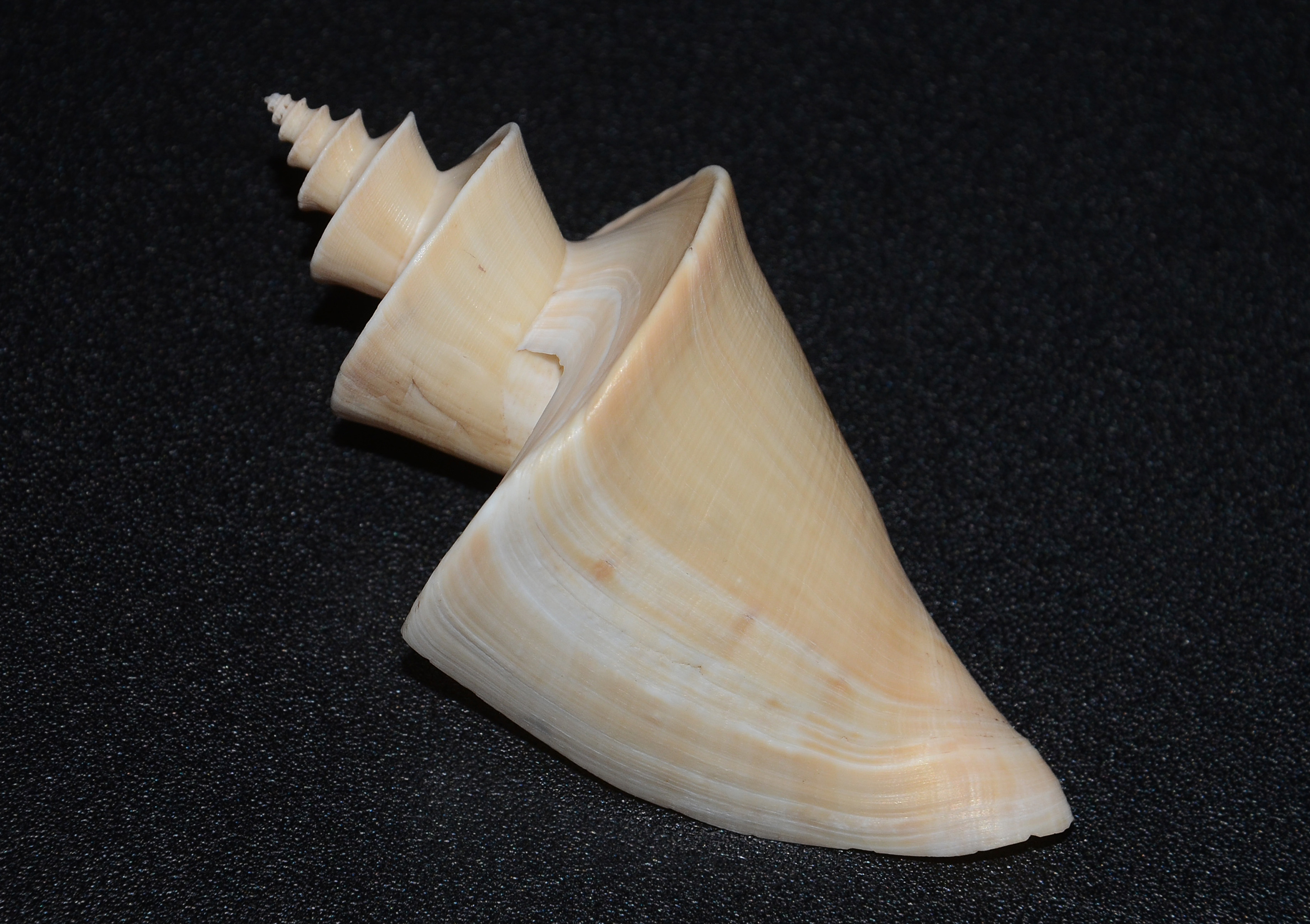
Thatcheria mirabilis,  Angas, 1877
Like most everything else – our “Japanese Wonder Shell” comes from China! The shell looks like no other, it is unique in appearance. Because of its deep water habitat, it remained unknown until a solitary specimen was discovered in the late 1800s.
The following information is quoted from jaxshells.org
In describing the species in 1877, G. F. Angas said “This very remarkable shell, quite unlike anything hitherto met with, was recently brought from Japan by Mr. Charles Thatcher,” and, because Angas was at a loss to place it in a known genus, Mr. Thatcher acquired an unexpected immortality. Conchologists, puzzled by its peculiar appearance, were equally doubtful where to place it systematically and often they echoed the words of G. W. Tryon: “That this shell is a scalaiform monstrosity cannot be doubted, but what may be its normal form is not so readily ascertained”.
No others were known until the early 1930’s when several, exactly comparable, were fished up in Japanese waters; it was no longer a monstrosity and its systematic position was established a few years later. It is a member of the Turridae.
Today, Thatcheria mirablis are still quite scarce though not rare. The shell is hard to find in collectible condition so few make it to the market. Our specimen was trawled by a Chinese commerical fishing fleet in 100 fathoms,  North China Sea, 2010. It is typical in size and condition as to what is available.


JERSEY CAPE SHELL SHOW

The Jersey Cape Shell Club will have its 37th annual shell show August 19-21 at The Wetlands Institute in Stone Harbor, New Jersey, and everyone is welcome to participate/attend.    It will be held at The Academy of Natural Sciences in Philadelphia,  Scientific and artistic entries are welcome

While I am it, my other home club, The Philadelphia Shell Club, will be having their show at an earlier date this year, October 1 and 2.  For more information;  www.phillyshellclub.org.

I am looking forward to seeing many of you during the Shell Show Season.

Sue Hobbs

Cape May, NJ

SHELL OF THE MONTH AUGUST 2011

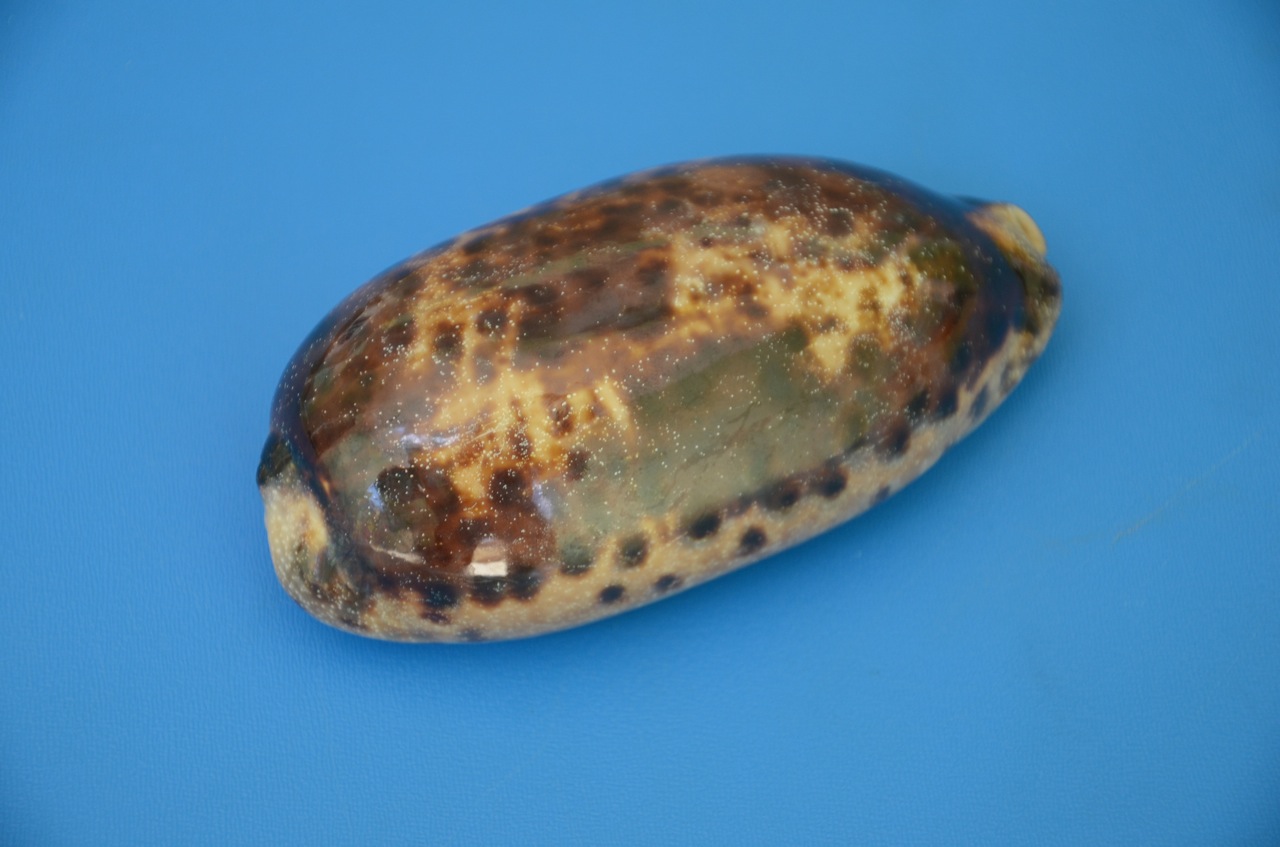
Cypraea testudinaria, Linne 1758 – the Tortoise Cowrie.  It’s amazing how many shells Linnaeus classified, even more amazing that so many names remain valid today.  Cypraea testudinaria is instantly recognizable. It is impossible to confuse with any other cypraea. Its shape, sizing and coloring is distinct. It is a heavy massive shell that grows up to 5″ in length. Cypraea testudinaria is cylindrical in shape, brownish in color, big irregular spots around the margins and a pattern of dark brown blotches that extend across the dorsum. It also has white flecks imbedded in the nacre making it look as if covered with dandruff. The white flecks seem to be a mystery, there doesn’t appear to be a published explanation. Outside of size, there is little variation, the pattern is rather consistent from one specimen to the next though some have larger dark area than others. The base seems to have more variation than the dorsum, ranging from light grey to almost pink to tan through shades of brown. Cypraea testudinaria is widespread across the tropical Indo-Pacific, however it is relatively uncommon. Like most cypraea it is a reef dweller. Our specimen was found exposed at night on reef rubble off Samar Island, Philippines in 2006. It is darker than average in color, fully mature and over 4″ in size. Donated by Richard Kent

SHELL OF THE MONTH JULY 2011

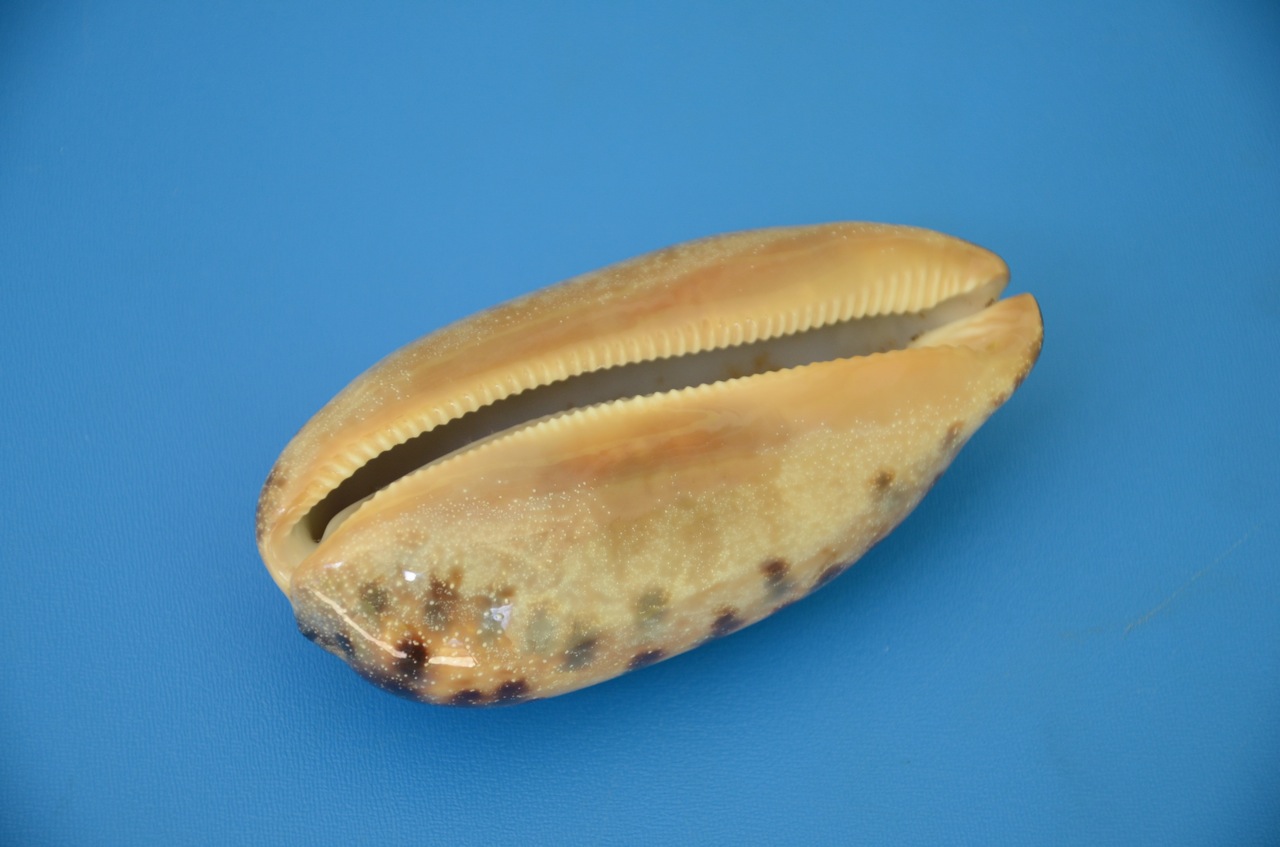
Most marginella are small shells often about 10-20 millimeters in size. There are exceptions. Our shells of the month are two of the largest, both being over 40mm. In addition they are large for their species. Thai fishing boats have been active in Burmese waters. Both specimens were collected by trawlers working off the coast of the Mergui Islands in the Andaman Sea during December of 2010

Marginella strigata (Unicolor Margin Shell) and Marginella Elegans (Elegant Margin Shell) are very similar. The obvious difference is one is patterned, the other not. Both are grey. The outer lip of  strigata is tan, elegans is deep red brown.

The following description is adopted from Wikipedia:

Marginella is a genus of small tropical and warm-water marine gastropods in the family  Marginellidae, the margin snails. It is the type genus of the family.

The shells of species in this genus are rounded, smooth and glossy, with a large aperture that appears to be toothed because it shows the edge of the collumellar folds. In many species the shells are colorful. The glossy surface of the shell results from the fact that the mantle covers most of the shell when the animal is active. The animal has a long siphon. When the animal is active, the foot extends much further out than the edge of the shell. Marginella are carnivorous and predatory. The shells of the species in this genus have spires which range from moderately elevated to flattened. The surface of the shell is glossy and porcellaneous, and it is often but not always colourful. The columella has four definite, subequal plaits on its anterior half. The outer lip is thickened, and generally denticulate inside, with distinct teeth or folds. The siphonal canal is not deeply incised. There is no operculum.

Marginella strigata Dillwyn, 1817
Trawled At 30-60 Meters
Mergui islands, Burma
Northern Andaman Sea 12/2010

Marginella elegans Gmelin, 1791
Trawled At 30-60 Meters
Mergui islands, Burma
Northern Andaman Sea 12/2010


SHELL OF THE MONTH JUNE 2011

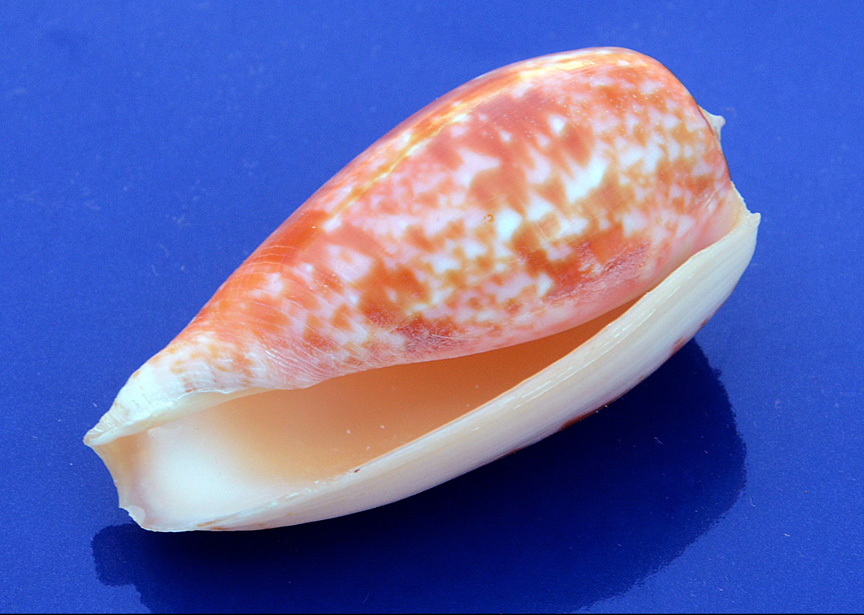
Conus bullatus, Linne, 1758  is Fay’s Shell of the Month for June 2011. It is a most attractive cone, with its bright orange/red color, high gloss and distinctive shape. Do you know why the aperature is so wide in this cone? Conus bullatus is a member of group called bubble cones because of their common shape. The wide aperature is because the snail is piscivores. It eats fish and quite large ones too. Conus bullatus lies burried in the sand with just its proboscis extended. When it senses a fish in the vicinity it goes into action, launching a harpoon that paralyzes the fish. Next the snail extends its mouth and sucks in the fish whole. “This species of cone snail immobilizes its prey in a split second with lightning-strike cabal toxins,” states the Howard Hills Medical Institute on its web site. You can see Conus bullatus feeding in videos on Youtube or theconesnail.com  We recommed this web site to learn more about the eating habits of Conus bullautus and other cones. Much research has been done on the venom of Conus bullatus. “Characterization of the Conus bullatus genome and its venom-duct transcriptome” by Hu H is the main technical writing available on the web. Why would one be inerested? Because scientists are looking at conus venom for possible use in human medicine.
  We as collectors are probably more interested in the shell. Conus bullatus until recently has been a rare and valuable shell, so it comes as a surprise that Linnaeus know it in his day.  The shell is a creamy color overlaid with a cloudy orange to red series of blotches sometimes forming indistinct bands. The pattern appears blurred. Some specimens have darker dashes encircling the shell, others have none at all. The lip thickens with age.  As it does the pattern is obscured so mature specimens have no pattern near the lip. Younger ones, or those in a growth phases will have the pattern extended to the growing edge of a thin lip.  Conus bullatus is a clean shell, rarely with growth lines or erosion so its is usually available in higher grades. The range is sporadic through Indo-Pacific including Hawaii where specimens are especially colorful. Our specimen, donated by Richard Kent, is from off Balut Island, Mindanao, Philippines and was taken by tangle net at a depth of 100m.  It is 56mm in size, near gem in condition, fullly adult, and was collected in 2010. If stored in darkness it will maintain its color but bright light will cause fading. Retail value for a specimen this size and quality is in the $25-$40 range.

MESSAGE FROM THE PRESIDENT

Hello everyone!

I’d like to take this opportunity to say just a few things.  First of all, a HUGE THANK YOU to Bob Pace for all of his hard work and dedication as our outgoing President.  A special Thank You to Alice for her support too!  Second, I want to tell you how much I am looking forward to the upcoming year.   We have a wonderful organization that includes all levels of interest from beginning to more scientific collectors as well as lots of arts & craft folks.  There is something for everyone.

The Board (thank you all for continuing on in your positions from last year!) and I are very interested in hearing your comments and suggestions and look forward to working together to continue the growth of the Club.   If you would like to volunteer to help with any aspect of the Club, please contact me or any Board member.

We will have lots of exciting activities this year beyond our monthly meetings, including a field trip to Sanibel Island to visit the Bailey Matthews Shell Museum, an overnight trip to Gainesville for a visit to the Florida Museum of Natural History which will include a behind the scenes tour with the curator, the annual collecting/picnic trip to the Keys as well as the Shell Show in January.  As you can see, we will be very busy!  I hope each one of you will become more involved in YOUR club!

– LINDA

BROWARD SHELL CLUB MINUTES APRIL 13, 2011

Elections were held and those chosen by the nominating committee were approved by the members attending the general meeting.

Members elected were:
President:  Linda Sunderland
Vice-President:  Sonny Ogden
Treasurer:  Ike Alvo
Recording Sec.:  Elaine Alvo
Corresponding Sec.: Carolyn Harvey
COMMITTEES:
Auction:  Bob Pace 
Membership: Heather Strawbridge
Membership Assistant.: Joy Stafford
Holiday Party: Carolyn Harvey & Toni Fisher
Hospitality: Doug & Toni Fisher
Library: Juan Marrero
Newsletter:  Richard Sedlak Newsletter Assistant: Richard Kent
Programs: Tom Ball
Raffle table: Richard Sedlak
Shell Show: Nancy Galdo
Shell Show Assistant:  Alice Pace
Web Page:  Richard Kent
Photographer & Club Historian: Violet Maas / Assistant: Kevan Sunderland
The COA Liaison, Custodian, Educational, Fieldtrips and Scholarship positions are being covered by the Board in general.

Unfortunately Violet is still ill.  We all hope for a full recovery soon. Attendance was really good.  Long time members showed up as well as new and newer members.  Heather mentioned Linda Ebeling and Sue and Ted (and others I can’t remember) as well as the 2 ladies I talked to quite a bit so you can see I am not good at names!   We are planning a bus trip to Sanibel Island to visit the Shell Museum and go to the beach.  Richard will drive.    Our speaker, Bob Janowsky gave a very well received presentation.  Many questions were asked and answered.  Everyone had good things to say about Bob.  We had over 50 members in attendance. The raffle table took in $50.00.  Thank you all.
Elaine Alvo    Recording Sec.

IN MEMORIUM

The club recently lost two long-time members.

Polly Fletcher and her husband, John were VERY helpful to me years ago when we had an enormous mailing list and it was assistance I had always appreciated.  Polly was quite active in much more than just the Shell Club, belonging to more than one of the local orchid societies and “who-knows” how many other organizations.  Her orchid collection was phenomenal.  She was not only remembered by our club at the April meeting, but also praised and fondly remembered at other venues such as the Fort Lauderdale Orchid Society (for which I was present).  We had not seen Polly for some time although she had made it to our last shell show.  Polly succumbed to cancer just before the April meeting.

The other member is one MOST of you would not remember and it will come as a shock to those who do!  Pat Armes had gone to hospital last month for some tests….but never came out.  Her husband Rod called me this weekend to inform me of this and said she succumbed to “organ failure”.  Pat was a Florida native hailing from St. Petersburg and she married Rod when he was with the Royal Air Force.  After working for many years in the Ft. Lauderdale area they moved to a small village near Lincoln, England for retirement.  Between the two of them they had an incredible shell collection, which “caught” the attention of the British Museum in London.  The museum negotiated with the Armes…..sent down several lorries (trucks – to us Yanks) to pack up the collection, which the Armes subsequently donated to the museum.  As we speak their collection resides in a special display room entitled “The Rod & Pat Armes Collection”.  A fitting tribute to a special lady and avid collector.

I will personally miss you, Pat!   You were a good and long-time friend. – Richard Sedlak.

SHELL OF THE MONTH MAY 2011

Murex pecten, Lightfoot, 1786, commonly known at the Venus Comb Murex is our shell of the month. The Venus Comb is not only a collectors favorite but a popular subject for both photographers and still life painters. The shell has over one hundred spines, which provide protection from predation, and prevent the snail from sinking in the soft mud where it is often found feeding on bivalves. Its range is extensive, across the the entire Indo-Pacific region. Perfect specimens are hard to find because of the fragile spines. It is also difficult to acquire specimens with the operculum.  Adult sizes are between 100 and 170mm but real large specimens aren’t found too often recently. Did you know that the flesh of this murex is edible? Our specimen came from Balicasag Island, Bohol, Philippines and was found by tangle net at a depth of 30-50 meters in 2008.