New Posts

SHELL OF THE MONTH SEPTEMBER 2012

A conch is a conch believed the great naturalist Linnaeus, so in 1758 he classified our shell as Strombus Lambis. This didn’t sit well with his followers who observed a group of conchs with claw like extensions that they believed deserved their own genus.  Lamark in 1799 renamed our shell Pterocera Lambis – from the Greek, pteron, wing and keras, a horn. This is in my opinion a fantastic name. Unfortunately in 1798 Roding was also reclassifying the spider conchs and beat Lamark to the punch, hence ourshell is known today by the boring name Lambis lambis, Linnaeus 1758.
The distinctive feature of the spider conchs is that the mantle in the adult expands into a series of long finger-like processes each of which secretes a calcareous process or “claw” that give the shell its most distinctive appearance.
Lambis lambis is one of the few shells that exhibit sexual dimorphism. First, the females grow to almost twice the size of the males. Second, the claws point out in opposite directions, with the females longer and more finely developed. Third, they are different in color. The female tends to be a solid drab tan. The male mottled tan and cream while in some populations, as this one, a rich chocolate making it a most stunning shell.
It is interesting to note that the only other member in this small genus to exhibit sexual dimorphism is Lambis chiragra, Linnaeus 1758. The spider conchs, also known as scorpion shells, live in coral reef areas. They can be found in littoral and sublittoral zones, in tidal pools and low tide levels to a depth of around 25 meters. They are herbvivores.
Our specimen comes complete with the operculum, is from the Philippines and was donated from the collection of Richard Kent

HELEN STANLEY MEMORIAL DONATION

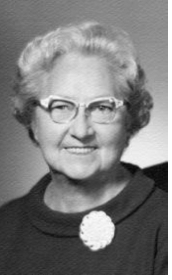
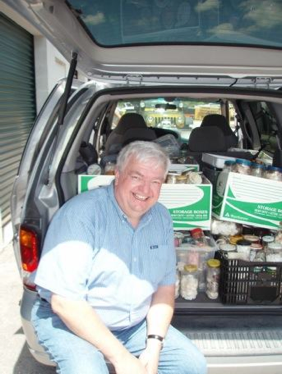
To honor his grandmother, Helen Stanley, Lorin Cope, of St. Louis, MO, has donated her huge collection of shell craft material to the Broward Shell Club. We are grateful to Mr. Cope for going well out of his way to drive an SUV, filled with plastic bins holding hundreds of jars of tiny shells, all the way from Ohio to Homestead for us. Additionally, he emptied out a Homestead storage room with countless more plastic bins of shells that were stored for over twenty years. Thank you, Lorin, for your generosity to our club and for honoring your grandmother by looking after her treasures!!!Mrs. Helen E. Stanley (1901-1992) Married to Lorin Stanley. Grew up in Ohio but started going to Florida in 1932 because her husband hated cold weather and they needed to make money during the depression. They were dairy farmers in Ohio and worked in the tomato, bean, and cucumber fields in South Florida each winter. They built their first Florida home in 1946. Helen started collecting, showing and “working” with shells in the 1960’s. A few of her shells were picked up along the beach, but many were purchased and shipped to her in Ohio as well as in Florida. She loved going to Marco Island, long before all the homes, hotels and condos were built, to pick up shells and visit the stores selling shells along the coast. A member of the Greater Miami Shell Club, Helen won Shell Show ribbons and awards during the 70s and 80s for her beautiful shell craft exhibits! One of her most prestigious awards is a wooden plaque from the Greater Miami Shell Club’s 23rd Shell Show in 1985 for Best Shell Art Exhibit.

SHELL OF THE MONTH AUGUST 2012

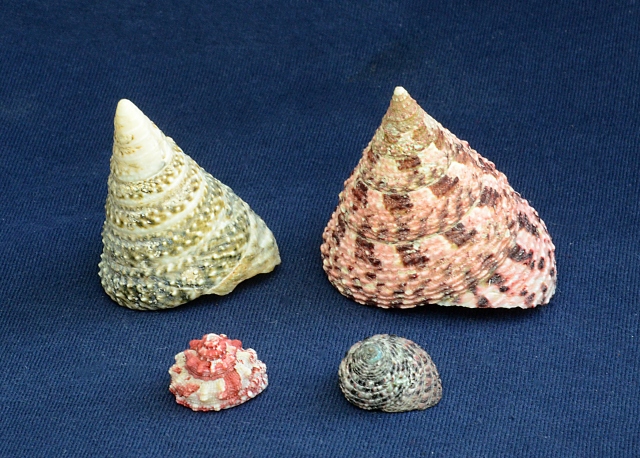
Tectus triserialis, Lamarck, 1822. Caught in 50 meters deep rocky & muddy bottom, Semirara Islands, Samar, Philippines.

Tectus conus, Gmelin, 1791. On rock and rubble, collected by local fishermen by nets near Rapu Rapu Island, Albay Gulf,  Philippines.

Trochus ferreirai, Bozzetti, 1996. Trawled in 50 meters depth, Masbate, Philippines.

Monodonta labio, Linné 1758. Rocky shore in shallow water, Negros Island, Philippines.

The Trochidae are conical shaped gastropods. They are herbivorous and found grazing on seaweed and algae covered rocks. Trochidae are found worldwide in tropical waters and well represented in the Philippines where all of our specimens were collected. These four specimens exhibit the diversity of the family in shape and size, although many come much much smaller and one, Tectus niloticus. grows so large that it dwarfs the largest of these. It is interesting that this family favors reds and greens, two colors not often found in other gastropods. These shells are pearlescent under the outer layer. This inner layer is called “nacre” or mother of pearl in plain English.  “Pearlized” specimens of the larger specie are found in the tourist shops. Trochus ferreirai was discovered less than twenty years ago and until very recently sold for over $20 each. Its red and white swirls make it very attractive Specimens of the upside down ice cream cone shaped Tectus triserialis, while not rare, are difficult to acquire. Tectus conus is the most popular of the lot, rightfully so due its large size, elegant shape and beautiful coloration.

Shells donated by Richard Kent

SHELL OF THE MONTH JULY 2012

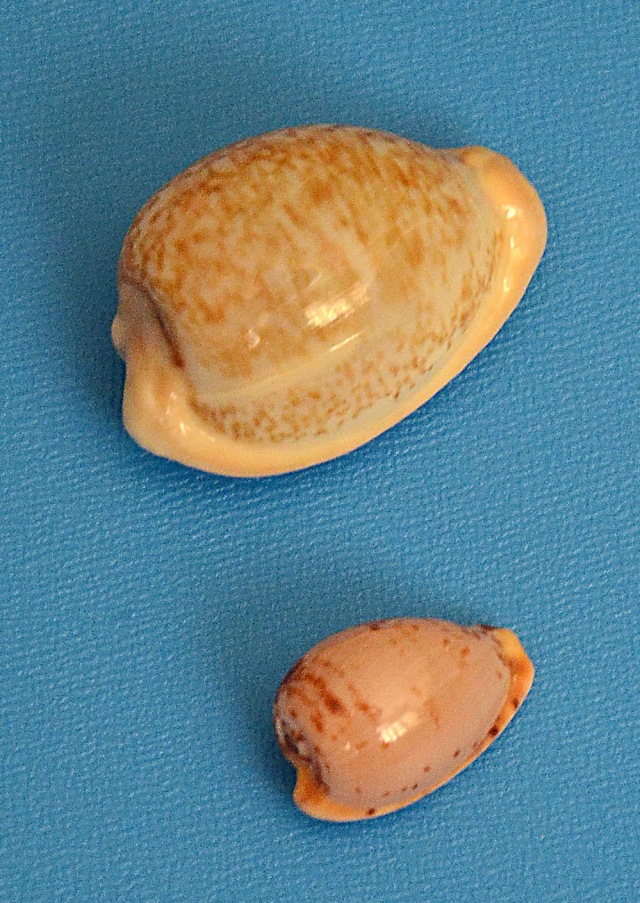
When B.C. Burgess wrote his monumental book “The Living Cowries” in 1970 little was known about the South African endemic cowries. In fact according to Burgess there existed no live collected specimens of either Cypraea fuscorobra or Cypraea edentula. In the years that have passed, SCUBA has become much more prevalent and live specimens of all the South Africans are available. Still they are anything but plentiful on the market. At the Cape of Good Hope the Atlantic and the Indian Oceans converge. All the major mollusc families have members indigenous to the area. Cypraea fuscorobra and Cypraea edentula are members of the genus Cypraeaovula, Gray 1824. Both belong to the “algoensis” group. Cypraeaovula are noted for ecological variations and hybridization. Some are quite difficult to identify, even with a guide book. Cypraea edentula, Gray 1825 lacks teeth and is called, as to be expected, the Toothless Cowrie. It is commonly between 18 and 24 millimeters in size. Small specimens are more available than large ones. Cypraea fuscorobra, Shaw 1909, has the boring common name of “Reddish Brown Cowrie.” It is rather globular in shape with a large callous and larger in size, the average being between 30-36 millimeters. Both retail in the $15 to $25 range. Choice specimens, especially of Cypraea edentula are hard to find. Both are prone to stress marks across the dorsums. Our two specimens both collected this year are donated by Richard Kent. They were acquired direct from a South African dealer, are of superior quality and fine starters for a South African collection. Many of the closely related and similar looking species are considerably more expensive and very difficult to acquire without a direct South African source.

Cypraea fuscorubra, Shaw 1910, Scuba on reef at 36-40m, Hout Bay, South Africa 2012

Cypraea edentula, Gray 1822, Scuba at 15m on reef, Port Elizabeth, South Africa 2012

SHELLERS JAMBOREE OF 2012

The Shellers’ Jamboree was held this past Memorial Day weekend. As always, the Clearwater club, worked very hard and we had an interesting weekend.

 Beginning on Saturday morning there was a 4 hour flea market where registrants could sell items. While we were getting settled in, there was Shell ID, Shell measuring and the silent Auction.

There were old acquaintances to greet and in our packet two word searches and a word Scramble. A packet of cartoons where we were asked to provide the captions was also included.

The festivities began after lunch with a spoof on shell collectors from different clubs, with our own Bob and Alice Pace donning fishing gear and “fishing” for shells. After that we had lunch.

The first program was Rick Batt speaking about Sand. Different beaches were explored including glass sand. That was followed by Dennis Sargent on “The Discovery and Description of a New Conch Species”.

After the first two programs we had a game called the BEACH Shell Hunt. We had teams based on our name tag colors and had to come up with as many names as possible using only Genus or Common Names. Anne Joffe was captain of a team, consisting of Jose Leal, Bill Lyons, Jim Cordy, Rick Batt and myself. We came up with 67 names for the highest score. Yea TEAM!!!

After the game, Dr. Jose Leal gave his program “Cowries: Natural History, Diversity and Cultural Impact.”

A game was played involving small bottles of sand with 40 items buried in them. We had to see if we could find all 40 items. It was quite interesting as objects would show themselves and then hide again.

Shortly after that the Silent Auction ended and we had a Happy Hour and our dinner buffet.

After dinner Anne Joffe, gave a program “Shelling in Guaymas, Mexico.

At that, our first busy day ended and we all retired to our motel rooms.

Sunday everyone who wanted to entered the Snail Parade, Coastal Creations and Treasures of the Sea. Another Silent Auction began. The first program was Morums A to Z, by Dr. Harry Lee. We then had a verbal auction with any extra monies going to Bailey-Matthews Museum. At 12:30 we had a BBQ lunch.

After lunch, Carole Marshall gave a program “Micro mollusks of South Florida.” That was followed by “Shelling in the Philippines” by Doug Jeffrey.  We then had the show awards given out and the end of the Silent auction.

That evening there was a banquet with a program “Living Shells” by Charles E. Rawlings, who also had his book for sale.  As a table favor we each had a lovely poem at our place setting, and then the Raffle tickets were pulled.

A high point of the banquet was that Linda Sunderland and I both won a raffle prize. Linda won a huge Melo and I won a lovely diorama made by the late Bob Pierson.  That was the end of a very busy Jamboree and an enjoyable reunion with many friends I don’t get to see enough.

I was sorry that not more Broward Shell Club members did not attend.  I hope if there ever is another Jamboree, more of our members will attend.

Carole P. Marshall

SHELL OF THE MONTH JUNE 2012

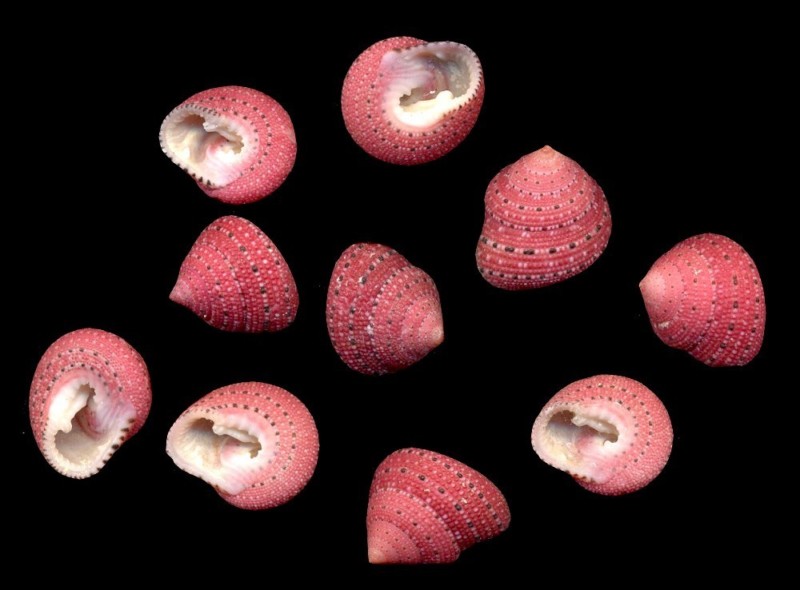
Clanculus puniceus (Philippi, 1846)  –  “The Strawberry Shell” – set of 6. Collected in Madagascar.

The Strawberry Top is one of the most “collectible” of the top shells, mainly for its wonderful, rich red coloring. Not many shells have a color like this! As a matter of fact, this shell was featured in our newspaper article show publicity a few years ago….and by the first day all of the dealers who had the shell in stock were sold out! The Clanculus are part of the Top-Shell Family, Trochidae. It is a very large worldwide family with numerous genera and hundreds of species. Most are top shaped (hence the name), but many are also “button” shaped and some even resemble Abalones. They have an iridescent interior and a round, many-whorled horny operculum. They occur from tidal rock pools to the deepest portions of the oceans. Most feed on seaweeds but many eat bryozoans and sponges.

GAINESVILLE FIELD TRIP

WHAT: A trip to Gainesville to see behind the scenes in the Department of Invertebrate Zoology. The second largest collection in the United States is housed here. We will meet with John Slapcinsky and tour the section. Later we will go behind the scenes of the Paleontology section. A trip to the Forida State Museum and their exhibits, for a slight extra fee, you can tour their Butterfly Garden.
WHERE: The weekend of July 27, 28 and 29. Leave Friday night, come back Sunday.
WHEN: Stay at the Paradise Motel on Hwy 441, just 1 1/2 miles from the Museum. The rates are really excellent, less than $50 per night, rooms with 2 queen beds. Lounge and Restaurant in the motel. Swimming Pool, balcony for poolside rooms. Poolside is a little extra. I will have a menu from the Restaurant at the next meeting.
Plans are a little sketchy as it will depend on who wants to go and what the majority want to do. Here is the bare bones:
Leave Friday July 27, meet or carpool or rent a van, depending on the majorities wishes. Stay at the Paramount Plaza Motel, which is about 11/2 mile S. of the turnoff to the Museum collections on 441. There is an ad in the Florida Roomsaver magazine for one King or 2 double beds room at $42.99 per night, plus taxes etc. That is still pretty reasonable. Plus there might be an even better rate as it is off season.
I have never stayed there, but they let me look at one of the rooms and it is very nice. Saturday morning go to the collections Department for a tour. Depending on the timing, we will go to lunch. Also we should have time to either go to the fossil collections department or to the actual public museum with butterfly gardens. Sunday we will possibly do again, either the fossil collections or the museum, whichever we did not do the day before. Depending on the time we can either leave for home or try to go to Blue Springs or Ginnie Springs for a short while. Again, it is up to the participants to determine.
The variable factors are: how many people want to go by themselves or want to chip in and rent a car. Let me know at the next meeting if you wish to go.
Carole Marshall
561-386-5036

EXTREME LOW TIDE IN EARLY MAY

According to the tide charts from http://www.saltwatertides.com, there are very low tides Sunday and Monday afternoons, May 6th and 7th. Maybe I’ll see you out there on the sandbars…

Tides for South Port Everglades, ICWW starting with May 4, 2012.
Day High Tide Height Sunrise Moon Time % Moon
/Low Time Feet Sunset Visible

F 4 Low 1:02 AM 0.1 6:41 AM Set 5:13 AM 92
4 High 7:12 AM 3.0 7:54 PM Rise 6:34 PM
4 Low 1:23 PM -0.6
4 High 7:54 PM 3.3
Sa 5 Low 1:54 AM 0.0 6:40 AM Set 6:00 AM 97
5 High 8:04 AM 3.1 7:54 PM Rise 7:43 PM
5 Low 2:14 PM -0.7
5 High 8:46 PM 3.4
Su 6 Low 2:46 AM -0.1 6:39 AM Set 6:53 AM 99
6 High 8:56 AM 3.2 7:55 PM Rise 8:51 PM
6 Low 3:06 PM -0.9
6 High 9:38 PM 3.5
M 7 Low 3:38 AM -0.1 6:39 AM Set 7:51 AM 99
7 High 9:48 AM 3.2 7:55 PM Rise 9:57 PM
7 Low 3:58 PM -0.9
7 High 10:29 PM 3.4

-TOM BALL


JETTY REOPENS TO PUBLIC

On Monday, April 16th, 2012, the rock jetty on the North end of John U. Lloyd State Park has been reopened to visitors. They have also opened the northernmost 200 feet of beach, which has been closed to the public for at least 7 years. Maybe some good shelling on untouched beaches? This also means that snorkeling along the South side of the rock jetty is allowed for the first time in years, if there aren’t too many fishermen there. If you have your Salt Water Fishing License, you might be able to collect live shells (as the fishermen are collecting live fish from the park). I heard in the past that Trivia nix (now named Niveria nix) – the little solid-colored Trivia – are found live there. -submitted by Tom Ball

The following article appeared in the Sun-Sentinel

By Mike Clary, Sun Sentinel

1:47 p.m. EDT, April 16, 2012

DANIA BEACH—
For more than seven years, a lack of money and a lot of bureaucratic wrangling left one of Broward County’s best sightseeing spots off-limits to all but crabs and laughing gulls.

Clare Frost, a Dania Beach native, felt the loss of the 1,000-foot rock jetty at John U. Lloyd Beach State Park. “Standing out there is as close to going to sea as you can get without having a boat,” said Frost, 54.

At 2 p.m. Monday, it opened once more, fresh from a $700,000 makeover that includes a new paved walkway on top, stainless steel railings and six designated fishing spots for the disabled.

Video: Mugging of elderly sisters caught on bus video camera

The reopening comes just in time for the 23rd annual Fleet Week, which begins April 25, and the Air & Sea Show, which returns April 28 after a 5-year hiatus.

“Being able to stand 50 feet or so from a moving ship, a warship or one of the largest cruise ships in the world, like the Oasis of the Seas, is pretty awesome,” said Carmelo Duesler, a park ranger for 28 years.

The jetty, jutting into the Atlantic Ocean to form the south side of the Port Everglades Inlet, was deemed unsafe and closed in October 2004. Repeated bashings from storms, including hurricanes Frances and Jeanne, had caused some of the underwater rocks to shift and the blacktop walkway to crack.

Although it lies within a state park, the jetty is owned by theU.S. Army Corps of Engineers, and the number of state, federal and local agencies with an interest in the rock pile made deciding how to fix it, and who should pay, a nightmare to figure out.

“It was very frustrating to tell people the jetty was closed and that there was no money to fix it,” Duesler said. “They would get angry. I just tried to explain that we had to do whatever we could to keep it safe.”

After years of inaction, Jeff Raley, coastal project manager for the state’s Department of Environmental Protection, led the push to break through what he called “the quagmire of having so many parties involved.”

He helped find a $350,000 grant from the Florida Inland Navigation District, $200,000 from Broward County’s Department of Environmental Protection & Growth Management and Port Everglades, and $150,000 from his own agency.

The work was done in less than four months. Pac Comm Inc., a Miami marine contractor, packed the underlying rocks with sand, hauled in granite fill from Tennesseee and Georgia to plug leaks, and then capped the structure with a smooth concrete walkway.

The contractor also built two groins south of the jetty to slow beach erosion.

“This is a flagship project for us,” said David Juelle, Pac Comm’s director of operations.

The jetty’s importance to the park was plain to see in attendance figures. Visitors dropped by more than 100,000 a year after its closure, said Duesler. The reopening now will mean up to 150,000 more park visitors, with an annual economic impact of $5.9 million, according to state estimates.

Frost, her husband Clive Taylor, 69, and other local residents plan to join a host of public officials Monday for the ceremonial ribbon-cutting.

“When we were kids, there was no walkway on top,” said Frost. “You had to jump from rock to rock and you always got wet. Now the jetty is perfect for families, for children, picnics and fishing. And when the big ships come by, it’s great enterTainment.”