SHELL CRAFTER’S CLUB UPDATE

For those of you wondering if you missed the first shellcraft get together tentatively scheduled for August 4th-You didn’t miss it. Too many unexpected things happened this past month for me to organize our first get together.And I somehow managed to lose the list of those members signed up for shell crafts. I apologize for this. I’m hoping those who want to do some crafts will please sign up again at our next club meeting on August 14th. There will be a sign up sheet at the raffle table.

Several members have expressed interest in learning how to make shell flowers. We have a very experienced club member, Patty Jenkins, who is willing to teach small groups how to make a variety of flowers. There will be a second sheet at the raffle table for those interested specifically in flower making.

We still have not found a meeting place for the shellcraft group. If you know of a place we could meet, please let me know. Thank you for your interest in shell crafts.

Linda Laurin llaurin@gmail.com

SHELL OF THE MONTH – AUGUST 2013

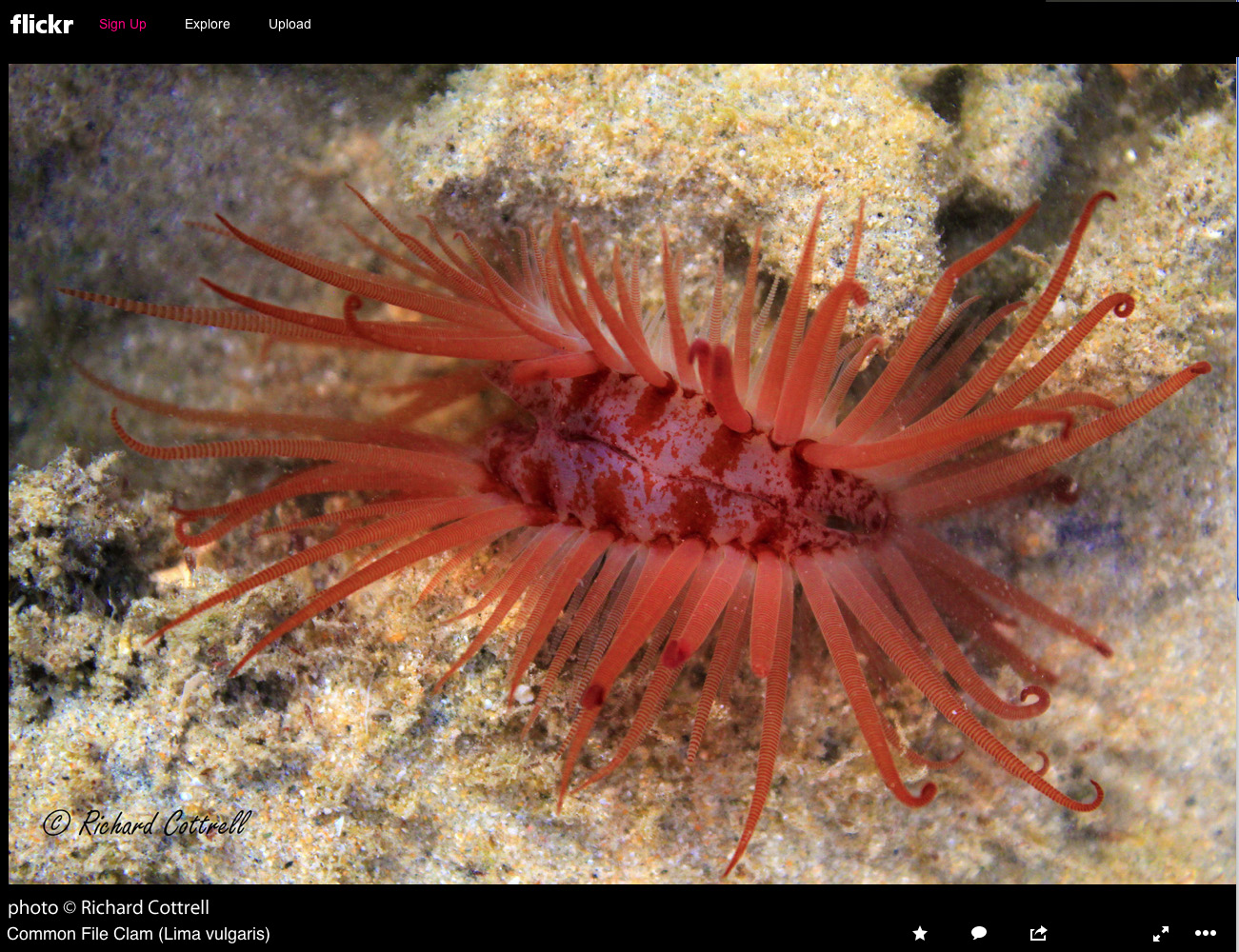
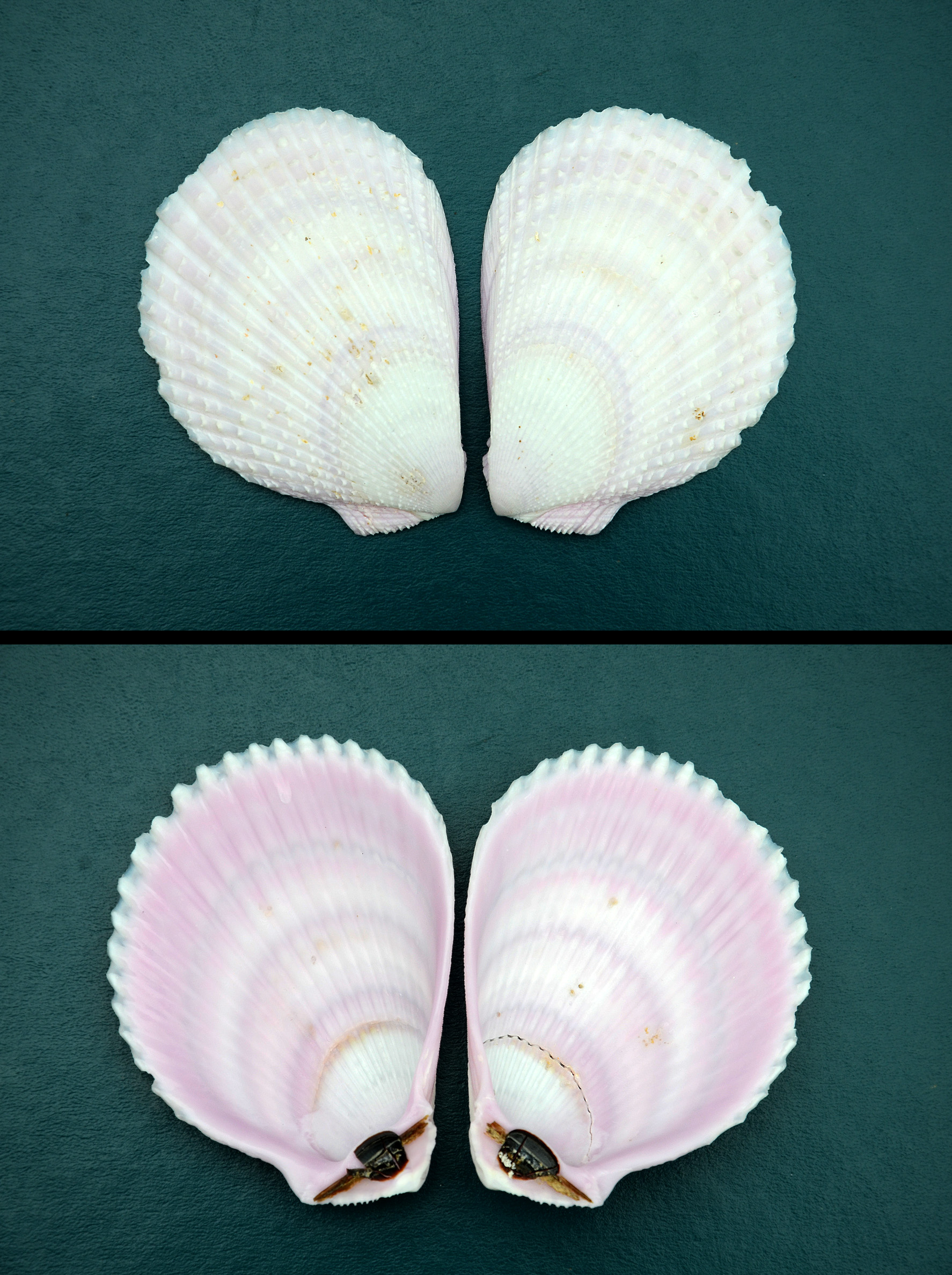
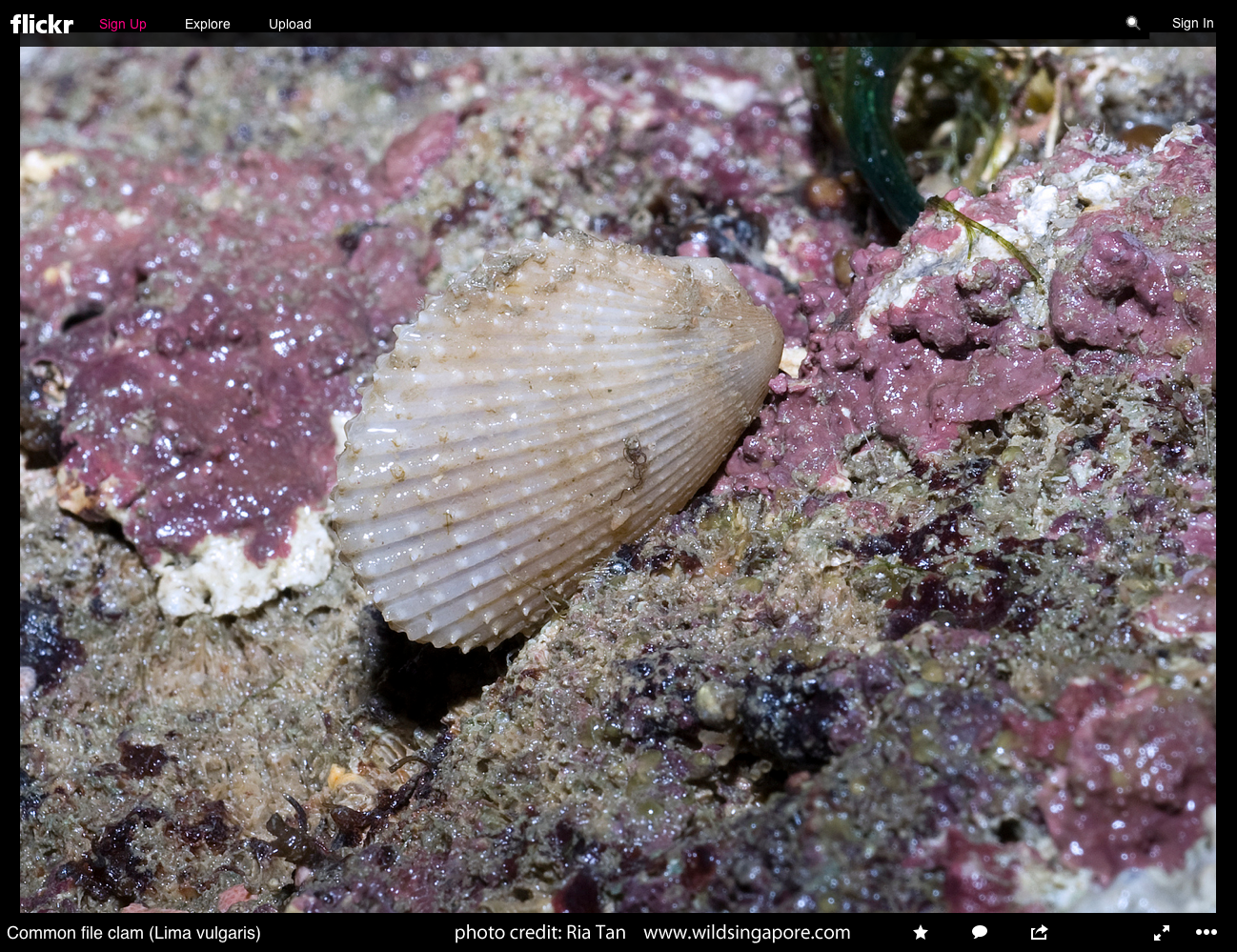
LimaVulgarisLima vulgaris Link, 1807 is a bivalve from the order Limoida, family Limidae. Its common name is File Clam or Spiny File Clam.  It is world wide is distribution in tropical waters. Originally our shell was named Lima lima Linnaeaus, 1758 and Philippine dealers used the name Lima lima vulgaris Link. 1807 to differentiate the populations with a pink interior from those with a white interior. Today Lima lima is reserved for Caribbean and Mediterranean shells while Lima vulgaris to those from the Indo-Pacific. There is no difference in the shells and not all vulgaris have pink interiors.

Lima vulgaris is a filter feeder and is capable of free swimming propelling itself by clapping its valves open and shut expelling water.  Normally they settle down between rock or reef rubble where they display their long tentatcles. The live animal is very attractive.

The top and bottom valve mirror each other and according to the literature the interior color comes from the pigment hemoglobin.

This specimen is a giant being over 4 1/2″ (113mm) and is about as large they come.  It was collected by Philippine divers nestled in rocks off Dawaho Island, Leyte, Philippines. It was donated by club member Richard Kent from his collection.

limavulgaris Screen shot 2013-07-14 at 2.28.28 PM

DORRIE HIPSCHMAN APPOINTED NEW DIRECTOR OF BAILEY-MATHEWS SHELL MUSEUM

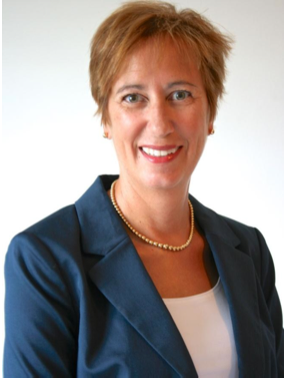
Screen shot 2013-07-08 at 12.06.25 AMSanibel, Fla. (Thursday, June 27, 2013) – The Board of Trustees of the Bailey-Matthews Shell Museum is proud to announce the hiring of Dorrie Hipschman as the Museum’s Executive Director. She brings a wealth of experience with more than 20 years leading non-profit organizations. Most recently, Hipschman was the Executive Director of the Cade Museum in Gainesville, Florida. Additionally, she has served as Executive Director at The Building for Kids in Appleton, Wisconsin, the Children’s Museum in Stockton, California, and the Flathead Convention and Visitors Association in Whitefish, Montana. She was also Development Director at the Plains Art Museum in Fargo, ND. Hipschman is a cum laude graduate of Georgetown University with a degree in American Studies and additional MBA courses at the University of Hawaii. The Museum will greatly benefit from Hipschman’s extensive skills in strategic planning, museum expansion, major gift fundraising and grant writing, and experience in managing staff and volunteers, according to Board President Clair Beckmann. Hipschman has received several museum awards including the American Library Services for Children Award, MetLife Promising Practices Award for children’s health programming and the Wisconsin Convention & Visitors Bureau Destination Builder Award. “Dorrie Hipschman is a lifelong enthusiast of both shells and the ocean environment that they represent. Having come from a large, scientifically-minded, sailing family, she has spent much of her life hunting for, cleaning and collecting seashells along the Atlantic coast, while scuba diving in Hawaii, on Sanibel Island and while snorkeling in Saipan.” Beckmann said. The Board also said Dr. José Leal will transition to become Curator and Director of Education. “From the unique perspective of a marine scientist, it will be great to have the opportunity to expand on and interpret new findings to our visitors and followers worldwide. With Dorrie taking on the Museum management, I will be able to devote my time, as Curator, to the very specialty that introduced me to museum activities in the first place—collection-based research and organization. My thanks to our supporters for their continued assistance and support of the Shell Museum and its efforts,” Leal said. Dorrie Hipschman (dorriehipschman@gmail.com or 352-682-292 Of the more than 17,500 museums in the U.S., The Bailey-Matthews Shell Museum is one of approximately 800 institutions accredited by the American Alliance of Museums. The Museum features more than 35 exhibits of shells and mollusks from around the world. Exhibits are devoted to shells in art and history, shell habitat, rare specimens, fossil shells, common Southwest Florida shells, and more. The learning lab features a hands-on play area for children, displays, games, and a tank with indigenous mollusks. Two half-hour videos, “Mollusks in Action” & “Tales and Trails,” are shown throughout the day, and a children’s video is shown continuously. The Museum Store offers a wide selection of shell books. The Museum is open 7 days a week, 10 a.m. – 5 p.m. LIBRARY NEWS

SHELL OF THE MONTH – JULY 2013

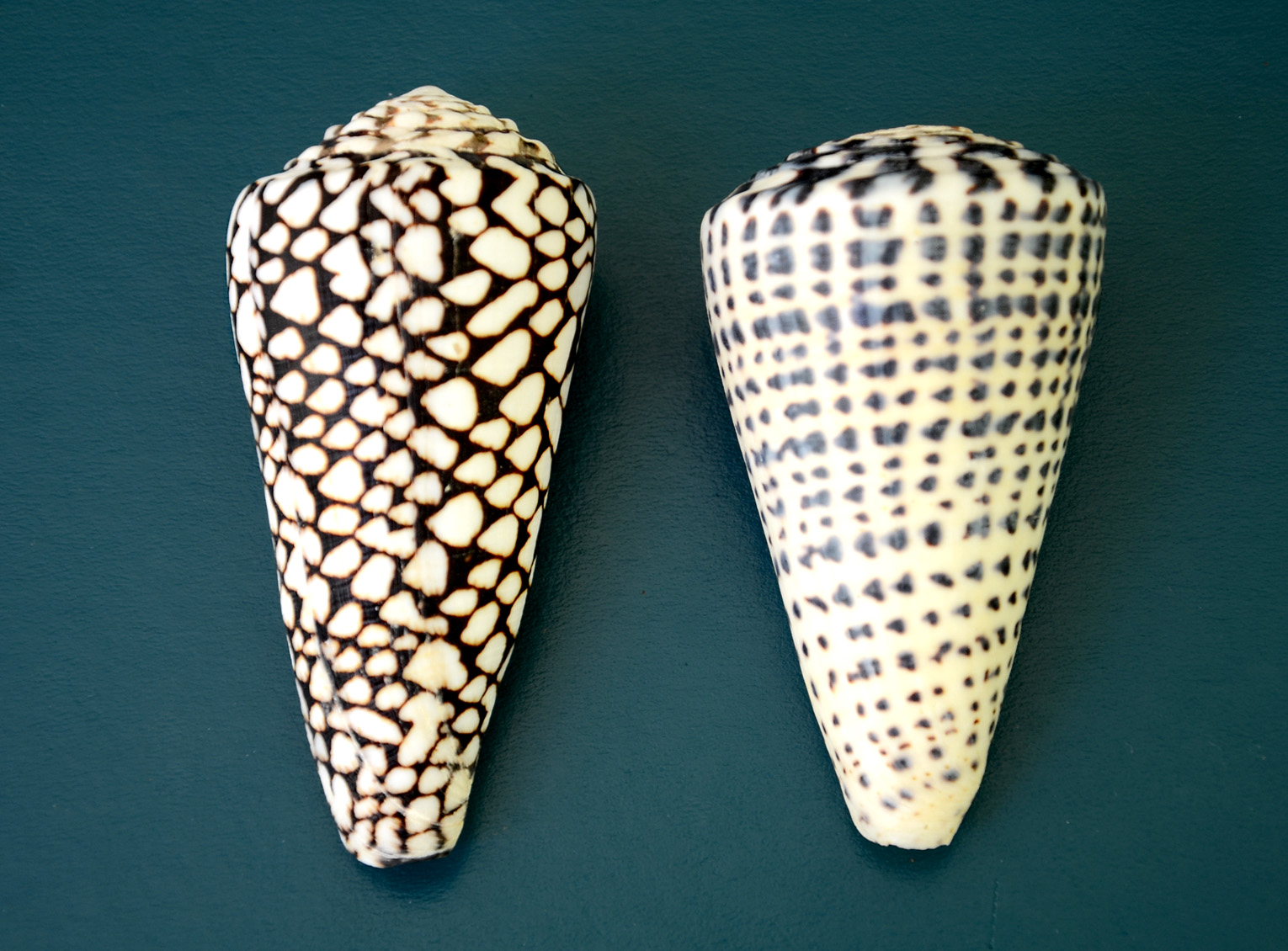
DSC_9964This month we have two large cones which are almost opposites. Both are favorites of collectors and artists alike. Any still life of shells is likely to include one or both!

Conus marmoreous is one of the classic shells described in Linnaeus’s monumental 1758 “Systemtema Naturae.” The marbled cone is about the most striking of all shells, black in color covered with uniformly sized white tents. It has an elegant ice cream cone shape. Younger shells up to about 60mm are especially beautiful with a high gloss but as the shells grow in size the surface changes from waxy to dull.  Conus marmoreous is predatory, living on other molluscs and inhabits the coral reefs in shallow waters across the Indo-Pacific range. This specimen is a larger shell of about 100mm.
Conus Leopardus was named by Roding in 1798. The shell has a cream colored waxy surface and is uniformly banded, top to bottom, with evenly sized and spaced black spots. Sadly larger specimens tend to loose the regularity of pattern making most specimens over 120mm less attractive. The leopard cone is one of the largest growing up to 200mm. Giant specimens today are quite rare and then they look like they have gone to war and lost, having lost their spots, turned chalky, and are marred by irregularly spaced growth lines plus heavy spire and body erosion. Conus leopardus too is predatory and is found across the entire Indo-Pacific range. Our specimen is small for a leopardus but is quite attractive and clean.
Both specimens are from the Philippines and were collected by local divers in sand pockets, inside coral reefs and in shallow water.

COA CONVENTION CONTEST

COA Convention Contest – For Broward Shell Club members only. Win a prize and grab the glory!!!

BSC members, put your thinking caps on! The club board announces a contest to submit a name and a logo for our 2015 COA Convention.

The title should be representative of something in South Florida pertaining to shells or nature and the logo should have a shell motif or at least a shell of some type in it. The logo should be a drawing (not a photograph) that can be utilized in color and/or black and white. We will utilize the name and logo in all print and on various pieces of merchandise we manufacture to sell at the COA. Those of you who attended our special May COA meeting saw various bags, t-shirts and hats adorned with various years’ logos and themes. We will be adding the following to our printed material/merchandise: 2015 COA Convention or 2015 Conchologists of America Convention.

Please submit your name/logo entry to either Nancy Galdo or Linda Sunderland. The contest deadline for submission is November 1st, 2013. We will present our 2015 COA name, logo and event plans next summer at the 2014 COA Convention in North Carolina!

There will be a very exciting prize for the winner (TBD). The board will announce the grand prize in the near future. The Broward Shell Club board of directors will choose the winner at its November board meeting. Good luck to all!!!

Examples of previous COA titles are:

2013 – Sarasota – A Circus of Shells

2011 – Melbourne – Space Coast Treasures

2010 – Boston – Shellebration

2007 – Portland, OR – Chardonnay & Shells

2003 – COA logo created in Seattle – The Watchman (see top of next column)

This year the COA will be in Sarasota, Florida and next year (2014) it will be in North Carolina. Our club has had the honor of hosting the Convention two times previously in 1977 and 1986. This annual event has taken place annually since 1972 and is the ultimate shell experience. Meeting other collectors from all over the world, fantastic programs, banquets, field trips, and the ultimate “shell-collecting-orgy” the dealers’ bourse. This is an overload of the senses where shells are concerned….but what a way to go!!

BROWARD SHELL CLUB TO HOST 2015 SOUTH FLORIDA COA

Many of our club members know already, but just in case you haven’t been around lately…….. the Broward Shell Club will host a shell convention in 2015!!! The COA (Conchologists of America) convention will be held at the beautiful, newly refurbished Bonaventure Golf Resort and Spa in Weston, FL from July 14-19, 2015! The annual Convention features lectures, symposia, field trips, auctions, shell dealer’s bourse, exhibits, banquet, and other exciting activities. Our club is already hard at work planning the initial stages and organizing committees. If you would like to participate with us in this exciting event, we’d love to include

you. Nancy Galdo an

COMMITTEE CONTACTS

Here is a list of those who are in charge for the various committees within club so you know who to contact with questions and to volunteer

Auction – Linda Zylman

COA 2015 – Nancy Galdo / Linda Sunderland

Correspondence – Carolyn Harvey

Educational – Richard Sedlak

Fieldtrips – The Board

Holiday Party – Linda Ebeling

Hospitality – Linda Ebeling

Library – Alice Lustig

Membership – Heather Strawbridge

Newsletter (Busycon) – Richard Sedlak / Tracy Dale

Photographer – Violet Mas

President – Linda Sunderland

Programs – Tom Ball

Raffle Table – Cindy Murphy

Recording Secretary – Linda Laurin

Scholarships – Linda Sunderland / The Board

Shell Show – Alice Pace Treasurer – Tom Ball

Vice President – Sonny Ogden

Web Site – Richard Kent

REMEMBERING JOSY WIENER

Josy Wiener passed away on April 18, 2013. For those of you who knew Josy well, you know she usually said what she was thinking. In these days of subterfuge and shilly-shallying this was actually refreshing. If you wanted something sugarcoated, find someone else to sugarcoat it, please.

Josy was born in Berlin, Germany. During the frantic exodus from Germany in 1939, Josy and her family were allowed to emigrate to Chile, where an uncle had previously settled. While not at first understanding a word of Spanish, she quickly learned to make her way in an unfamiliar

environment. It was in 1949 that she was able to move to the United States. There were a couple of years traveling and moving from Indiana to California and finally to Miami. In the 1950’s, Josy joined the U.S. Marine Corps Reserve. Although she never saw active duty, she was proud to serve her adoptive Country. She went to work at Neiman-Marcus and by working during the day and going to school at night, got her cosmetology license and became a beautician. She worked for Neiman Marcus in various places including Havana. She opened her own shop, Bejo in Miami Shores and made it a success. She met her husband Ben in 1954 and they were married in 1961. In addition to her own shop, Josy helped Ben run his hardware store in Miami.

In 1964 on a trip to Sanibel, they became interested in shell collecting. Josy and Ben held many positions in the Miami Shell Club, as well as assisting in the Broward Shell Club. Josy and Ben were the recipients of the Neptunea Award, the first year it was given by the Conchologists of America. She and Ben were often COA reps for the Miami Shell Club and Josy held many different positions in that club .Josy, with Ben, traveled to many countries, making friends wherever they went. Through shell collecting contacts, she also traded shells with others in various parts of the world. They also supported the Shriners in Miami.

In archived photos, Josy and Ben are known for matching shell outfits. Josy will best be known for her tireless efforts to sell raffle tickets. The Miami Shell Club, the Broward Shell Club and the Conchologists of America were recipients of her efforts. Her cry of “Shake ‘em Up!!!” will long be remembered. Occasionally in life, you will come in contact with an individual unlike anyone else, and Josy was one of those unique individuals. She had a life that would have defeated almost anyone else, but managed to persevere and even thrive. She corresponded regularly with people from many countries. If she found an article she thought you would be interested in, it would show up in your mailbox with a short note, plus notes of encouragement in times of stress, times of joy and just notes. Her friends were often in her thoughts. Josy leaves one sister, Lilo Layton, in Miami and many nieces and nephews.
SHELL OF THE MONTH – JUNE 2013


DSC_7616

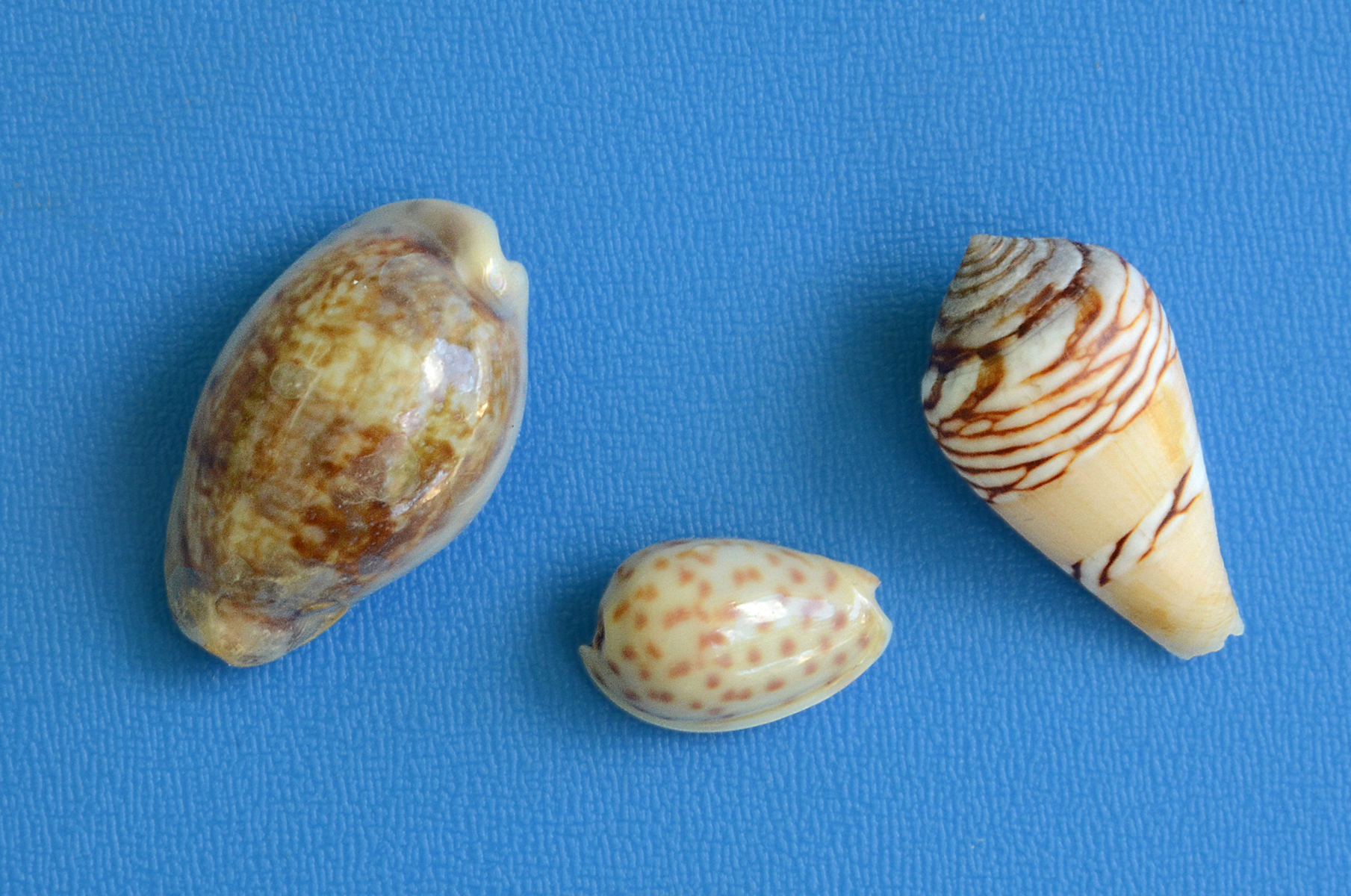
Conus mercator Linnaeus, 1758
Cypraea zonaria Gmelin, 1791
Persicula persicula Lamarck, 1822
   This month our shells come from Senegal, located on the “Bulge of Africa” – the westernmost point of the continent. Senegal is midway between the Tropic of Cancer and the Equator. The Portuguese were the first Europeans to reach the bulge in 1444. In 1677 the French took control of Gorée Island, in the harbor of what is now Dakar, and used it as a base in the slave trade. Senegal then became a French possession and remained so until it gained independence.
   Senegal is home to many desirable shells, but unfortunately for us, due to the ties with France, very few specimens come our way. Unlike in the Indo-Pacific Oceans where species have extended ranges, in the Atlantic virtually no species of shells are found across the ocean. The coast off Senegal and neighboring countries have their own distinct shells and most are endemic to the area.
   Conus Mercator is named after the great cartologist Geradus Mercator who was the creator of the first atlas.  It is very variable in pattern and that makes it fascinating to collect. Most specimens on the market come from the offshore Cape Verde Islands but ours in from the mainland. Conus Mercator typically has spire and body erosion; this is a very clean specimen. It small for a conus and this specimen is just barely 30mm.
   Cypraea (zonaria) zonaria is indigenous to West Africa. It is quite variable in size, shape and color. Unlike Conus Mercator that exhibits great variety from the same location, zonarias tend to vary according to location.
   The marginella family is exceptionally well represented on the Atlantic  of Africa with an extensive list of specie in many different families.  Perisicula periscula is quite attractive with its evenly spotted pattern.


   Recent sales on ebay would put the combined value of these three shells at between $40 and $50.  They were donated by Richard Kent.