July Program

Caitlin Shea-Vantine is a second year Masters student working under Dr. Stephen Kajiura at Florida Atlantic University on the Boca Raton campus. Caitlin attended undergrad at St. Michael’s College in Colchester, VT and previously held positions at the University of Georgia Aquarium in Savannah, GA and the Northeastern Marine Science Center (Nahant, MA). She is very passionate about conservation and getting young girls interested in STEM.

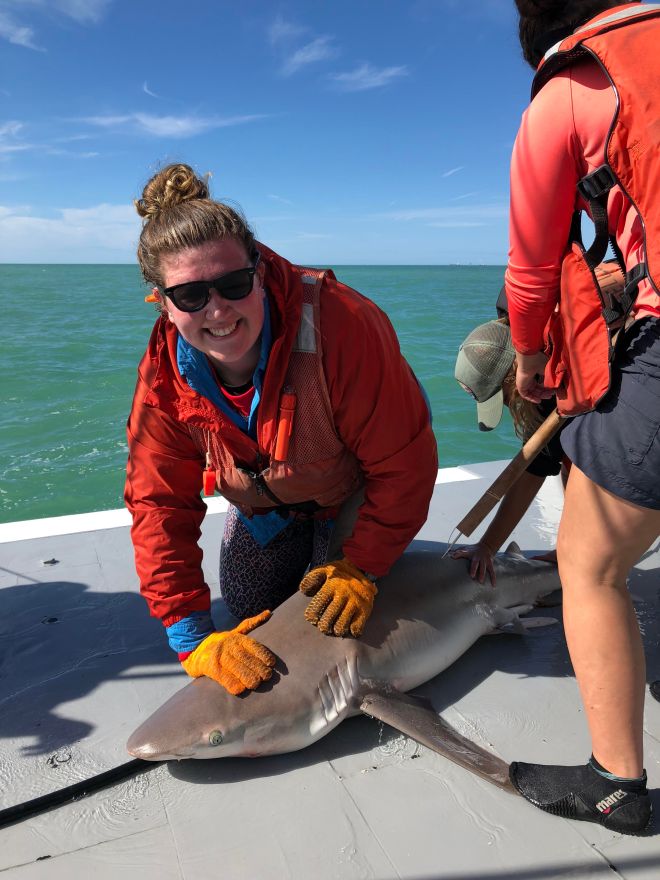
Caitlin will be talking about the Stingray’s in our Waters. She will give an overview of they types of Stingrays to be found here, how they use their defense system and how dangerous they are to humans. Caitlin works with Stephen Kajiura, the shark expert at FAU and the photo is of her helping tag a shark to then monitor where it goes.
SHELL OF THE MONTH – JULY 2019

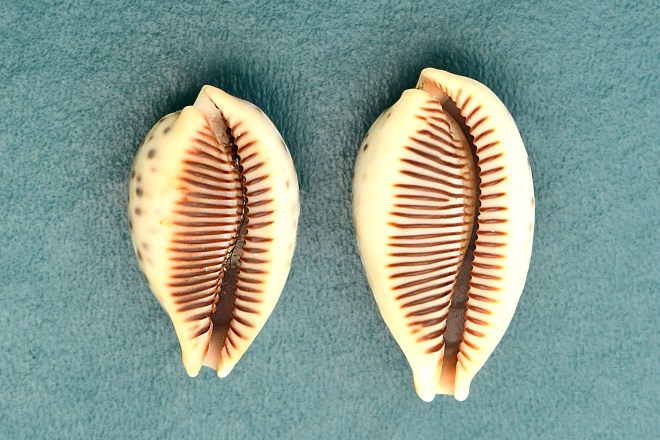
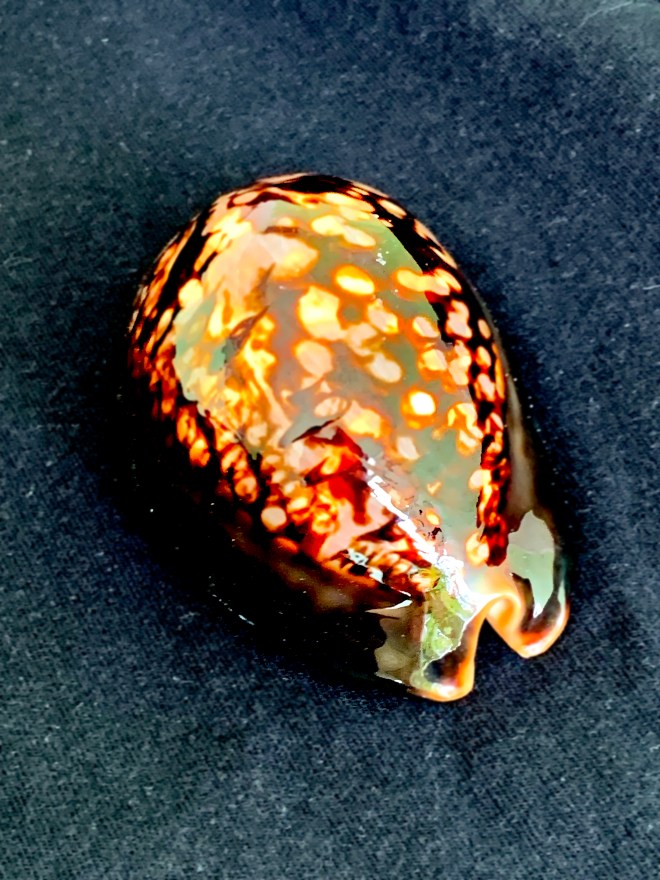
Mauritia mauritania Linn, 1758 is an impressive unmistakable cowry. It grows to over four inches and is decidedly a heavyweight.
It is a member of the Arabian complex although it hardly resembles its siblings. Mauritania is the only specie in the group with a solid color base and a dorsum that lacks all over fine reticuations. Its flanged callus is distinctive as is its tall hump.
Mauritania is brown to black/brown in color on both base and dorsum. The dorsum has large irregular white spots that vary in number with the very rare specimen virtually lacking in spots. Hawaiian specimens are as a rule darker in color than the more readily available Philippine ones. Dwarf specimens are found in the Andaman Sea.
Mauritania has a very wide distribution across the Indo Pacific region but apparently only lives in areas of high surf pounding against a vertical wall. It is nocturnal. In Hawaii it is associated with lava. Although not scarce its habitat makes it difficult to collect and due to the rough surf many specimens have scratches and dings. A true gem from Hawaii is scarce.
This specimen came from the small island of Lanai that sees little collection. It was collected this January and has a gorgeous glassy surface. It is a real treasure. Donated by Richard Kent and obtained from the diver who found it.

Program for June Meeting

This month’s program will be Carole Marshall. The title of her program is “So You Think You Want to Write a Shell Book?” Carole has been writing a shell book on the “Seashells of Peanut Island and the Lake Worth Lagoon”, for about 12 years now and she still isn’t finished. This is a humorous tongue in cheek, informative program on the things she has learned along the way and why she still isn’t finished. There is also a lot of good information for anyone who is interested in learning about mollusks, web sites that are important for everyone to know and how technology has changed Malacology in the last 12 years. There will be a hand out on important web sites as well.

Carole has always been interested in Natural History, collecting fresh water snails along the Rock River in Wisconsin as a child, majoring in Science in High School and later learning about sea shells. Her mother started collecting shells on trips to Ft. Myers Beach in the 1960’s and Carole soon realized how many interesting stories came with the shells. At a small club she gave a talk on shells to the group during hobby night when a woman came and asked her if she would be interested in joining the Chicago Shell Club. (Her response was “They HAVE CLUBS for People who Collect Shells?) For several years Carole and her parents, John and Lorraine Landers made the trip to the city (Chicago) from the suburbs. Shortly after 1969, when her parents moved to Ft. Myers, Carole and family moved to the West Palm Beach area in 1970.
Although she swears it was extreme mental incapacity that made her do it, Carole has been President of 3 different Shell Clubs. She has written many small articles for the clubs, COA magazine and for Of Sea and Shore Magazine as well as having given talks at Jamborees, COA Conventions, at the American Malacological Society, Florida United Malacologists meetings and for many local groups and organizations. She loves to teach about shells and finds the stories about shell use from ancient times to their uses today, of endless fascination.
Carole also discovered that the stories she loves about shells, can also be found on coins and paper money and Carole has an extensive collection of paper money, coins from ancient to modern, other exonumia, poker chips, medals and trade tokens.
Hopefully you will come to the meeting, be amused, laugh a little and learn.

SHELL OF THE MONTH – JUNE 2019

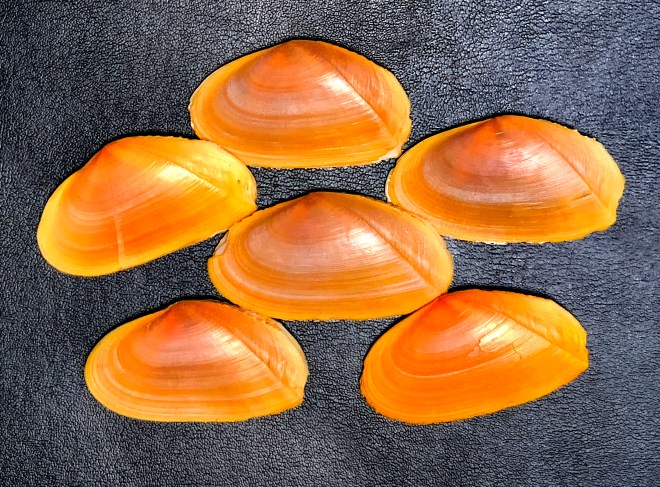
Tellina Foliacea Linne, 1758
netted burrowed in sand at 30 meters deep
Bantayan, Phillipines 2018

The genus Tellina is a widely distributed marine mollusc and a member of the family Tellinida. Tellins are filter feeding bivalves that inhabit tropical waters around the world. They are edible. All together there are about one hundred species, most of which are rather bland, solid whitish in color. Tellina Foliacea Linne, 1758 is one of the few exceptions with its bright uniform orange color.
One of the most beautiful bivalves is Tellina radiata Linne, 1758 which comes from the Caribbean Sea. It is called the Sunrise Tellin because of its colorful radiating bands of purple on a yellow and whitish shell. Unfortunately it is rather hard to come by recently. Large specimens over three inches are impressive.
Here in Florida we have Tellina lineata W. Truton,1819, the Rose Colored Tellin, which is a shell crafters favorite. It is white with rose color overtones and often about an inch and a half in size.. It can be found burrowed in sand bars at low tide in the Keys and on both coasts. Halves often wash up on shore.
The most commonly available Tellin is Tellina virgata Linne, 1758, a Philippine shell widely wholesaled for shell crafting. It is similar to the Sunrise Tellin but the bands lacks the colorful yellows.
We are offering in this raffle a half dozen pairs of Tellina foliacea, large in size of about 3″. They are very fresh specimens, collected by native divers in 2018. Donated by Richard Kent and recently obtained from a Philippine dealer. Tellina foliacea is not an easy shell to obtain, making this a very desirable raffle to win, whether the shells are won by specimen collectors or shell crafters.

SHELL OF THE MONTH – MAY 2019

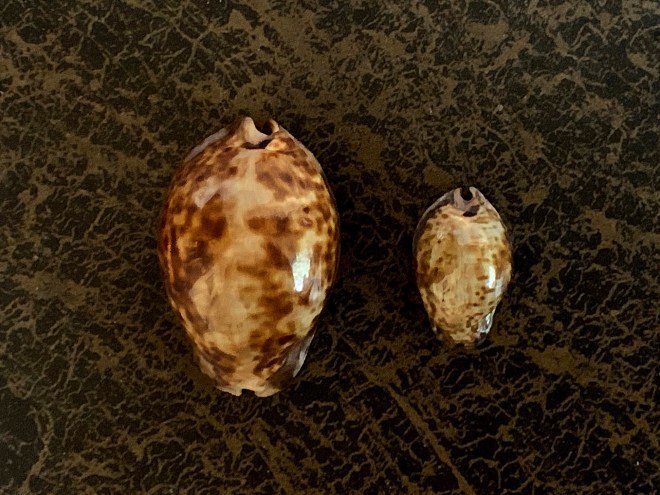
Trona stercoraria (Linnaeus, 1758) by diver at night, low tide in seaweed at 3 meters, M’bour, Senegal
Trona stercoraria (Linnaeus, 1758) dwarf. by diver on rocks at 10 meters, Gulf of Guinae, Limbe, Cameroon

Trona stercoraria (Linnaeus, 1758) is a popular cowrie among collectors due to its extreme variability in size, shape, color and even pattern. Its common name the Rat Cowry or Droppings Cowry. Certain populations have overcastings that make for bizarre specimens which may look as if they were infected by disease (and possibly they are). These are common in some locations.
Even with all the variation stercoraria is easily recognized and can’t be confused with any other cypraea. Its coloration could be considered drab (mousy, hence the name Rat). It is certainly not flashy. Typical specimens have a mocha colored base with dark brown chiseled teeth. The dorsum is similar in color and covered with blurred brown blotches. Some specimens are light, others dark in color. Scarce specimens have a largely clear dorsum, others with an irregular pattern while the occasional one has the blotches fused to almost sold and even scarcer almost black. The margins are calloused and both extremities are rostrate. Sizes run from extreme dwarfs of 1″ to giants of about 3.75”. The majority fall between 2 and 2.5″. While typically rhomboid, sone specimens are oval.
There are populations with an extreme hump that were named Trona stercoraria rattus (Lamarck, 1810). Linnaeus call the dwarfs “minima”. Even with all the variation the vast majority have the patterns and shape of the two offered here.
Trona stercoraria is a West African cowry with a restricted range below the Bulge of Africa. Most specimens come from the Gulf of Guinea. It is fairly common in this area and lives in a variety of shallow water habitats.
The two shells were donated by Richard Kent and were obtained from European dealers. Average sized specimens retail for $20-25, dwarfs though much scarcer somewhat less. Large ones go for over $30. Giants and unusual specimens can be found on eBay from $60 to over $300. In fact there is one very dark 95mm specimen with blueish borders listed for sale at $520!

SHELL OF THE MONTH – APRIL 2019

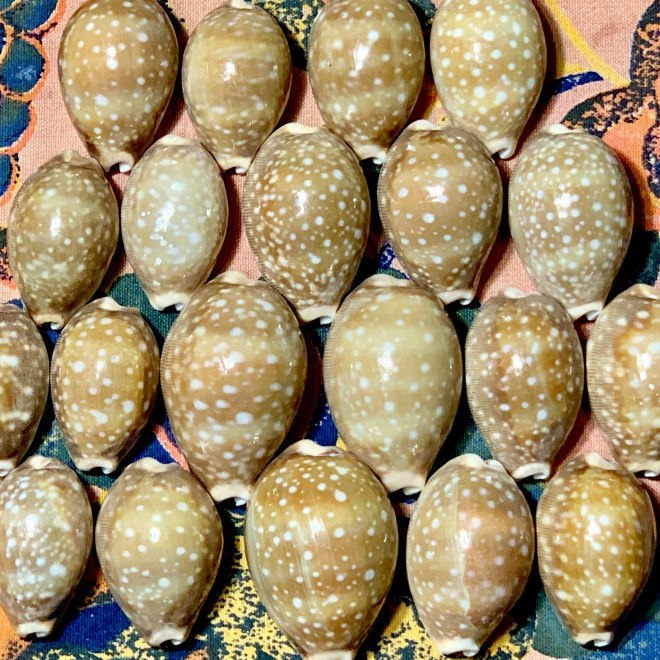
Our April Shell of the Month is for the shell crafters. It is a set of 20 Cypraea vitellus Linn, 1758 commonly know as the Calf Cowry. Cypraea vitellus is one of the most common medium sized cowries, It inhabits the reef in shallow water throughout the entire Indo-Pacific region. It’s a fawn colored shell  covered with white spots. The margins have closely spaced thin vertical whitish lines. T here is little variation in size and pattern. The shell is immediately recognizable. Juveniles are banded, the banding covered over as the shell matures.
These shells were purchased in bulk and came with no collection date. I imagine these twenty will be turned into wonderful little critters or whatever the shell crafter may imagine.
Donated by Richard Kent. Next month we shall return to specimen shells.

SHELL OF THE MONTH – FEBRUARY 2019

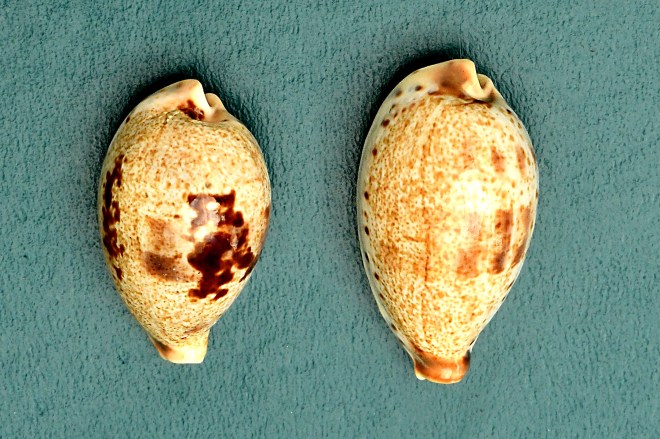
Cypraea pulchella (Swainson, 18230, Mergui Archipelago, trawled 100 meeters by fishing boats, Andaman Sea, Myanmar
Cypraea pulchella (Swainson, 18230, trawled by commercial fishing boats @100-150Meters off Hainan Island, South China Sea, China

Not only is Cypraea pulchella (Swainson, 1823) one of the most sought after cowries, it is also one of the most distinctive. Its deep brown teeth that extend across the base make it impossible to confuse with any other. The common name for this elegantly pyriform shell is the Pretty Cowrie and pretty it is.
The dorsum is pale, faintly mottled with light brown and typically has a large dark chocolate colored blotch on both the right and left side of the dorum, but not always. Less attractive specimens have the blotch on only one side or the other. The most interesting specimens have multiple blotches or one huge one in the center and they bring the highest prices. The occasional specimen has no blotch at all! (specimen #2 in our raffle). Normal size is between 35-45mm. Shells retail in the $15-25 range and two to three times that for the exceptional spectacular specimen.
Originally the north-western Indian Ocean variety, Cypraea pericalles (Melvill & Standen, 1904) was a distinct specie, separate from the more common Pacific one, but recently Cypraea pericalles has been downgraded into a subspecies. When the names were first described there was a gap in the range, but this was due to the nonexistence of shelling in Burma and Thailand. Specimens that come from the Andaman Sea (this area) often appear to be an intermediate of the two, but are usually sold as pericalles. The difference is that the original pericalles has shorter teeth, is less callus, and is of smaller average size, with a less pronounced blotch. Possibly the two subspecies fully intergrade.
Cypraea pulchella favors deep water, is variable in size and pattern and is widespread though uncommon in distribution. Most specimens on the market come form the Philippines, South China and Thailand. There are two other distinct subspecies, one unique to the southern Philippines and the other quite rare from New Guinea. The true pericalles from the west coast of India is currently very difficult to obtain.
Today with revisions of nomenclature the proper name is Ficadusta pulchella (Swainson, 1823). For old time collectors these revisions in Cypraea are hard to accept.
Donated from the collection of Richard Kent.

February Program

Our Program for February is Dr. Thomas Annesley,

Thomas Annesley is “Active Professor Emeritus” at the University of Michigan and Deputy Editor of the journal Clinical Chemistry. He has always had an interest in oceanography and spent summers in California, where his uncle dropped Tom off at the coastal tidepools on his way to work and the picked Tom up on his way home.

Tom has been listed in Who’s Who in Medicine Academia, Who’s Who in Science and Engineering, and Who’s Who in America. He has published more than 200 articles and presented more than 175 invited lectures in 10 countries.

At the Bailey-Matthews National Shell Museum Tom does public lectures, beach walks and the live tank talks. He is also President of the Sanibel-Captiva Shell Club.

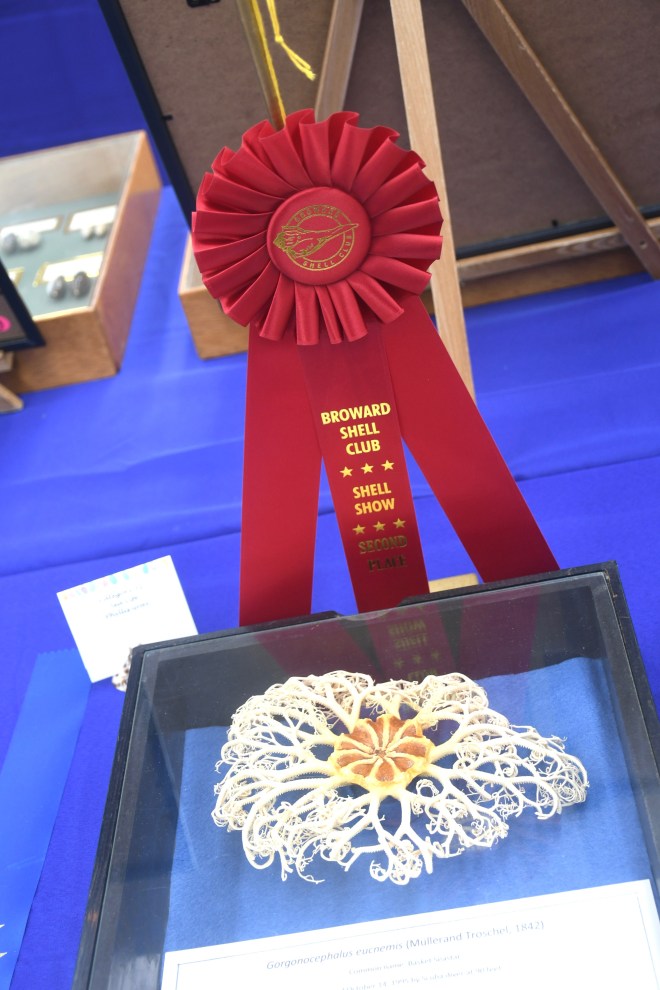
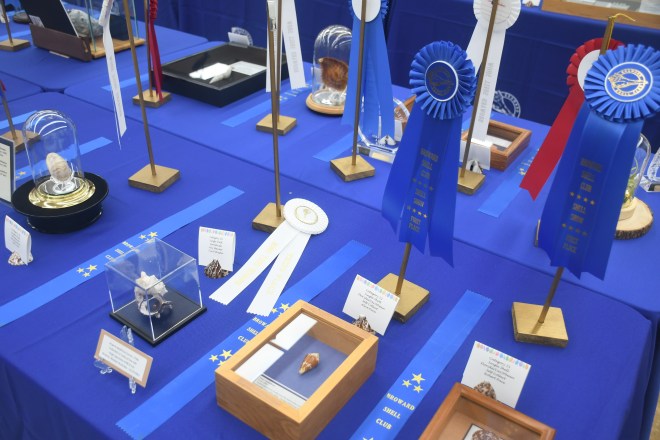
The title of his talk is “Cone Snails, Tennis Rackets, Pain Medications, and the Broward Shell Show”

Tom’s presentation will focus on scientific discoveries involving cone snails and their toxins. But as with many advances in science, there are elements of luck, happenstance, intrigue, mistakes, and creating lemonade out of lemons that contribute to the story. Dr. Annesley will show us how the supposedly unrelated topics of tennis, pain medications, and even the Broward Shell Show fit into the story of cone snails.

SHELL OF THE MONTH – NOVEMBER 2018

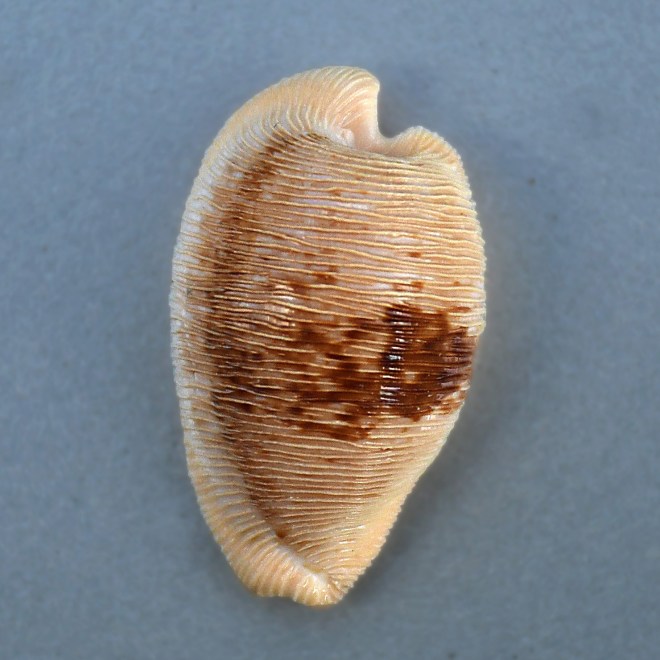
Cypraeaovula capensis capensis (Grey1828)
SCUBA at 10-12M on rock wall
Algoa Bay, Port Elizabeth, South Africa

The Atlantic and Indian Oceans meet the icy Antarctic waters below the coast of South Africa. In the sheltered bays a rich unique marine fauna has developed with an array of indigenous cyrpraea including a couple of oddballs that make shell collecting such a fascinating hobby.

Cypraea capensis is one such shell. It’s like no other. From a distance it looks likes a typical cowry, but on closer inspection one sees fins that originate in the aperture and completely cross over the base and dorsum encircling the shell and meeting the teeth on the opposite end. The shell is a pale uniform mushroom color with an irregular brown blotch and has a discernible mantle line. The dorsum is glossy. There is little variation in color and pattern from shell to shell. Even the blotch is fairly consistent.

Capsnsis lives on rocks in both moderate and deep water with deep water specimens bringing vastly higher prices. There are a few named varieties.

Before the popularity of SCUBA, virtually all specimens were dead collected on the beach. As the diving season is rather short, few capensis come to the market each year, making it a difficult shell to obtain.

Our specimen is of good size, 30mm and should be considered gem. Similar shells bring about $40 on the market. It was originally purchased in a small dealer’s lot from a South African diver/collector and is from the collection of Richard Kent. This is an intriguing shell to look at; one can spend much time studying its appearance.