SHELL OF THE MONTH – OCTOBER 2014

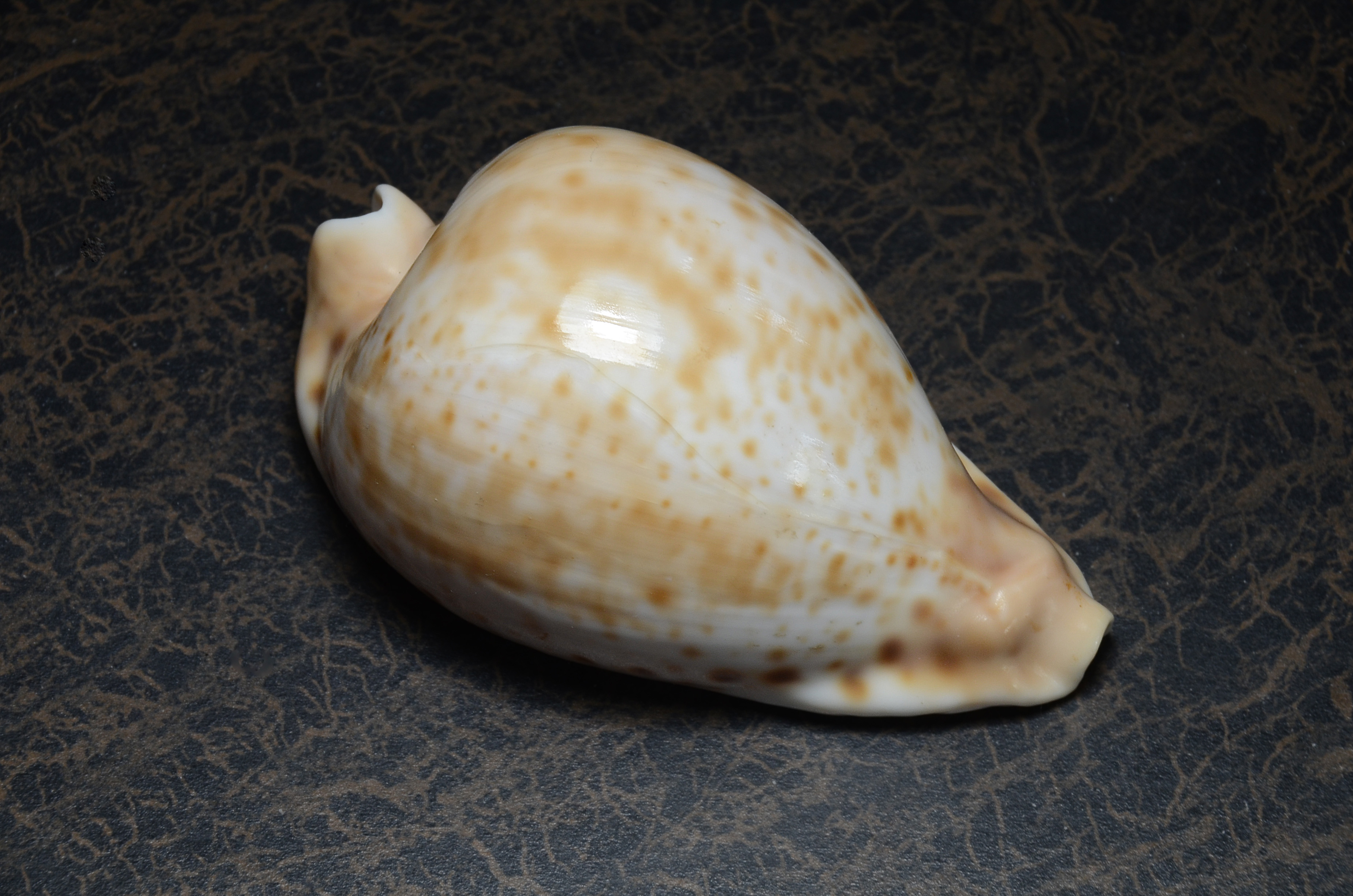
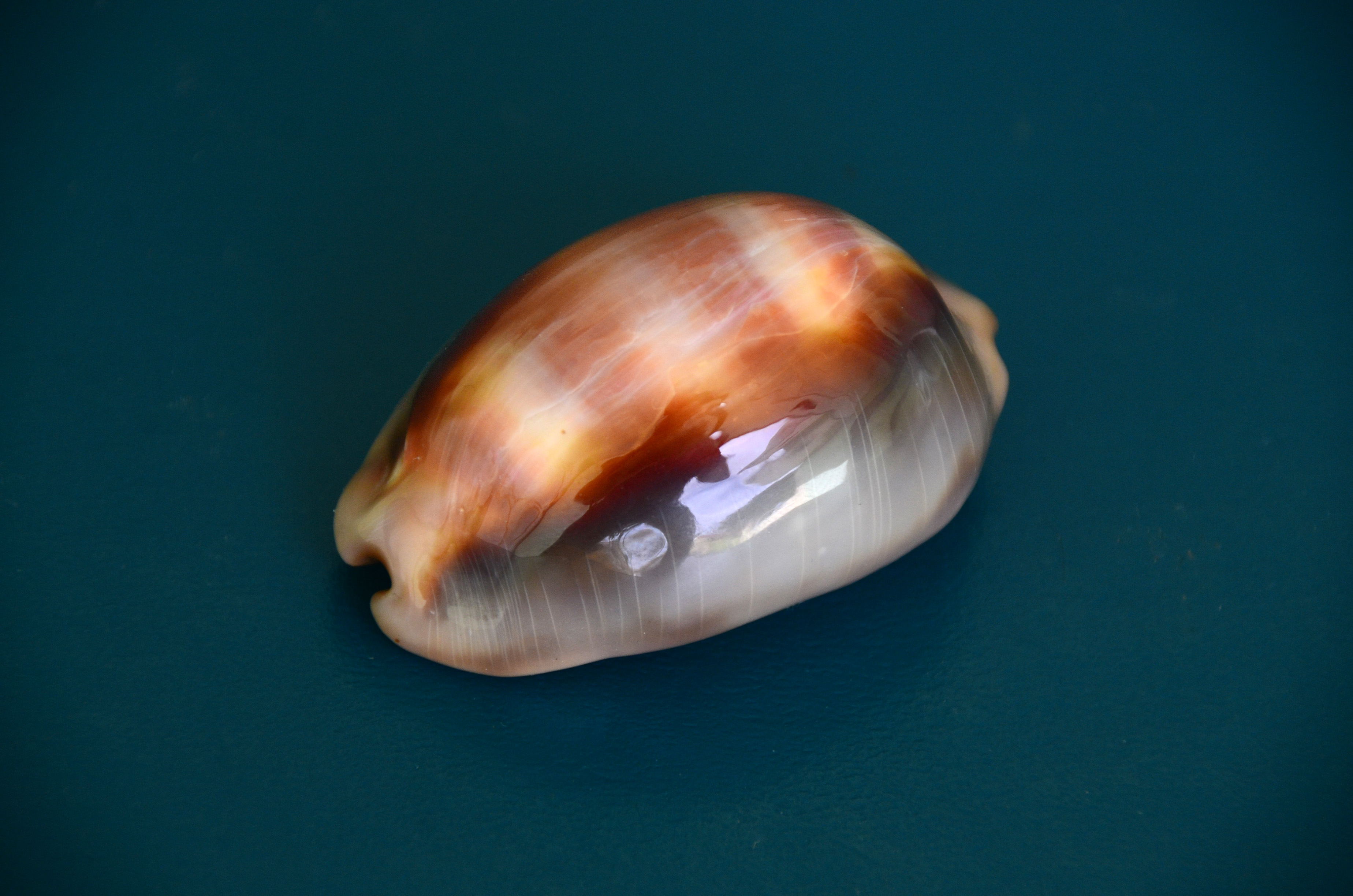
ventriculusLyncina ventriculus Lamarck, 1810
On coral reef at night, 15-20 meters
Rasa Island, Palawan, Philippines, 2012

Lyncina ventriculus Lamarck, 1810, is a very heavy massive shell, easily identified by its four dorsal bands that are almost obscured be a thick callous that reaches to the top of the shell. Although Lyncina ventriculus is placed in a large group of cowries, it stands alone with no close relative. When the scientists subdivided Lyncina, they isolated Lyncina ventriculus by itself. Lyncina schilderorum and Lyncina carneola are similar but quite different.
Although not rare, Lyncina ventriculus is difficult to obtain. Whereas most cypraea are collected by the dozens, ventriculus seems to be found one at a time. It’s distribution supposedly ranges from the Philippines thru Polynesia, however only occasional specimens from Tahiti and the Visayas in the Philippines reach the market. Polynesian specimens are much smaller in size than their Philippine relatives.
Our specimen is a giant, almost 60mm in length. It has glossed over growth stress lines on the dorsum which is typical for ventriculus; true gems are a rarity. Otherwise it is a beautiful specimen. Ventriculus fades rapidly after collection. Fresh specimens are vibrant with the upper reaches of the callus black but this rapidly fades to grey. Even storage in darkness will not prevent the fading.
Donated by Richard Kent
SHELL OF THE MONTH – SEPTEMBER 2014

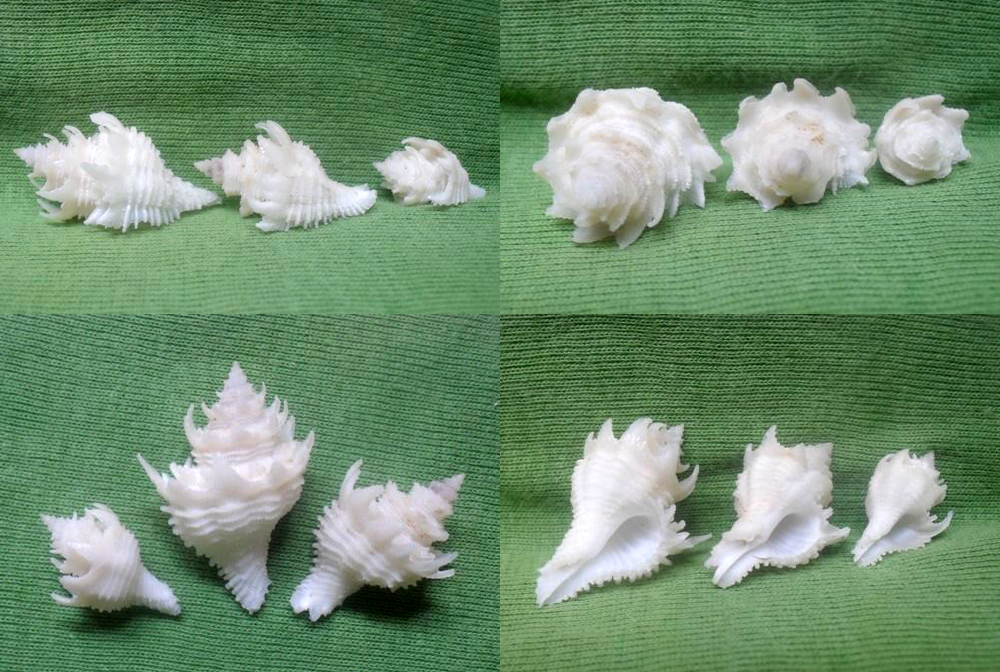
lataxisFor September we have a very special shell of the month from a family seldom available to collectors: Latiaxis japonicus Dunker, 1882 a member of Coralliophilidae, There are three genus, Coralliophila, Rapa, and Latiaxis in the family. Although the shells in each genus hardly resemble each other, they have much in common being carnivorous gastropods that live in corals and on sea fans, often in deep water and all lacking a radula. Lataxis is the largest generic group, found mostly in Japan and the Philippines, with many hundreds of species, that are in many cases extremely difficult to differentiate due to their small size (15-35mm), having shoulder spines and are white or whitish coloration. Latiaxis japonicus Dunker, 1882, an exquisitely sculptured pure white shell, is an exception – the triangular shoulder spines make it unmistakable. It is difficult to obtain a single specimen much less a growth series of three as we have here. One needs to collect a large specimen to complete this series, but for whatever reason very large ones over 32mm don’t ever seem to be available. Although it’s named after Japan, this growth series was collected earlier this year in the Philippines.

Donated by Richard Kent. Our thanks to Sally Marshall and James Redding for their donations to the Raffle Table.

SHELL OF THE MONTH – AUGUST 2014

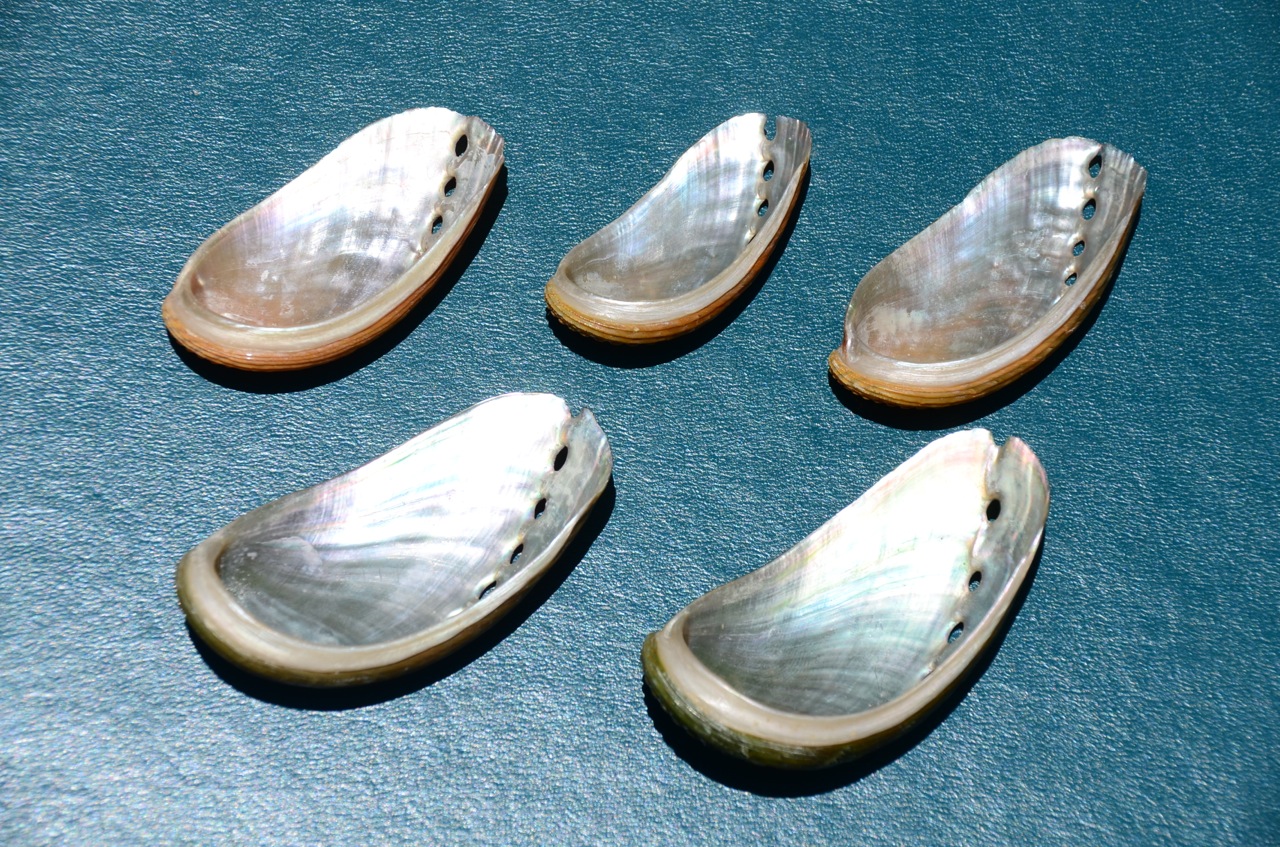
DSC_7183Donkey’s Ear Abalone – Set of 5
 
Haliotis Asinina Linn 1758, taken in coral reef at 10-15m, Biri Island, N Samar, Philippines
   Halitotis, commonly known as abalone, ear shells, or ormers, occupy a rather unique place in the world of gastropods. They are immediately recognizable, even to non collectors by their flattened saucer like shape, a body whorl almost as large as the shell itself, and the beautiful, nacerous (mother of pearl) interior. The giant abalone from California and Australia are popular edibles, so popular in fact that stocks have diminished to the point where survival of various specie is threatened. Abalone are herbivorous, generally live among rocks where they attach themselves using their large foot, the edible muscle. The mother of pearl interior is used for jewelry, buttons and other decoration. The giant abalone shells have traditionally been polished and used as souvenir ashtrays.
   There is one genus, Haliotis, in the family Haliotidae. There are about 100 species that live in temperate or tropical waters. Haliotis asinina Linn 1758, is one of a very few that inhabit Philippine waters. This growth series is representative, however asinina does grow much larger. Note the interesting olive green coloration of the larger specimens which is very rare in marine shells. These are fresh specimens collected late in 2013 by Philippine locals. Donated by Richard Kent.
DSC_7185


SHELL OF THE MONTH – JULY 2014

DSC_6421

Umbilia hesitata Iredale, 1916
Trawled off Cape Howe @ 300-400′
New South Wales, Australia

Our shell of the month was originally described as Cypraea umbilicata Sowerby, G.B.I., 1825, the Umbilicate Cowry. Unfortunately Sowerby hadn’t done his homework and the name was ruled invalid. Finally in 1919, close to a century later, naturalist Tom Iredale named it hesitata, the Undecided Cowry because it was so late in getting a proper name.

The genus Umbilia is a small genus consisting of the southernmost cowries that inhabit the cold deep water off the south coast of Australia. The living species are Umbilia capricornica Lorenz, 1989; Umbilia armeniaca Vercoi, 1912 and our shell Umbilia hesitata Iredale, 1916. Umbilia hesitata has two sub species, an albino form named Umbilia hesitata hesitata howelli (f). Iredale 1931, and a dwarf form Umbilia hesitata beddomei Schilder, 1930. (Umbilia is also known for fossils of several spectacular extinct species.)

Umbilia hesitiata is called the Wonder Cowry. It’s a large shell of 70-100mm with rostrate terminals and a sharp bend to the posterior. The surface is unlike that of any other Cypraea due to minute granulations that give the shell a waxy appearance. The vast majority of hesitata look very similar to this one, white with a light brown mottled pattern. Darker specimens are scarce and very dark colored ones bring a substantial premium that could more than double the price.

This shell was very rare until fishing fleets trawling the depths off New South Wales and the southern Australian coast began netting specimens. It is interesting that the prices on close relative Umbilia armeniaca have dropped dramatically due to increased fishing whereas it’s prices have crept upwards to the point where the two are now close in value. Several years back one could purchase nice specimens of hesitata for about $20-$25, not anymore. Today there is an extreme range in price running from about $30 on the low end to over $100 for exceptional specimens. One reason for the variation in price is that few specimens grade gem as hesitata often suffers flaws. On this specimen the terminals are intact and there are no sand inclusions nor dull areas, however it does have a well healed growth line on the dorsum making it grade as F++.
Donated by Richard Kent

DSC_6431


SHELL OF THE MONTH – JUNE 2014

urceus2 urceus1

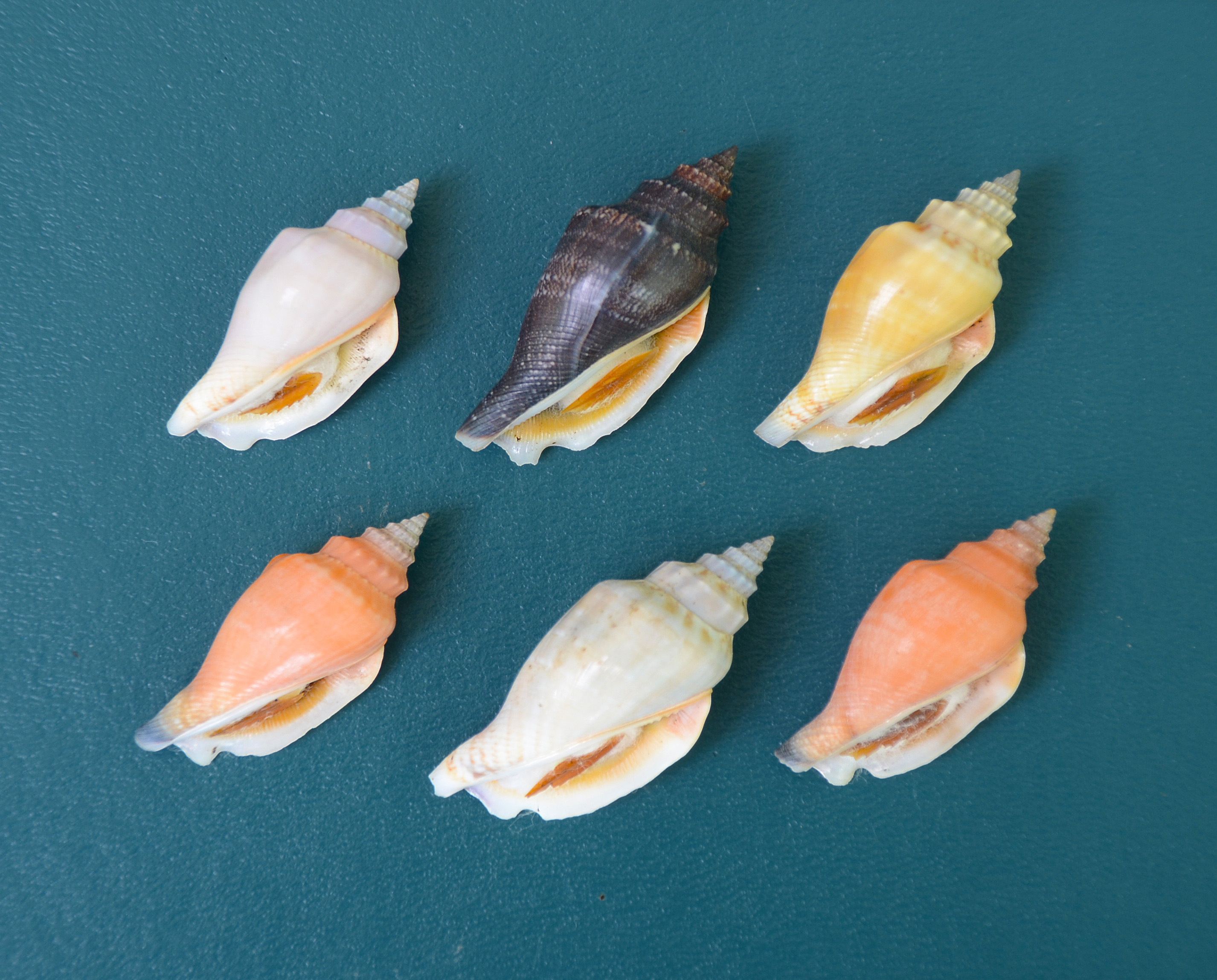
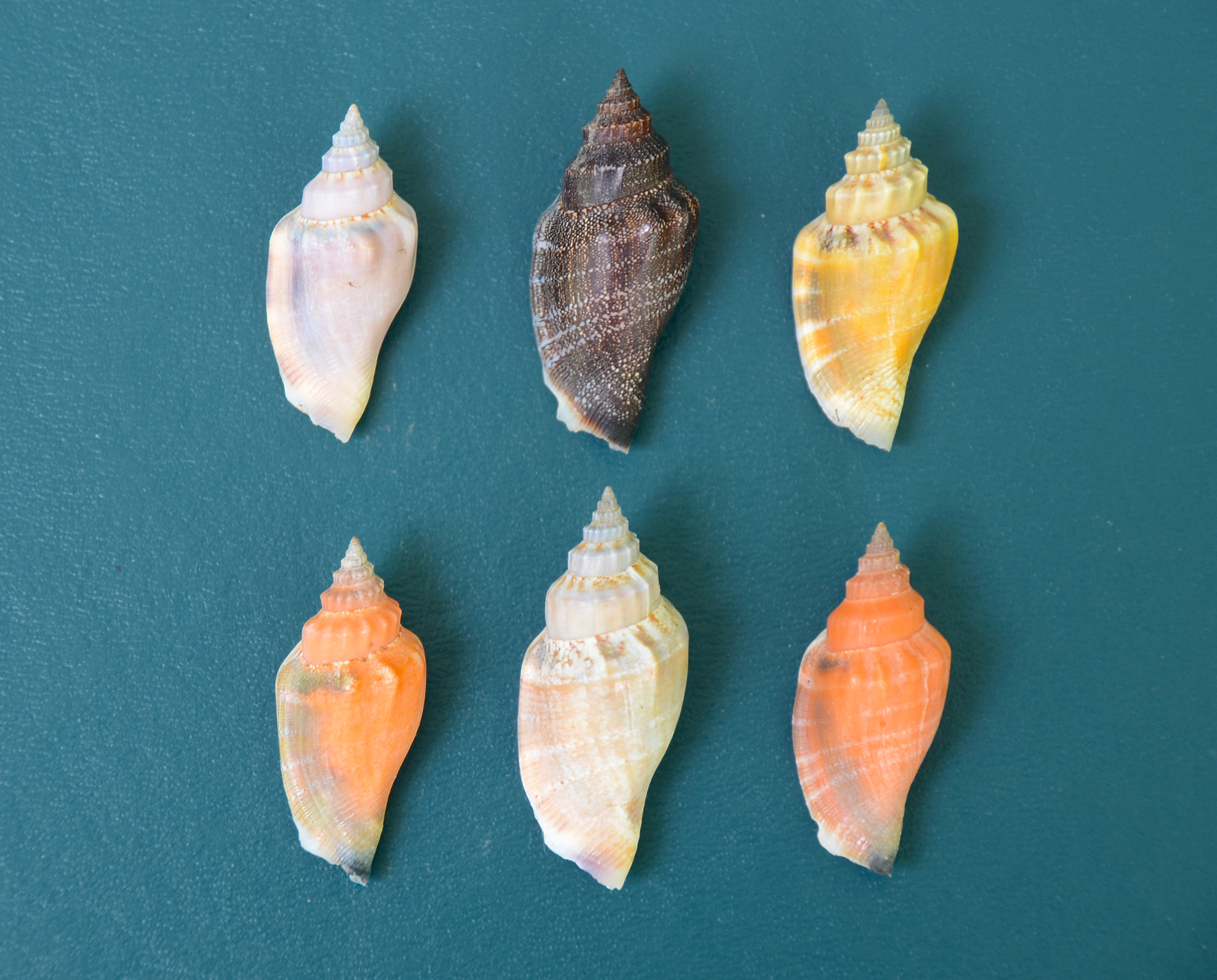
Strombus (canarium) urceus Linnaeus, 1758
colorful set of 6 with operculums
netted in sand/sea grasses at 20 meters by local fishermen
off Negros Island, Central Philippines. March 2012

With some shells if you have seen one, you’ve seen them all. Not so with the little bear conch (Canarium urceus Linnaeus, 1758). It has exceptional variety with every element of the shell variable – and that is what makes it so much fun to collect! These six specimens collected from off of the coast of Negros Island in the Philippines represent only a small sampling of this diverse shell. Just about everything is variable with Canarium urceus – size, shape, body color and pattern, color of aperture, color of lip, depth of stromboid notch, number and size of shoulder nodules, etc. Probably the most common color forms are fawn with white striations or whitish with fawn blotches, however in the market place the pretty pastel colors are seen most, for the obvious reason – they bring the best prices! Black and deep brown are also choice.

Canarium urceus is widespread and common throughout the Pacific Ocean, living in colonies and as typical of all Strombus, found among the sea grasses in moderately shallow water.

The winner will have a nice starter set of little bear conchs. With little difficulty one can assemble a collection of about two dozen different shells. To get a fuller idea of just how variable this shell is, check out this website:

http://www.stromboidea.de/?n=Species.CanariumUrceus

You might be amazed!

Set of shells donated by Richard Kent.


SHELL OF THE MONTH – MAY 2014

Cypraea_vitellus_002Cypraea vitellus (Linne 1758)

Also known as the Pacific Deer Cowrie, these specimens were collected by Jean Redding and graciously donated by Emmett and James Redding.

Common in Fiji July 1978 – on Rat Tail Reef, Suva, Cowry Patch, Suva; Runway Beach and Sand Bank, Malololailai. The largest ones came from Sand Bank.

Our thanks to Patty Jenkins, Patty Springborn, Carole Marshall and Steve Braska for their donations to the Raffle Table at the April meeting.


SHELL OF THE MONTH – APRIL 2014

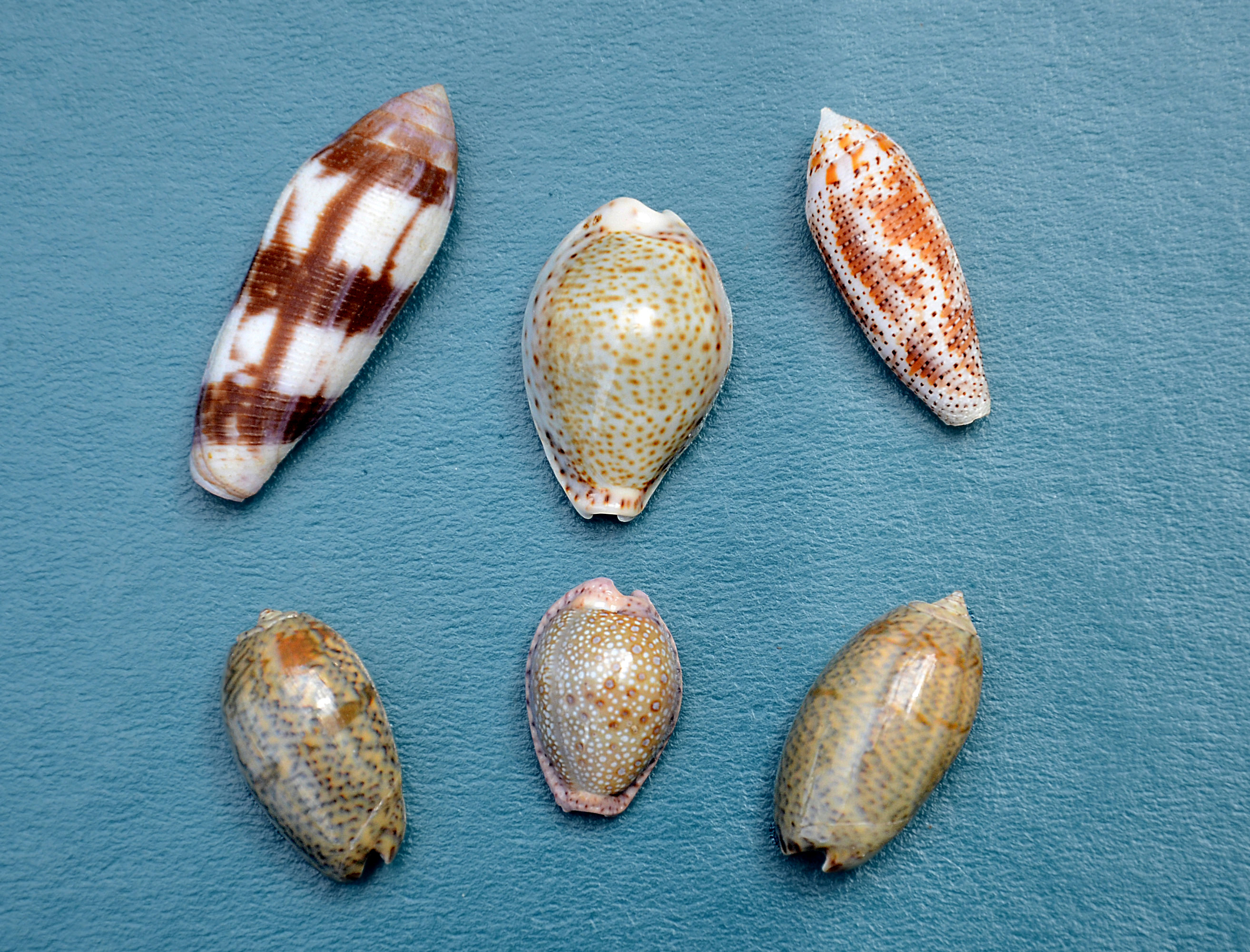
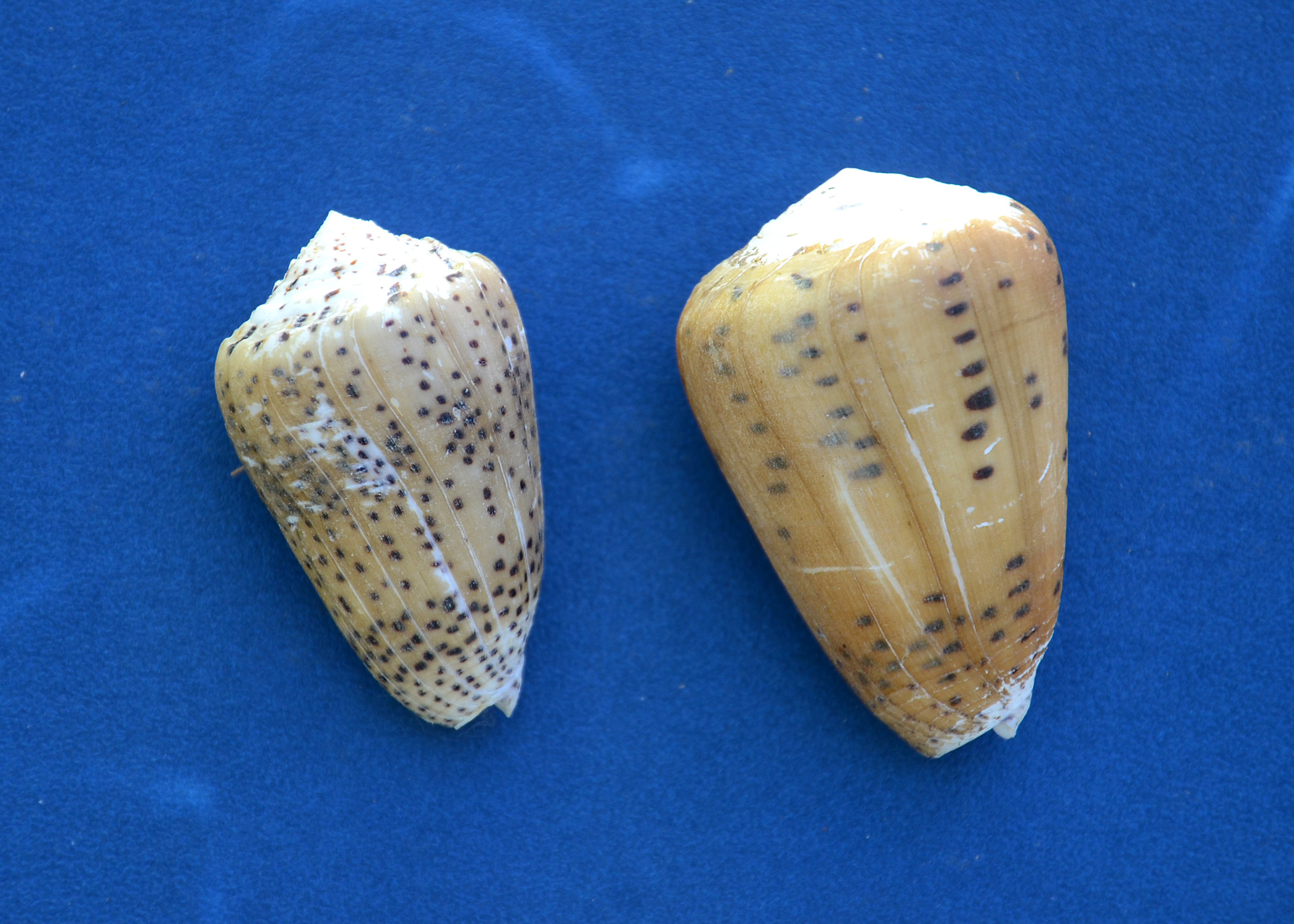
DSC_1731Conus violaceus Gmelin, 1791
Conus nussatella Linnaeus, 1758
Cypraea marginalis Dillwyn, 1817
Cypraea turdus Lamarck, 1810
Oliva bulbosa Röding, 1798

The Horn of Africa juts out from the continent where the Indian Ocean meets the Gulf of Aden. It is a strategic location as shipping from the Suez Canal passes through the Red Sea and the Gulf of Aden on its way to the open seas of the Indian Ocean. Four countries, Djibouti, Eritrea, Ethiopia, Somalia share the peninsula. Somalia is the former Italian Somaliland and British Somaliland. Since gaining independence in 1960 the country has been in near constant turmoil going from extremes as a socialist Soviet satellite and an Islamist nation. Several years back Somalia gained infamy as a heaven for pirates attacking shipping.

The coastal waters are rich in sea life. It is a great location for shells. A few Italian dealers monopolized the trade up until around 2010 when the pipeline dried up. I was fortunate to purchase a large amount shells from a dealer in Rome, both in retail and dealer lots. The shells presented here are from that source. These specimens have decent location data but not habitat as they were “netted by native fishing boats.” All were collected off the southern coast near the port of Merca (also spelled Marka).

Several of the shells warrant further mention. Conus violaceus is an Indian Ocean shell. It is scarce in all locations. Most specimens on the market come from Mozambique. All specimens have some spire erosion so this one is about as nice as they get.

The center of population for Cypraea marginalis is along the Indian Ocean coast of Somalia. It has been widely collected due to its attractiveness and variable pattern. Fresh specimens have an intense purple base which unfortunately fades rapidly. Even storage in darkness will not prevent fading. This is a choice specimen of good size.

Oliva bulbosa is widespread throughout the Indo-Pacific region and comes in more color forms than one could count. Most color varieties have their own individual names. These from Somalia, which came from a wholesale lot, all had a similar color, size and pattern which appears to be unique to the location.

As it is highly unlikely that in 2014 one would find fresh specimens offered from Somalia, winning this raffle makes for an exceptional addition to one’s collection.

– Richard Kent

SHELL OF THE MONTH – APRIL FOOL


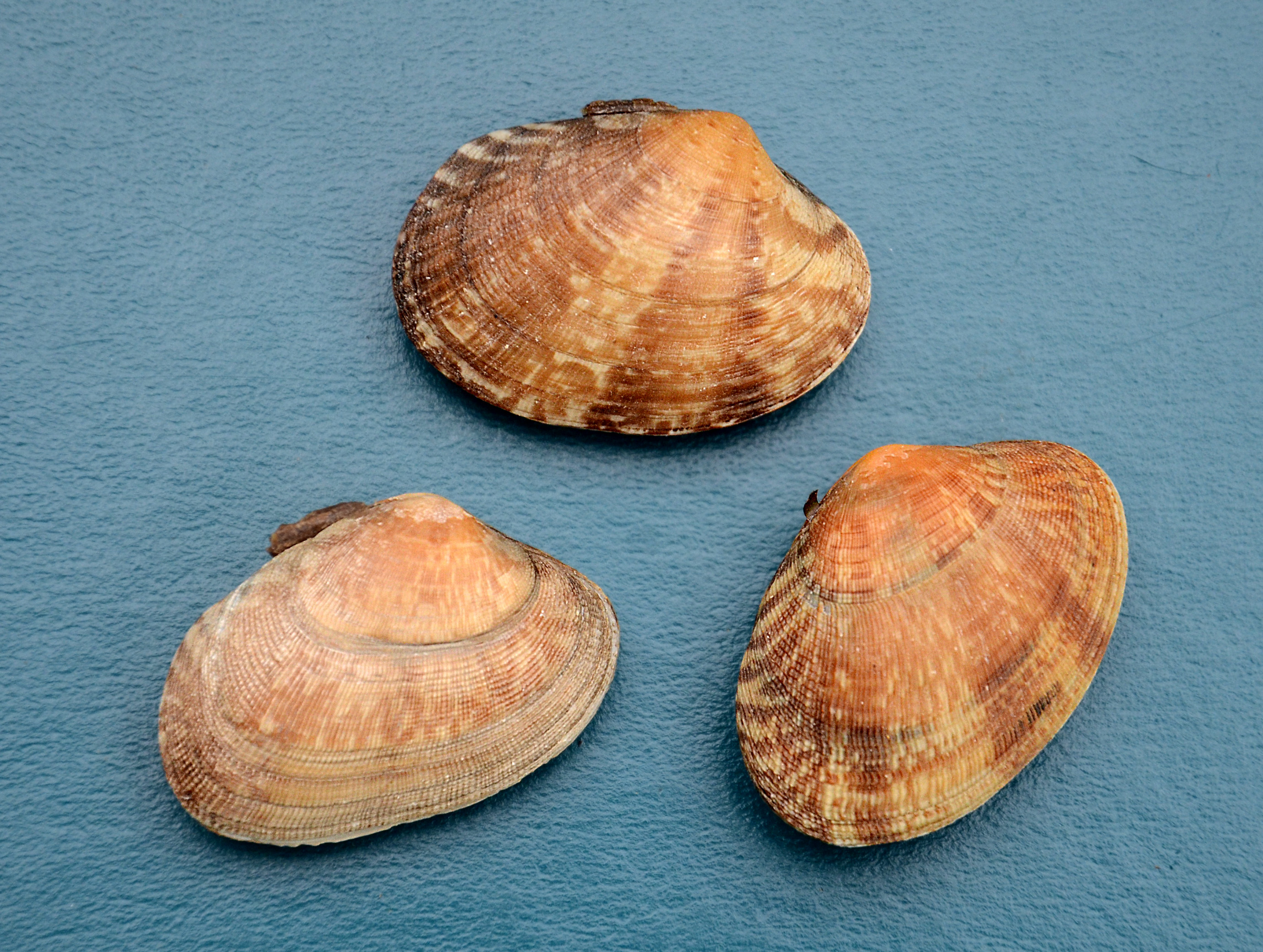
April Shell of the Month: Venerupis philippinarum (A. Adams & Reeve, 1850)
DSC_ManillaTo a cochologist, mollusks are collected for the beauty and variety of their shells. Certain mollusks are collected for their edibility and taste. Venerupis philippinarium, commonly known as the Manilla Clam, is a favorite of moon snails (Euspira lewisii), the Atlantic oyster drill (Urosalpinx cinerea), Dungeness crab (Metacarcinus magister), red rock crab (Cancer productus), bat rays (Mylobatus californicus), flounder, sturgeon, willet (Catoptrophorus semipalmatus), ring billed gulls (Larus delawarensis), raccoons (Procyon lotor) among others and last but most important human beings.
Although going by the moniker “Manila”, Venerupis philppinarum is not indigenous to the the Philippines. It is originally from China and was introduced to Manilia Bay where  it flourished. It has also been brought to the California Coast as a food source. It lives intertidal in bays and estuaries, prefers muddy or sand and mud bottoms where it borrows about one inch deep.
This bivalve is oval-elongate and sculptured with fine ribs, generally decorated with tent like patterns. It grows to about 2-3″. Shells collected in muddy areas are drab.
The Manila clam is typically steamed in its own liquor or white wine, garlic and butter, topped with fresh parsley and lemon wedge and often severed over pasta.
Our specimens were hand selected out of hundreds for their detailed pattern from the steam table at the Pharoah’s Buffet in the Luxor Hotel and Casino, Las Vegas, Nevada in 2013. They were savored before being saved. April fool! The actually shell of the month will be announced in a few days – you will like the set we have for you in April.


SHELL OF THE MONTH – JANUARY 2014

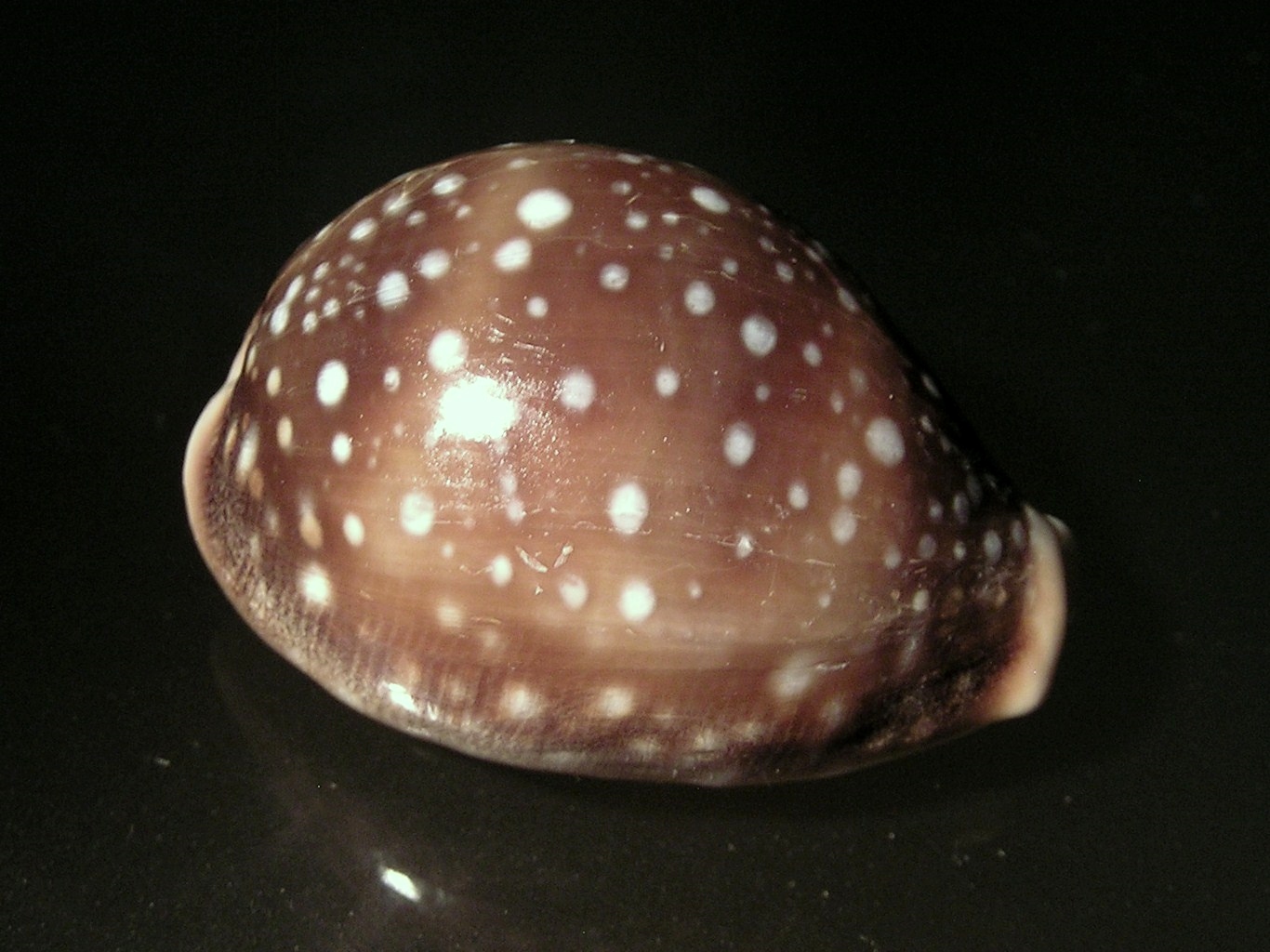
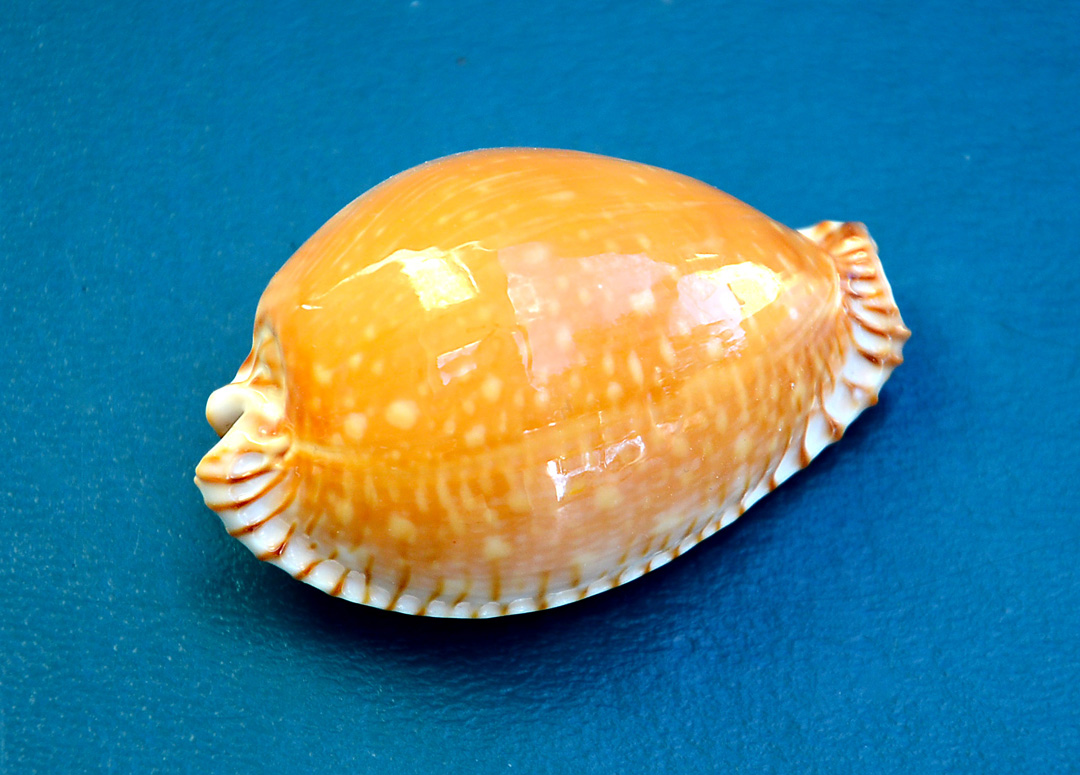
GuttataCypraea guttata azumai, Schilder 1960

Cypraea guttata, Gmelin 1791 is one of the most exquisite of all shells. Until recently it was also one of the rarest. When Burgess wrote his monumental book “The Living Cowries” in 1970, he stated that there were fewer than 20 known specimens. Today due to the Asian commercial fishing fleets trawling in deep water, specimens consistently come to the market. Cypraea guttata has an orange dorsum with white “drops”; The extremities are rostrate and spiny. The prominent teeth extend the width of the base and are deep brown stained contrasting to a white base.

   The variety Erosaria guttata azumai, which is presented here, was not known until Schilder described two dead collected specimens from off the coast of Japan  in 1960. Today specimens collected in the East and South China Seas are the ones most likely to be offered by dealers. Cypraea guttata guttata, Gmelin 1791, the Philippine variety and first described is the hardest to acquire. They grow to the largest size and these big specimens are incredibly striking (and super expensive too!)  Cypraea guttata surinensis, Raybaudi 1978  which comes from the Andaman Sea is the most vibrant with a richer color and almost black teeth. It also tends to bring the highest prices. Because most specimens come from commercial trawling, too many substandard and immature specimens reach the market. This specimen though is in gem condition, average in size, and exemplifies the reduced spotting that is typical of the azumai variety. It was trawled in 2008 at 200 meters deep off the coast of Zhejang Province near Ningbo City in the East China Sea. The shell  was purchased direct from China and donated by Richard Kent.