SHELL OF THE MONTH – NOVEMBER 2018

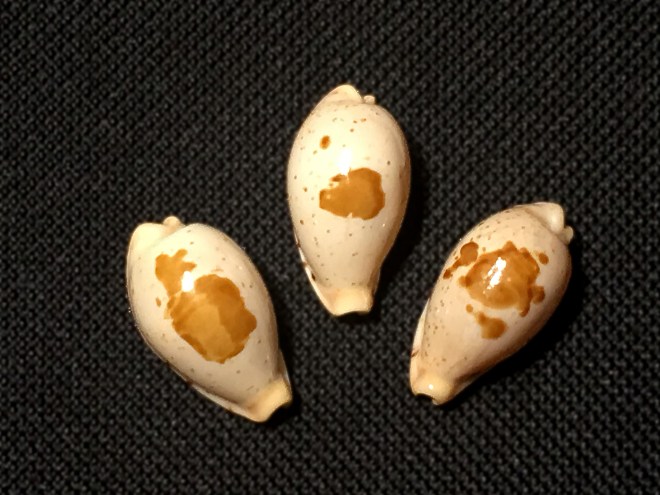
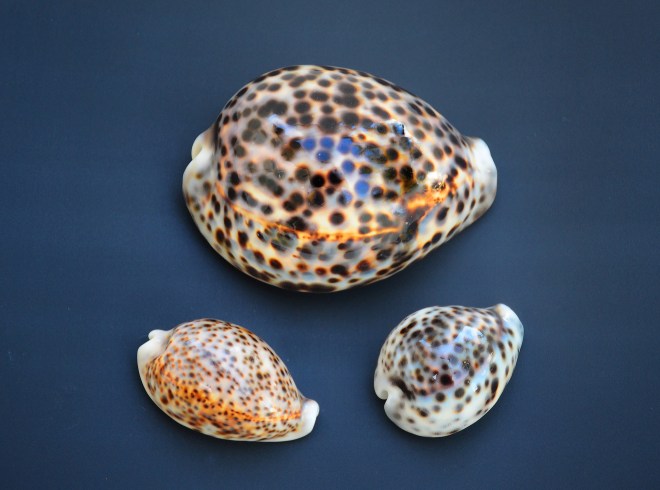
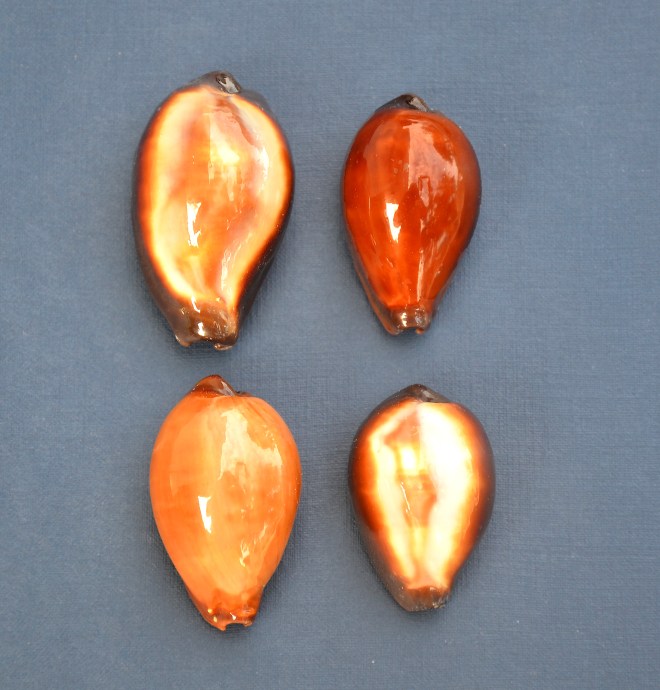
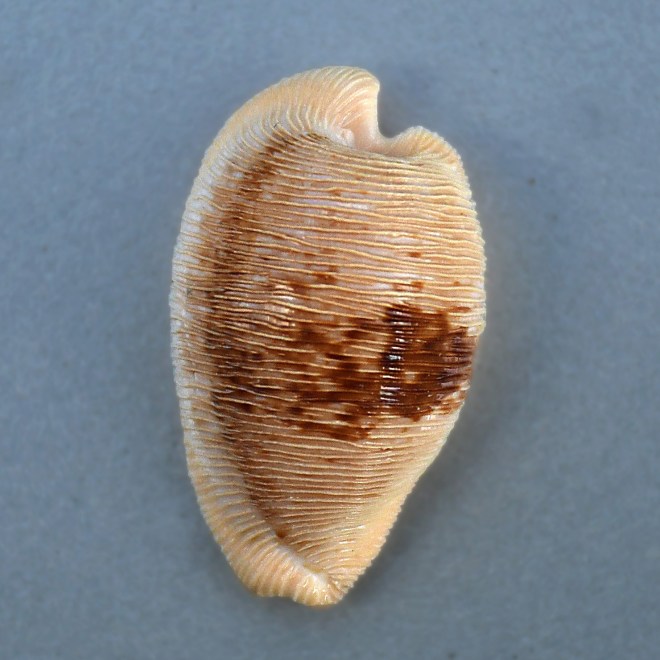
Cypraeaovula capensis capensis (Grey1828)
SCUBA at 10-12M on rock wall
Algoa Bay, Port Elizabeth, South Africa

The Atlantic and Indian Oceans meet the icy Antarctic waters below the coast of South Africa. In the sheltered bays a rich unique marine fauna has developed with an array of indigenous cyrpraea including a couple of oddballs that make shell collecting such a fascinating hobby.

Cypraea capensis is one such shell. It’s like no other. From a distance it looks likes a typical cowry, but on closer inspection one sees fins that originate in the aperture and completely cross over the base and dorsum encircling the shell and meeting the teeth on the opposite end. The shell is a pale uniform mushroom color with an irregular brown blotch and has a discernible mantle line. The dorsum is glossy. There is little variation in color and pattern from shell to shell. Even the blotch is fairly consistent.

Capsnsis lives on rocks in both moderate and deep water with deep water specimens bringing vastly higher prices. There are a few named varieties.

Before the popularity of SCUBA, virtually all specimens were dead collected on the beach. As the diving season is rather short, few capensis come to the market each year, making it a difficult shell to obtain.

Our specimen is of good size, 30mm and should be considered gem. Similar shells bring about $40 on the market. It was originally purchased in a small dealer’s lot from a South African diver/collector and is from the collection of Richard Kent. This is an intriguing shell to look at; one can spend much time studying its appearance.
SHELL OF THE MONTH – OCTOBER 2018

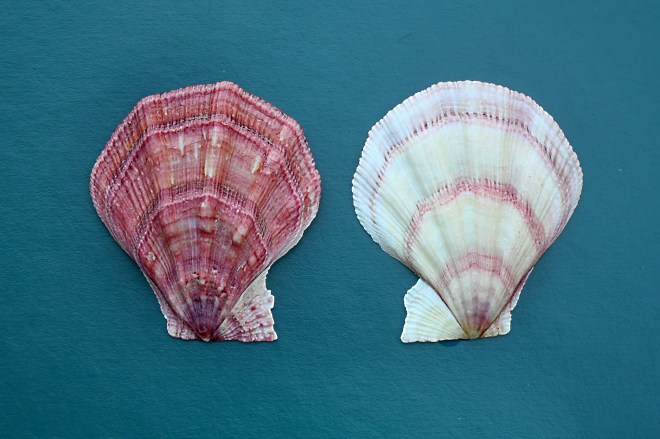
Swiftopecten swiftii (Bernardi, 1858)
trawled at 60m fishing fleet
Sapporo, Japan

Pectens, scallops as they are commonly known, are the most collected bivalve. Pectinidae is an extremely large family that are worldwide in distribution and are found in tropical, temperate and even arctic seas.

They are most interesting to observe when alive as they jet propel themselves across the ocean floor. They make a very popular meal and are a standard item at seafood restaurants.

There are about 500 different recent species. They all have two valves with an almost round outline, with radiating ribs and two ears on each side of the shell. Pectens are fascinating to collect because of the wide variety of colors and patterns found in many species.

Swiftopecten swiftii (Bernardi, 1858) is a large solid shell growing up to 4” in size. They are easy to distinguish from all other pecten due to their elongated triangular shape and unique sculpture. (Most all pecten are roundish). They grow in spurts as can be clearly seen in the photo. At the conclusion of each growth cycle the shell forms knobs, as does Florida’s Nodipecten nodosus (Linnaeus, 1758).

This specimen is the typical purplish color. Rare specimens are yellow, pink, albino and even maroon! One side is always colored and the other whitish. A color set is extremely difficult and expensive to obtain. Seeing one is quite impressive!

Swiftopecten swiftii (Bernardi, 1858) has a limited range from the north of Japan to the Russian mainland. This Japanese specimen is donated from the collection of Richard Kent. For those who collect scallop shells, swifti is a must.

SHELL OF THE MONTH – SEPTEMBER 2018


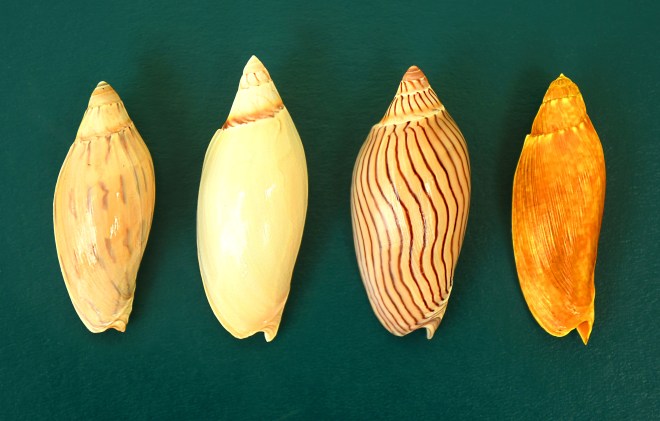
Four Australian Volutes

Australia is known for its outstanding indigenous fauna, both on land and under the sea. Due to its isolation, species evolved independently from the rest of the Pacific basin.

Australian cypraea are famous for their uniqueness, variation and for many specie, exorbitant prices. The volutes too offer a very wide variety and fortunately for the collector, many are moderately priced, although none are cheap.

We have four volutes on the raffle table this month and they come from opposite ends of the Australian continent. The two from Western Australia were obtained from a Singapore dealer while the two from Queensland from an Australian diver and collector.

A fascinating thing about shell collecting in Australia is that every five hundred or so miles different species will be found. Yes, most species have an extremely limited range, with a very few extending across the region. Western Australia has extreme tides and it is possible to walk great distances from the shore at low tide, making collecting an easy task, however one has to be quite aware of the incoming tide! Many varieties of volutes can be found inhabiting the sand flats.

Amoria are very attractive shells, glossy with a pleasing shape and a wide range of patterns. In life, the mollusk has a large foot, the top of which is often very colorful. Amoria is a small genus with less than 20 members, all restricted to Australia. The three included here are representative of the genus.

Volutoconus has an extremely small family of only four. Volutoconus grossi, is not so attractive, its shape slightly distorted and to the eye the proportions don’t seem quite right. Although it is not a rare shell it is seldom seem.

All four specimens, while gem in quality, are on the smaller size. Each year large specimens become more and more difficult and more expensive to obtain.
Donated by Richard Kent

left to right
Amoria maculata Swainson, 1822
by diver in rubble 10-20m
Bunker Islands, Queensland, Australia

Amoria grayi Ludbrook, 1953
extreme low tide on sand flat
Broome, West Australia

Amoria ellioti G. B. Sowerby II, 1864
Sandbar at low tide
Port Hedland, West Australia

Volutoconus grossi Iredale, 1927
trawled, fishing boats
Keppel Bay, Queensland, Australia

SHELL OF THE MONTH – AUGUST 2018

Cypraea saulae Gaskoin, 1843
under rock and coral by local divers at 10 meters
Balicasag Island, Bohol, Philippines

Miss Jane Saul was a famous British shell collector who was born in 1807 and lived to be 98 years old. In 1843 J. S. Gaskoin named this lovely little cowry after her. There does not appear to be a record of their relationship, if any.

Cypraea saulae is a collector favorite, scarce and not that easy to obtain. Most specimens come from the Philippines although the occasional few are found in Indonesia, New Guinea and off the north coast of Australia.

The shell is pyriform in shape, about an inch in size, cream in color on the dorsum with a white base. The dorsum has pale brown freckles and a blotch in the center of the dorsum. Often there are additional blotches that flank the main blotch. In rare instances there is no blotch at all. The margins are finely spotted. In some populations the intercises between the teeth are yellow, in others, white. Several varieties have been named but none are recognized today.

Cypaea saulae lives under coral slabs and rock, in shallow water and at depths up to 150 meters.

Three gem specimens are offered in this raffle to give collectors a sample of the never ending variety of patterns on this attractive little cowry. Donated by Richard Kent

SHELL OF THE MONTH – JULY 2018

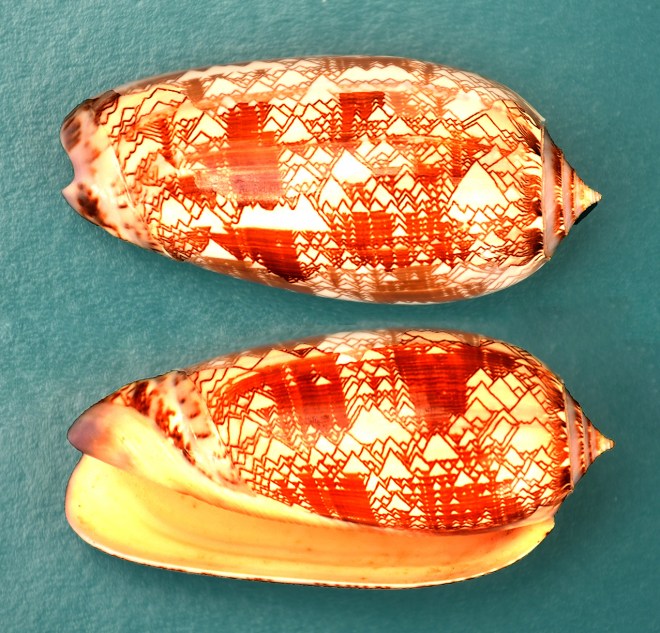
Oliva porphyria (Linnaeus, 1758) Diver at night on sand at 80-90 feet near Loreto, Baja Sur, Mexico, 2005

Oliva porphyria Linne, 1758 is the king of the olive family. It grows to the largest size and is stately in shape and pattern. Although not rare it is dif cult to obtain as it lives in deeper water far away from the shore line. Beach specimens are rare to nd. Most specimens come from off the coast of Mexico though its range goes south beyond Panama. The common name is the Tent Olive. When looking at the pattern one can see whole cities of tents or maybe the tents might appear to be mountain tops. The shell is two tone cream and chestnut brown although freshly collected specimens have a purple tinge to the base. The Tent Olive is incredibly consistent in color with virtually no variation. The tented pattern does vary but not to any great extent. It grows up to 5.5″ in size but 3.5-4″ is the common size. The price skyrockets for the larger shells from $80 to over $200 or more for a 5″ specimen. Our specimen is slightly over 3.5″ and is close to gem. At that size it would fetch at least $40 retail making it a valuable addition to any collection. Donated by Richard Kent.

SHELL OF THE MONTH – JUNE 2018

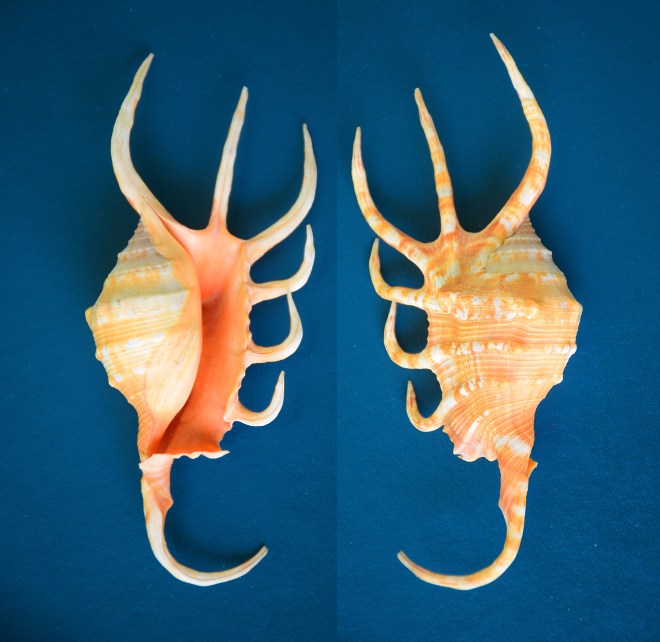
Lambis crocata (Link, 1807)
in sea grasses 15-20 meters
Kinbu Bay, Okinawa, Japan

The Spider Conchs are a small genus in the Strombidae family all of which inhabit the tropical seas of the Indo-Pacific region. The genus – Lambis – originally had the exotic name of Pterocera, so today Pterocera crocata Link, 1807 is now Lambis crocata Link, 1807.
An interesting feature of this genus is that the species have different numbers of fingers or arms or whatever one chooses to call the appendages that distinguish the spider conchs from the true conchs
Lambis crocata has the common name of Orange Spider Conch although the shell is rarely orange in color; the common color being tan or beige, but they do have an orange or peach colored aperture.
Lambis crocata has long, curved and delicate appendages making it one of the most attractive species of the genus. It is quite different from the large and heavy chunky, bland Lambis truncata Lightfoot, 1786 that has little interest to most collectors. There is a rare and expensive subspecies named Lambis crocata pilsbryi Abbott, 1961that has exceptionally long arms and is spectacular in appearance.
Most of the spider conchs are common, crocata being scarce, however the beautiful and prized Lambis violacea Swainson, 1821 is quite rare and very costly making it near impossible to collect the the complete genus.
Our specimen is very attractive, orangish is color with an intricate pattern on the dorsum and long graceful fingers. It is close to gem in quality, collected from a desirable location. Donated from the collection of Richard Kent.

SHELL OF THE MONTH – MAY 2018


It’s a wonder of nature how a simple snail can create such a masterpiece of a house for itself. The spirals of the Sundial shells, family Architechonicidae, are always perfect. Architechonicidae is a small family with members in topical seas around the world. There are only three, possibly four species that attain a size of over 2 inches, however there are numerous species that are quite small and rarely collected.
The Sundials are all very similar in appearance. It is not easy to tell them apart. Architectonica perspectiva (Linnaeus, 1758) is the most common Indo-Pacific Sundial. Adult specimens are normally about an inch and a half. Smaller ones were often collected and sold in bulk for the craft market, but nowadays these are not so easy to come by. We have two specimens, the smaller is typical and the two and a quarter inch one a prize catch from Thailand.
Architectonica maxima (Philippi, 1849) is the largest of the Sundials growing to a maximum of three inches. Occasionally one that big is collected in Viet-Nam. This specimen is about as big as one is likely to encounter.
The most obvious differences in the two specie is, one: A solid line in perspectiva that encircles the shell as opposed to to the mottled line in maxima, though as the shell grows in size the line will break up and, two: The more intense colors of perspectiva. There are other differences such as the spacing of groves, nodulues, and color pattern. Examine closely with a magnifying glass and one will see they are quite different.
In the Caribbean we have the Common Sundial, Architectonica nobilis (Roding, 1789,) which is anything but common recently. It also will grow to over two inches. Additionaly as in the Pacific there are numerous small species.
Donated from the collection of Richard Kent

Architectonica perspectiva (Linnaeus, 1758)
by diver on sandy bottom 15-20m depth
off Phuket Island, Andamen Sea, Thailand

Architectonica perspectiva (Linnaeus, 1758)
netted by fishermen, 10m,
grass and sandy bottom
Manila Bay, Phillipines

Architectonica maxima (Philippi, 1849)
netted by local fishermen
Nago Bay, Okinawa, Japan

SHELL OF THE MONTH – APRIL 2018

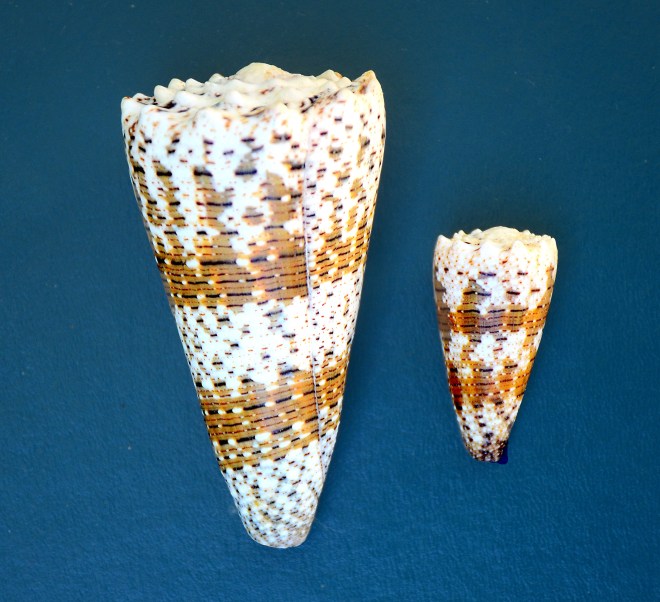
The Imperial Cone, Conus imperialis Linnaeus 1758, is a most majestic shell. With its classic “ice cream cone” shape and white crown, large size and striking colors it is one of the most popular members of the family. Although it is fairly common and widespread across the Indo-Pacific, high quality specimens are not that easy to find.
Conus imperialis reaches an adult size of about three inches. The base color is creamy white. Typical specimens have two broken golden bands that encircle the shell. Long and short brown and black dashes plus white dots overlay the entire shell. The shell has a low gloss, the spire always suffers from erosion. This specimen has a perfectly straight grown line that runs top to bottom. This is normal with shells that grown in spurts, then rest up before growing again. The lip is smooth and natural. At 3.5″ tall it is large, quite large in today’s market as shells don’t seem to grown like they used to.
The small specimen is half the size of the big one. It’s rare to find one of this size.
Specimens from off the coast of Africa are smaller and tend to have the golden bands replaced by irregular axial blotches. They are ofter tan rather than gold and the base color could be grayish. They were given the name of Conus fuscatus Born 1778.
The vast majority of Imperial Cones come from the Philippines so the winner is quite fortunate to own a Hawaiian specimen. These two are donated from the collection of Richard Kent.

SHELL OF THE MONTH – FEBRUARY 2018

Cypraea tigris Linn, 1758
on rocks in shallow water
Nha Trang, Vietnam 2015

Cypraea tigris Linn, 1758
on reef inside lagoon,1-2m
Dehpek Island
Pohnpei, Micronesia 2009

Cypraea pantherina Solander, 1786
Bahlak Archipelago, Eritrea
in the Red Sea off
Masawa, Ethiopia 2012

What was Carl Linnaeus thinking in 1758 when he named a spotted shell after a tiger? A large and beautiful cowrie, Cypraea tigris often is the first and always a must have in every shell collection. Once abundant, it is now scarce and in many locations endangered. Not only has it been over collected for the specimen and shell craft markets, but it is edible and a local delicacy.
Cypraea pantherina is its very close sibling. Although the patterns and colors are almost identical the two are easy to distinguish by size and shape. Panthers, are elongate and never reach the size of Tigers plus the average size is considerably smaller. Cypreae tigris is widespread in coral reefs throughout the Indo-Pacific region while Cypraes pantherina is restricted to the Red Sea.
Our February specimens are desirable to both the beginning and advanced collector. To the beginner it illustrates the size variation of adults from extra large to dwarf specimens of Cypraea tigris, while comparing the Tiger to the Panther teaches how to distinguish the difference between closely related specie. For the advanced collector, the locations are very desirable, especially the dwarf from Micronesia, a remote island whose shells virtually never reach our market. How often does one see shells form Ethiopia? These specimens are very attractive with dorsal colors that are out of the ordinary.
Old time collectors will be shocked at the prices these specimens now command. Philippine Tgers however are still among the cheaper specimen shells, for now anyway!
Donated from the collection of Richard Kent.

SHELL OF THE MONTH – JANUARY 2018

m the clockwise from top left

Erronea onyx Linnaeus, 1758
trawled in deep water
fishing fleet
Zhanjiang, China

Erronea adusta Lamarck, 1810
under rocks on exposed reef
Nacala Bay, Mozambique

Erronea onyx Linnaeus, 1758
by diver 3-5meter on reef
Masbate, Philippines

Erronea succincta Linnaeus, 1758
By locals at extreme low tides
mud flats
Tamilnadu, India

The Onyx Cowry (Erronea onyx Linnaeus, 1758) is stunning with its rich dark color and pastel blue and white window and mantle line on the dorsum. It is one of the most attractive of all Cypraea. The close relatives, the Dark Onyx (Erronea adusta Lamarck, 1810) and the Tanned Cowry (Erronea succincta Linnaeus, 1758) are also quite attractive, especially extremely dark solid mahogany colored specimens that are found in Zanzibar. There are several named varieties including a rare near albino one called Cypraea onyx nymphae Jay, 1850. All of these are variable making them fun to collect. Dwarfs and giants are exciting to locate.
Over the course of time there has been much debate over the nomenclature and validity of each name and the relationship of one to the other. It appears that Erronea succincta Linnaeus, 1758 is now unaccepted though collectors and dealers will continue to use the name.
Besides the differences in color and pattern, each has a distinct locality. Onyx is from the Pacific Ocean though some are found in deep water in the South China Sea. Succincta is found from Thailand across the Indian Ocean to the Middle East. Adusta comes from the coast of Africa and Madagascar.
Erronea onyx is the most readily available to collectors with the vast majority coming from the Philippines. The large heavy deep water specimen in this lot is from China and is rarely seen on the market, making it a great score for the winner of the auction.
Donated from the collection of Richard Kent