April Program

With NOAA Okeanos Explorer to the Deep Gulf of Mexico
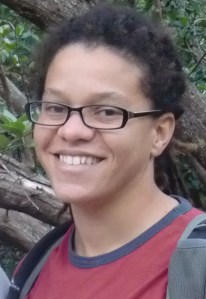
Charles G Messing, Ph.D., Nova Southeastern University

From 29 November to 21 December 2017, Professor Messing accompanied NOAA’s research vessel Okeanos Explorer to use the Remotely Operated Vehicle (ROV) Deep Discoverer to explore deep-sea habitats and associated marine life in the Gulf of Mexico. The 17 ROV dives ranged from depths of 300 to 2,321 m and investigated deep-sea coral and sponge communities, bottom-fish habitats, canyons, shipwrecks, and chemosynthetic habitats such as methane seeps, asphalt seeps and brine pools. Operation goals included surveys of areas identified by the Gulf of Mexico Fishery Management Council and Flower Garden Banks National Marine Sanctuary for baseline data to inform conservation priorities and possible expansion of managed areas. The expedition observed hundreds of different species of invertebrates and fishes, from carnivorous sponges to chimaeras, some never or rarely observed in their natural habitat, and collected dozens of specimens, including a few species new to science. Scientists from around the world participated via telephone or chatroom, and the video feed from the ROV on the seafloor, accompanied by Charles’ and colleagues’ narration, was transmitted live via the Internet and viewed by over a quarter of a million people.

Dr. Charles G. Messing is Professor of Marine Science at Nova Southeastern University. His research centers on the evolution, taxonomy and ecology of living crinoids (sea lilies and featherstars) and on the ecology of deep-sea coral communities and rocky-substrate habitats. He has also been involved in assessment of both shallow and deep-water habitats for fuel pipelines, fiber-optic cables, artificial reefs, and beach renourishment. Charles has led 14 deep-sea submersible expeditions funded by NSF and NOAA, and led or participated in over 30 other research and educational expeditions as far afield as Papua New Guinea and the Bahamas. He has written or co-authored 61 peer-reviewed scientific journal articles and has 47 years’ experience as a scientific illustrator. Currently, he is also a Research Associate at the Smithsonian Institution and at Scripps Institute of Oceanography and has been a repeated Visiting Scientist at the Muséum national d’Histoire naturelle, Paris. He has also written or hosted several science educational television programs. More at http://charles-messing.squarespace.com/

Charles G. Messing, Ph.D.
Professor
Department of Marine and Environmental Sciences
Halmos College of Natural Sciences and Oceanography
Nova Southeastern University
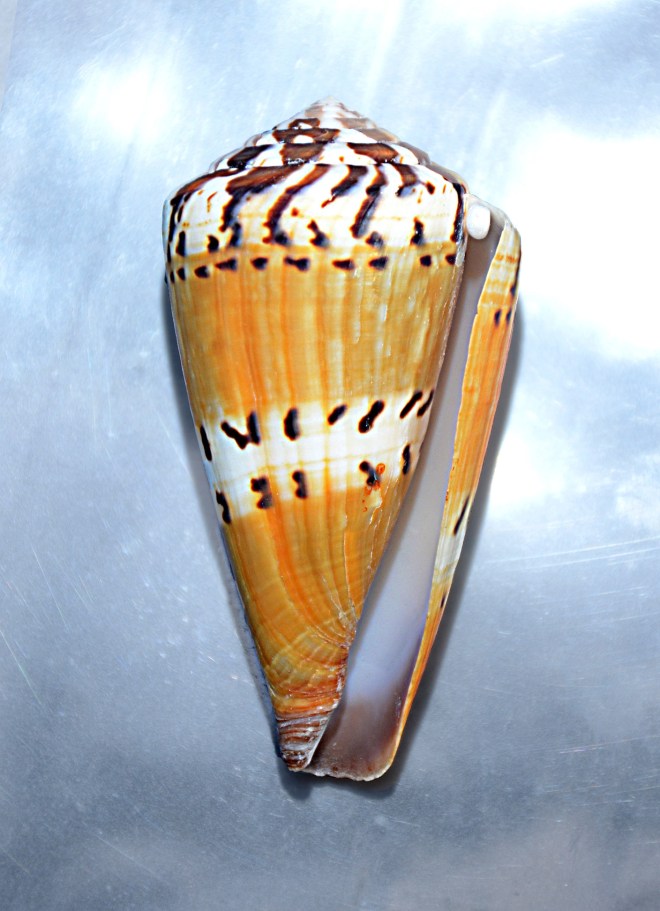
SHELL OF THE MONTH – APRIL 2018

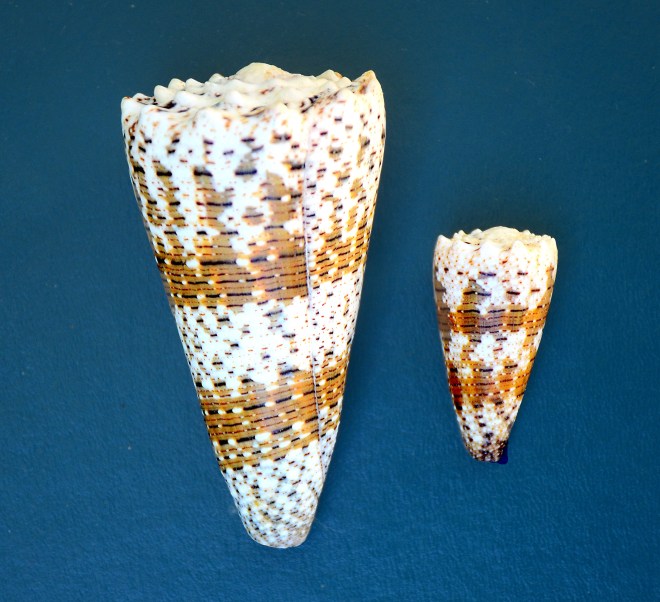
The Imperial Cone, Conus imperialis Linnaeus 1758, is a most majestic shell. With its classic “ice cream cone” shape and white crown, large size and striking colors it is one of the most popular members of the family. Although it is fairly common and widespread across the Indo-Pacific, high quality specimens are not that easy to find.
Conus imperialis reaches an adult size of about three inches. The base color is creamy white. Typical specimens have two broken golden bands that encircle the shell. Long and short brown and black dashes plus white dots overlay the entire shell. The shell has a low gloss, the spire always suffers from erosion. This specimen has a perfectly straight grown line that runs top to bottom. This is normal with shells that grown in spurts, then rest up before growing again. The lip is smooth and natural. At 3.5″ tall it is large, quite large in today’s market as shells don’t seem to grown like they used to.
The small specimen is half the size of the big one. It’s rare to find one of this size.
Specimens from off the coast of Africa are smaller and tend to have the golden bands replaced by irregular axial blotches. They are ofter tan rather than gold and the base color could be grayish. They were given the name of Conus fuscatus Born 1778.
The vast majority of Imperial Cones come from the Philippines so the winner is quite fortunate to own a Hawaiian specimen. These two are donated from the collection of Richard Kent.

BOOK REVIEW – Cowries by Felix Lorenz

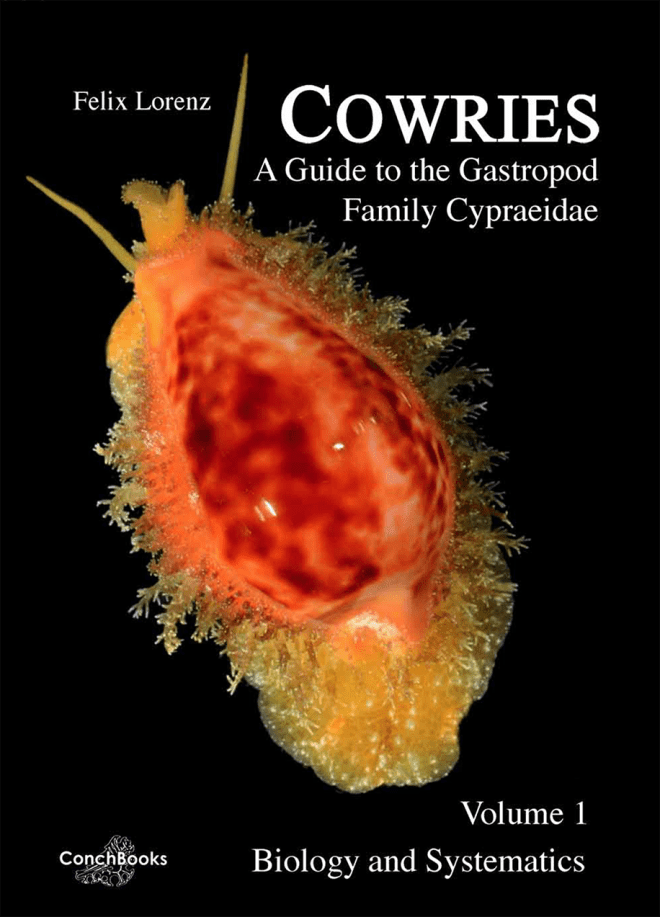
Cowries, A Guide to the Gastropod Family Cypraeidae” by Felix Lorenz

Book Reviewed by Richard Kent

Finally the highly anticipated sequel to “The Guide to Worldwide Cowries” by Lorenz and Hubert has been published. There is both good and bad news about the new book. We need to point out that “Cowries, A Guide to the Gastropod Family Cypraeidae” by Felix Lorenz and published by Conch Books is split into two volumes. At this time only Volume 1 is available.

First the good news. Everything one could possibly want to know about Cowries, live and extinct, is thoroughly discussed. This is the de nitive book on the subject.

The bad news. It’s 644 pages of exhaustive text is intended for the advanced collector. Photographs are minimal; Volume 2 will be the photo book. The price is a whopping $199 retail. The way the volumes are split up, readers will need to purchase both.

The rst 181 pages cover in seven chapters: Cowries and Man, Animal Morphology, Reproduction and Development, The Adult Shell, Habitat and Distribution, DNA, and Cowrie Evolution. It’s fascinating and essential reading that one needs to make the most out the second half of the book.

The balance of the book is a systematic Cowrie
Identification Guide, updating the original “Guide” to the present with numerous new subspecies and species. Collectors will especially get new insight on South African and Australian Cowries. Every species is given scientic name, synonyms, cited references, size range, habitat, distribution and a discussion. The descriptions are concise, cut and dry. One misses the air that Wells had in his book on Cones. There are also comparison charts and maps. Lorenz illustrates each species and subspecies with a photo of the dorsum and base of a typical specimen. All are shown the same size so the minute Cypraea microdon is illustrated at an identical size as Cypraea tigris. Even though all are shown the same size, the length of the discussion for each species varies greatly. It is obvious Lorenz has his favorites! He chooses to devote much space to discussions on nomenclature and DNA. Lorenz is what is known as a “splitter” (as opposed to “lumper”) and has introduced dozens of new names himself. At times the detail in these discussions can be overwhelming, even to an advanced collector.

Collectors could nd much that is controversial and open to debate. One of several instances that stood out to me is that according to Lorenz, Cypraea tigris tigris is an Indian Ocean cowrie whereas Cypraea tigris pardalis is the Philippine variety, but he fails to cite the original descriptions and type specimens to back this up. Having dealt with shell dealers for years, pardalis is an all white tiger with minimal black spotting and no dorsal line, just like the one illustrated in the groundbreaking Burgess book. It would be interesting to see that if one dozen tigers from various populations in the Indian Ocean were mixed with one dozen from the Paci c if any expert could correctly separate them. Lorenz says they have different DNA.

I read the book cover to cover taking a full week. Because I am an advanced collector I nd the book essential. It greatly added to my understanding and enjoyment of the hobby. I can’t wait for volume 2 with all the photos to be published.

A word to Mr. Lorenz – take only the information that is essential to the beginning and casual collectors and publish a condensed, concise photo guide. The hobby needs such a book. It will be a best seller!

SANIBEL FIELD TRIP

It is time for our annual trip to the Sanibel Shell Show! The date we plan on going is Saturday, March 3rd. More details will be available in the upcoming February issue of the “Busycon”. But what I need from you right now is to have you give me a “yea” or “nay” as to the club renting a full size bus. We need about 50 to keep the cost at about $25 per person. The trip is a one day event where we will take in the show, have a great lunch at the Island Cow and either stop at a shell shop or a location off island to do some shelling. With the large bus that will be the option for collecting as all shelling locations on Sanibel cannot accommodate large vehicles. However, I am planning the trip to Marco Island in early May where we will be taken to either Tice Island or Keewayden / North End of Tiger Tail Beach All these locations are only accessible by charter boat. That way we can all get our shelling “fix” then!

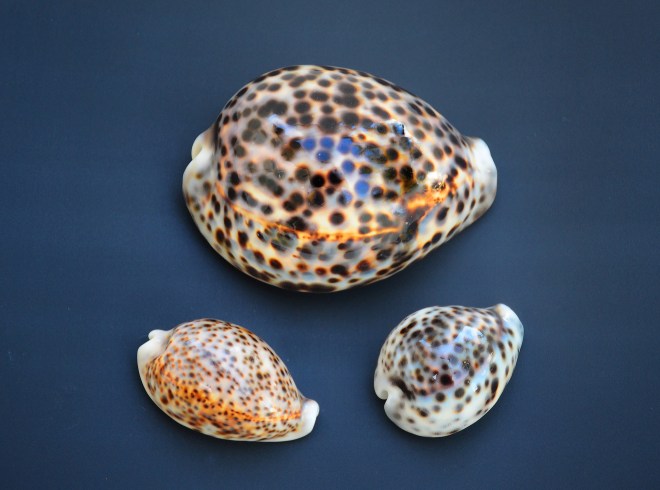
SHELL OF THE MONTH – FEBRUARY 2018

Cypraea tigris Linn, 1758
on rocks in shallow water
Nha Trang, Vietnam 2015

Cypraea tigris Linn, 1758
on reef inside lagoon,1-2m
Dehpek Island
Pohnpei, Micronesia 2009

Cypraea pantherina Solander, 1786
Bahlak Archipelago, Eritrea
in the Red Sea off
Masawa, Ethiopia 2012

What was Carl Linnaeus thinking in 1758 when he named a spotted shell after a tiger? A large and beautiful cowrie, Cypraea tigris often is the first and always a must have in every shell collection. Once abundant, it is now scarce and in many locations endangered. Not only has it been over collected for the specimen and shell craft markets, but it is edible and a local delicacy.
Cypraea pantherina is its very close sibling. Although the patterns and colors are almost identical the two are easy to distinguish by size and shape. Panthers, are elongate and never reach the size of Tigers plus the average size is considerably smaller. Cypreae tigris is widespread in coral reefs throughout the Indo-Pacific region while Cypraes pantherina is restricted to the Red Sea.
Our February specimens are desirable to both the beginning and advanced collector. To the beginner it illustrates the size variation of adults from extra large to dwarf specimens of Cypraea tigris, while comparing the Tiger to the Panther teaches how to distinguish the difference between closely related specie. For the advanced collector, the locations are very desirable, especially the dwarf from Micronesia, a remote island whose shells virtually never reach our market. How often does one see shells form Ethiopia? These specimens are very attractive with dorsal colors that are out of the ordinary.
Old time collectors will be shocked at the prices these specimens now command. Philippine Tgers however are still among the cheaper specimen shells, for now anyway!
Donated from the collection of Richard Kent.

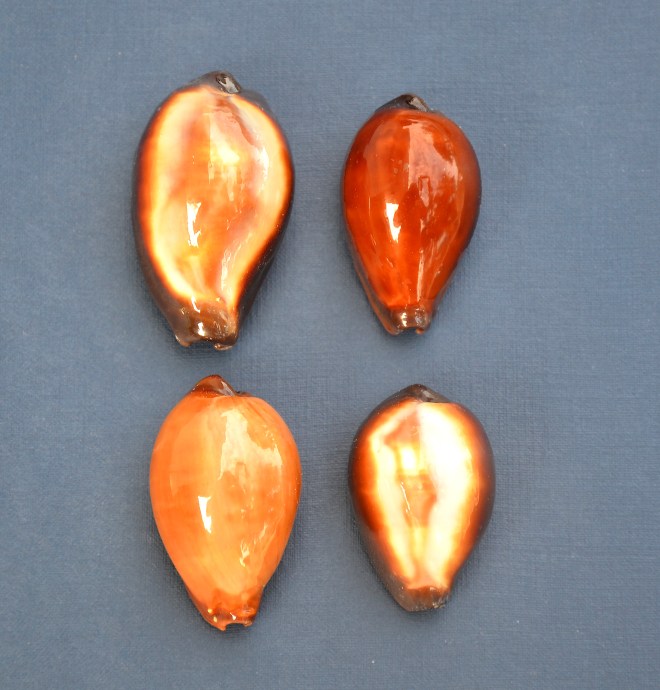
SHELL OF THE MONTH – JANUARY 2018

m the clockwise from top left

Erronea onyx Linnaeus, 1758
trawled in deep water
fishing fleet
Zhanjiang, China

Erronea adusta Lamarck, 1810
under rocks on exposed reef
Nacala Bay, Mozambique

Erronea onyx Linnaeus, 1758
by diver 3-5meter on reef
Masbate, Philippines

Erronea succincta Linnaeus, 1758
By locals at extreme low tides
mud flats
Tamilnadu, India

The Onyx Cowry (Erronea onyx Linnaeus, 1758) is stunning with its rich dark color and pastel blue and white window and mantle line on the dorsum. It is one of the most attractive of all Cypraea. The close relatives, the Dark Onyx (Erronea adusta Lamarck, 1810) and the Tanned Cowry (Erronea succincta Linnaeus, 1758) are also quite attractive, especially extremely dark solid mahogany colored specimens that are found in Zanzibar. There are several named varieties including a rare near albino one called Cypraea onyx nymphae Jay, 1850. All of these are variable making them fun to collect. Dwarfs and giants are exciting to locate.
Over the course of time there has been much debate over the nomenclature and validity of each name and the relationship of one to the other. It appears that Erronea succincta Linnaeus, 1758 is now unaccepted though collectors and dealers will continue to use the name.
Besides the differences in color and pattern, each has a distinct locality. Onyx is from the Pacific Ocean though some are found in deep water in the South China Sea. Succincta is found from Thailand across the Indian Ocean to the Middle East. Adusta comes from the coast of Africa and Madagascar.
Erronea onyx is the most readily available to collectors with the vast majority coming from the Philippines. The large heavy deep water specimen in this lot is from China and is rarely seen on the market, making it a great score for the winner of the auction.
Donated from the collection of Richard Kent


SHELL OF THE MONTH – NOVEMBER 2017

Conus (Rhizoconus) mustelinus Hwass in Bruguière, 1792
by native diver in sand patch among coral reef at 5-7m
Off Samar Island, Phillipines

Its attractive coloration and classic cone shape make Conus mustelinus a favorite among collectors. One would think because of its mustard color it would be called the mustard cone, but no, its popular name is ermine cone or weasel cone. We’ll never know what Hwass had in mind when he gave the shell its Latin name!
Conus mustelinus is widespread across the the Western Pacific Ocean. It is easy to collect as it favors shallow water and dwells exposed in the sand at the base of corals.
The shell is solid in color and comes in various shades of mustard with occasional populations greenish or maize. There is a narrow white band about midbody and occasionally a second closer to the shoulder. There are black dots on the edge of the bands and black chevrons on a white crown. The pattern is fairly constant from one to the next, but there is enough variation to make it fun to collect a series Young specimens have a nice gloss, mature ones do not.
This specimen is large in size at approximately 83mm in length. The lip is natural. The shell exhibits the minor scars that one would expect in a fully grown specimen, however the condition is as good as they come. Donated from the collection of Richard Kent.

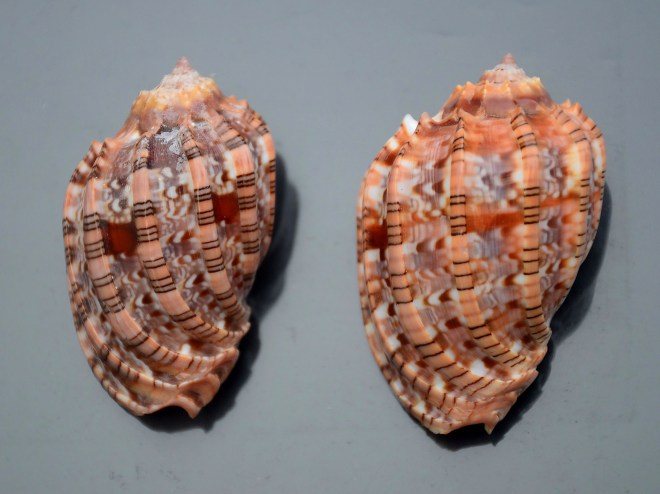
SHELL OF THE MONTH – OCTOBER 2017

Harpa harpa (Linnaeus, 1758) in sand at 10m by local fishermen, Pag Asa Island, Palawan, Philippines (left) inside reef at 10-15m by local divers, Bohol, Philippines (right)

Many collectors consider the harps to be the most beautiful of all shells. With their stately shape, complex sculpturing, intricate patters, coordinated color scheme and mid size, they live up to the claim.
The Harps are a small family that inhabit tropical waters, with the majority found in Philippine and Pacific waters. Harpa harpa, Linnaeus 1758, commonly called the Noble Harp is the namesake species and our shell of the month. We have two specimens, similar in size and although at first glance they appear nearly identical a close inspection will reveal many differences. Harpa harpa has about a dozen ribs with spines on the posterior end. Between the spines are fine groves with rows of chevron patterns. Distinguishing marks from the other harps are the groups of 2 or 3 fine black lines hat cross the ribs and the three brown blotches on the base.
Harps are carniverous and feed on small crabs and shrimp. They burrow in the sand and live in moderate depths.
These specimens, are both in gem condition with mature lips. They are from the collection of Richard Kent.

October Program with Jesene Aquino-Thomas

Jessene Aquino-Thomas is a Ph.D. candidate in Integrative Biology at Florida Atlantic University (FAU). She has a M.S. in Biology, a B.S. in Biology, and a B.A. in Anthropology/Sociology. Jessene has previously worked on several assessment and restoration projects including; The Deepwater Horizon oil spill: Assessing impacts on a critical habitat, oyster reeds and associated species in Florida Gulf estuaries, and St. Lucie and Loxahatchee Rivers Restoration project. She was part of a group at FAU that constructed a nature trail, butterfly gardens, and a community vegetable garden. Integral to the construction of these projects was education; on the natural trail grade school children were informed about Florida’s natural environments, and the community gardens were used to teach underprivileged children about sustainable agriculture. Jessene has worked extensively in the mangrove ecosystem, recently publishing one of the first papers on oysters residing on mangroves. Her current research focuses on a modification to current theory, this revision pioneers new study into interactions between foundation species and how these interactions facilitate biodiversity and resilience in near shore ecosystems. Fundamental to appreciating the role of foundation species, such as mangroves and oysters, is understanding what ecological functions are lost when foundation species are replaced with man-made structures. An off shot, of her dissertation research is a side project that has received a lot of public notice is artificial prop roots sea walls. The construction of shoreline armoring systems that benefit both the near shore ecosystem and humans is a logical extension of her research. A central theme to Jessene’s research is that coastal regions are an interface where not only the needs of the marine species, but also the cultural needs of humans have to be considered and understood.

Ecological foundation species are critical to community structure and ecological functions. However, the combined consequences of multiple foundation species co-occuring are poorly understood. My research investigates the connections between a primary foundation species (mangroves), dominant secondary foundations species (oysters, sponges, and barnacles), and the resulting biodiversity. Foundation species are habitat-modifying species that form the base of the community, have a disproportionate large effect on a community and typically promote increases in abundance, diversity, resilience, food web complexity, and productivity. Secondary foundation species are categorized as foundation species, but in a particular ecosystem are residing on another foundation species. The main objective of the research is to analyze the effect of the dominant secondary foundation species on mangrove prop roots along a latitudinal gradient and how these different species may affect the ecological functions within the system and test it against the current ecological theory for foundation species and my modification to the current theory.

SHELL OF THE MONTH – AUGUST 2017

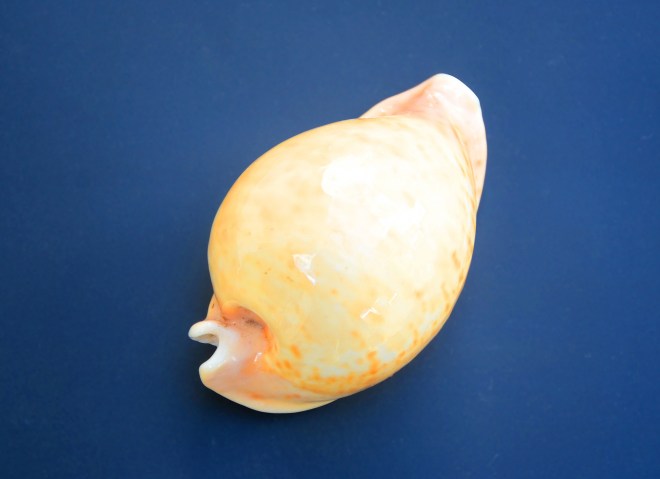
Umbilia armeniaca Verco, 1912
Trawled 150m
Great Australian BightSouth Australia, 2015

Once a prized extreme rarity, Umbilia armeniaca Verco, 1912, became available on the market due to very deep water trawling off the South Coast of Australia starting about five years ago. Although no longer rare specimens bring a hefty price.

The genus Umbilia is a small one with only three specie. All are deepwater and from Southetn Austalia. They are Umbilia armeniaca Verco, 1912; Umbilia capricornica Lorenz, 1989 and Umbilia hesitata Iredale, 1916.

Umbilia do not look like other Cypraea, with thier huge globose hump, extreme rostration, and curved aperture. Although it’s called the Tangerine Cowry, many populations are cream and beige. Most have a large variable botch of color that surrounds the hump, some do not. Specimens range for about 80-110mm in size with the majority falling on the smaller end of the range. This specimen is typical in size and does have stress (growth) lines.

Beige colored specimens of  Armeniaca may look very similar Hesitata, but are distinguished by the surface texture.  Armenia ae smooth and glossy whereas mature specimens of Hesitata ar porous and waxy.

This specimen is donated by Richard Kent, acquired from Australian dealer Doug Thorn.