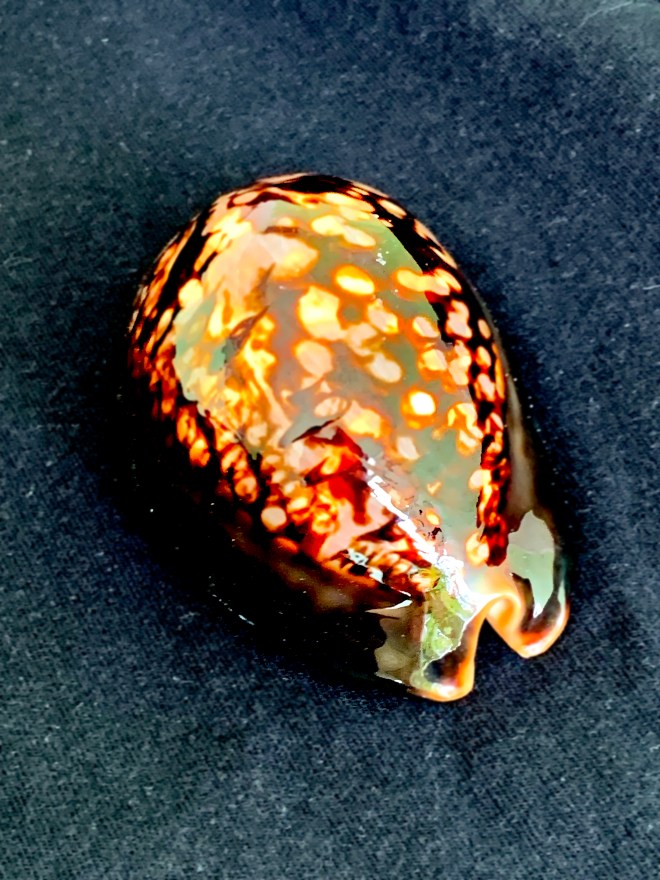
 Mauritia mauritania Linn, 1758 is an impressive unmistakable cowry. It grows to over four inches and is decidedly a heavyweight.
It is a member of the Arabian complex although it hardly resembles its siblings. Mauritania is the only specie in the group with a solid color base and a dorsum that lacks all over fine reticuations. Its flanged callus is distinctive as is its tall hump.
Mauritania is brown to black/brown in color on both base and dorsum. The dorsum has large irregular white spots that vary in number with the very rare specimen virtually lacking in spots. Hawaiian specimens are as a rule darker in color than the more readily available Philippine ones. Dwarf specimens are found in the Andaman Sea.
Mauritania has a very wide distribution across the Indo Pacific region but apparently only lives in areas of high surf pounding against a vertical wall. It is nocturnal. In Hawaii it is associated with lava. Although not scarce its habitat makes it difficult to collect and due to the rough surf many specimens have scratches and dings. A true gem from Hawaii is scarce.
This specimen came from the small island of Lanai that sees little collection. It was collected this January and has a gorgeous glassy surface. It is a real treasure. Donated by Richard Kent and obtained from the diver who found it.
Tag: Cypraea capensis
SHELL OF THE MONTH – NOVEMBER 2018
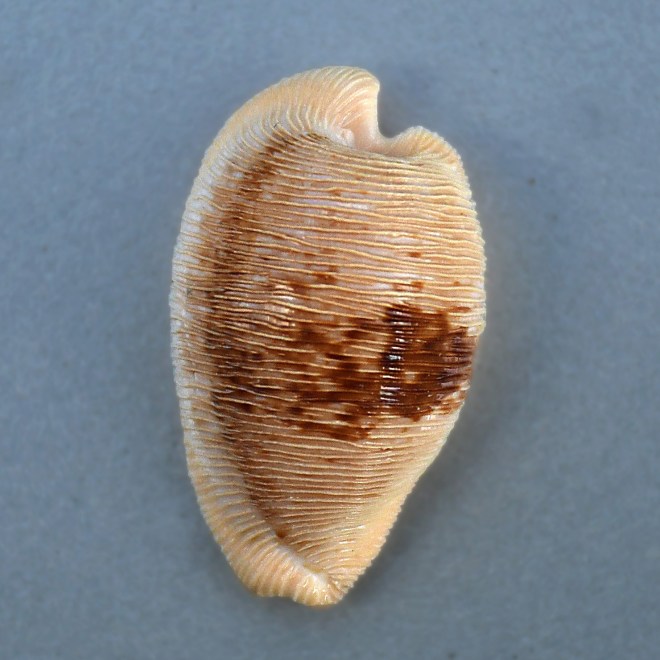 Cypraeaovula capensis capensis (Grey1828)
SCUBA at 10-12M on rock wall
Algoa Bay, Port Elizabeth, South Africa
The Atlantic and Indian Oceans meet the icy Antarctic waters below the coast of South Africa. In the sheltered bays a rich unique marine fauna has developed with an array of indigenous cyrpraea including a couple of oddballs that make shell collecting such a fascinating hobby.
Cypraea capensis is one such shell. It’s like no other. From a distance it looks likes a typical cowry, but on closer inspection one sees fins that originate in the aperture and completely cross over the base and dorsum encircling the shell and meeting the teeth on the opposite end. The shell is a pale uniform mushroom color with an irregular brown blotch and has a discernible mantle line. The dorsum is glossy. There is little variation in color and pattern from shell to shell. Even the blotch is fairly consistent.
Capsnsis lives on rocks in both moderate and deep water with deep water specimens bringing vastly higher prices. There are a few named varieties.
Before the popularity of SCUBA, virtually all specimens were dead collected on the beach. As the diving season is rather short, few capensis come to the market each year, making it a difficult shell to obtain.
Our specimen is of good size, 30mm and should be considered gem. Similar shells bring about $40 on the market. It was originally purchased in a small dealer’s lot from a South African diver/collector and is from the collection of Richard Kent. This is an intriguing shell to look at; one can spend much time studying its appearance.
 Broward Shell Club
You must be logged in to post a comment.