SHELL OF THE MONTH – JUNE 2017

Tutufa rubeta Linnaeus, 1758
by divers on coral reef at 15-20m
Poro Island, Camotes, Cebu
Philippines

Shells from the family Bursidae are commonly known as “Frog Shells.” The inhabit the tropial seas and live in the coral reefs. As such, they can end up encrusted with coral growths making them well camouflaged and difficult to cleanup. Tutufa rubeta, Linne, 1758 is but one of the many varieties of frog shells found in the Philippines. Relatively few specimens reach the market making Bursa a challenging family to collect.
Bursa are heavy for their size, are beige or tan in color and interesting detail in their mouth or aperture. Tutufa rubeta is named for its red mouth, although only young specimens exhibit the red coloring. The larger the specimen, the paler the mouth. This specimen is about 4″. Occasional specimens grow to just over 5″. This one was live collected and comes with the preserved operculum.
The most sought our member of the family is Tutufa Bubo Linne, 1758 which grows to a whopping 10″.
Donated from the collection of Richard Kent
SHELL OF THE MONTH – APRIL 2017


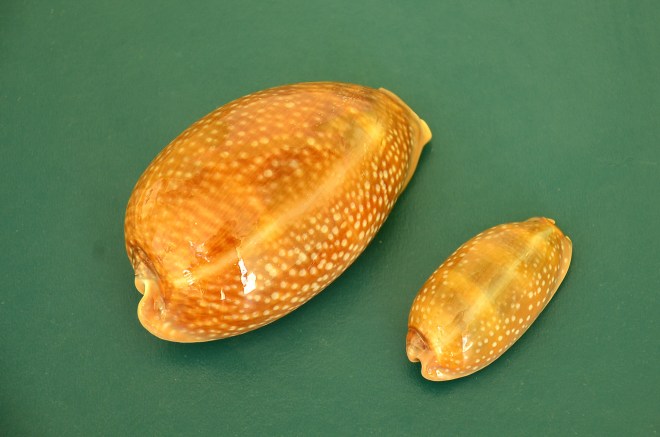
Cypraea cervus Linne 1758
under ledge by diver at 60′
Off Madiera Beach, Florida 2004

Cypraea cervinetta Kienner, 1843
under dead coral slabs,
shallow water at low tide
Pedro Gonzales, Panama


Deer Cowrie and Little Deer Cowrie. This month’s specimen shells are very closely related. They are near identical in color and pattern, both having fawn colored dorsums covered with hazy white spots and a clear area formed by the mantle line. Looking at the two side by side they are easy to separate. Cypraea cervus Linne 1758 is “plump” whereas Cypraea cervinetta Kienner, 1843 is “lean”. As a rule cervus is the much larger of the two. Cervinetta’s teeth are more strongly defined. Cervus is found in the Florida keys, the Florida gulf coast, Cuba and the Yucatan. Cervinetta lives on the west coast of Central America, most commonly found in Panama.

Both are noted for their extreme wide range in size. Cypraea cervus grows to the largest size of all cypraea, reaching a whopping 190mm (7.5″). Giant specimens which are very few and far between bring jaw dropping prices as they just don’t grow so large anymore. Today, typical specimens are 80-100mm. Cypraea cervinetta has dwarf populations going down to just under 30mm in size. Juveniles of both are banded. The banding gets glazed over in adults although most specimens of cervinetta will show some banding on the top of the dorsum. Fresh specimens have brown dorsums that fade rapidly to fawn even when stored in darkness.

The two specimens are close to “gem” in quality and are typical in pattern. They are donated from the collection of Richard Kent.

SHELL OF THE MONTH – APRIL 2016

DSC_5058

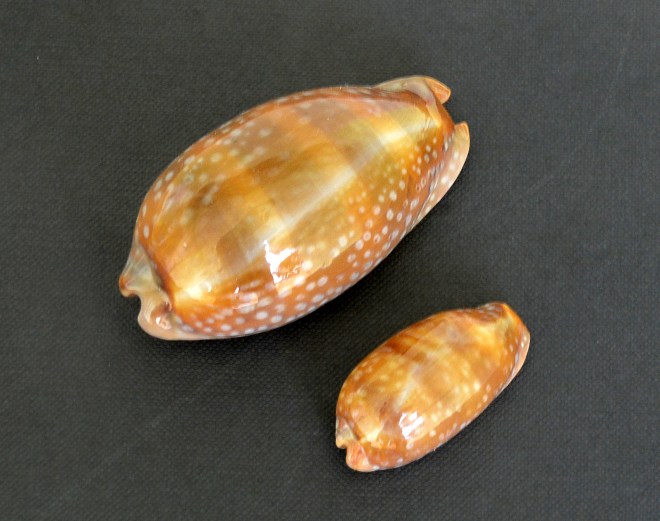
Macrocypraea cervinetta (Kiener, 1843), the Litttle Deer Cowrie, is a very close cousin to our own Macrocypraea cervus (Linne 1771), the Deer Cowrie. Both are among the largest growing of all cowries, however both are extremely variable in size, especially cervinetta as both dwarf populations and giant populations do exist. Size ranges from 130mm down to 35mm. Our specimens are approximately 72 and 40mm.

Both cervus and cervinetta are light in weight, and have an overall fawn color with a greyer base. They are heavily spotted with white. Often there is a gap in the coloring to expose dorsal banding and sometimes a mantle line. The teeth are stained dark. The pattern is very constant. The main difference is in shape where cervinetta is elongated and flattened and cervus is globular.

Cervus and cevinetta lives on opposite sides of our continent. Cervus in the Caribbean specie and cervinetta the Pacific. Although cervinetta has an extended range from Mexico south to Peru, virtually all specimens come from the coast of Panama. Cervinetta lives in shallow water, is nocturnal and if often found exposed in the moonlight.

Both specimens are donated from the collection of Richard Kent

FIRST OFFICIAL COA MEETING MAY 15

Many of you already know that the Broward Shell Club will be hosting the 2015 Conchologist’s Of America Convention at the Bonaventure Golf Resort & Spa from July 14-19, 2015. Our club has scheduled our first official COA planning meeting to begin organizing for the convention. The meeting will be held at the Civic Center from 6-9PM on Thursday night, May 15th (the night after our regular club meeting). We invite the entire club membership to attend and find out what activities have already been planned. We invite you to become involved (no matter how small the task)!

The board will be supplying pizza for dinner so you can come straight from work and have a bite to eat with us. For those of you who would like to know more about what a COA Convention is all about, please check out the following link; http://www.conchologistsofamerica. org/conventions/ We hope to see you there!!!

Please contact Nancy Galdo or Linda Sunderland to confirm your attendance so we can make sure we have enough pizza for everyone.