New Posts

SHELL OF THE MONTH – SEPTEMBER 2018


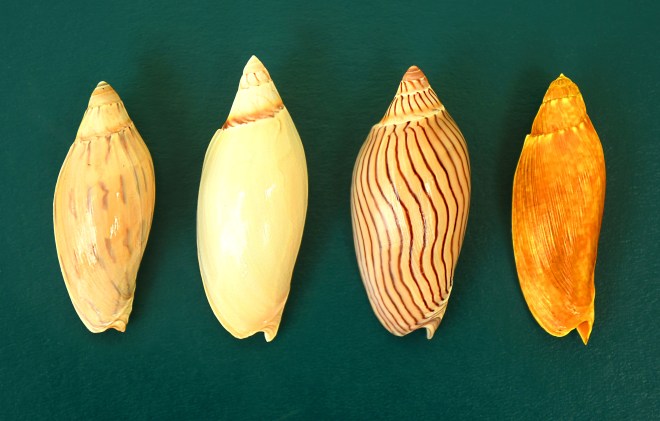
Four Australian Volutes

Australia is known for its outstanding indigenous fauna, both on land and under the sea. Due to its isolation, species evolved independently from the rest of the Pacific basin.

Australian cypraea are famous for their uniqueness, variation and for many specie, exorbitant prices. The volutes too offer a very wide variety and fortunately for the collector, many are moderately priced, although none are cheap.

We have four volutes on the raffle table this month and they come from opposite ends of the Australian continent. The two from Western Australia were obtained from a Singapore dealer while the two from Queensland from an Australian diver and collector.

A fascinating thing about shell collecting in Australia is that every five hundred or so miles different species will be found. Yes, most species have an extremely limited range, with a very few extending across the region. Western Australia has extreme tides and it is possible to walk great distances from the shore at low tide, making collecting an easy task, however one has to be quite aware of the incoming tide! Many varieties of volutes can be found inhabiting the sand flats.

Amoria are very attractive shells, glossy with a pleasing shape and a wide range of patterns. In life, the mollusk has a large foot, the top of which is often very colorful. Amoria is a small genus with less than 20 members, all restricted to Australia. The three included here are representative of the genus.

Volutoconus has an extremely small family of only four. Volutoconus grossi, is not so attractive, its shape slightly distorted and to the eye the proportions don’t seem quite right. Although it is not a rare shell it is seldom seem.

All four specimens, while gem in quality, are on the smaller size. Each year large specimens become more and more difficult and more expensive to obtain.
Donated by Richard Kent

left to right
Amoria maculata Swainson, 1822
by diver in rubble 10-20m
Bunker Islands, Queensland, Australia

Amoria grayi Ludbrook, 1953
extreme low tide on sand flat
Broome, West Australia

Amoria ellioti G. B. Sowerby II, 1864
Sandbar at low tide
Port Hedland, West Australia

Volutoconus grossi Iredale, 1927
trawled, fishing boats
Keppel Bay, Queensland, Australia

September Program

Biography:

My name is Michelot Michel, a South Florida native, and first-generation Haitian-American. I grew up in Miami as an only child. Without any siblings to amuse me, I developed a curious mind for the world around me. As I grew older, this curiosity transformed into an immense appreciation for science and discovery. I later attended high school at Maritime and Science Technology (MAST) Academy because of its strong marine science and college preparatory program. My time at MAST allowed me to explore my love for science while developing a desire for community service. This led me to pursue a career in medicine as it effortlessly combined my passion for science, discovery, and service. Four years later, I graduated with my Bachelor’s Degree in Biological Sciences with Honors, having completed several research projects that encompassed biomedical sciences and marine conservation. After graduating from college, I joined the EM Papper Clinical Immunology Lab at the Miami VA Medical Center as a Clinical Research Assistant. My work currently focuses on elucidating molecular markers and therapeutic targets for immune-related disorders such as Chronic Fatigue Syndrome and Gulf War Illness. The latter of which is focused directly on the US military veteran population who served in the Gulf War. As of late, I am in the process of applying to medical school, where I hope to continue my pursuit of a medical career filled with service and the advancement of knowledge.

Synopsis of Research:

The Environmental Epigenetics lab at Florida International University is a research group devoted to understanding the epigenetic mechanisms in marine organisms in response to changing environmental conditions. Epigenetics is defined as the study of heritable phenotype changes that do not involve changes in the DNA sequence. Some notable epigenetic mechanisms include histone modifications, DNA methylation, and RNA silencing. This particular study aimed to characterize the seasonal patterns in DNA methylation in the gill tissue of the flat tree oyster (Isognomon alatus) and its response to temperature, pH and salinity variations in Miami’s Northern Biscayne Bay. The results of this work will help pave the way for expanding environmental epigenetic analyses and their application to the management and conservation of diverse ecologically and commercially relevant marine species.


SHELL OF THE MONTH – AUGUST 2018

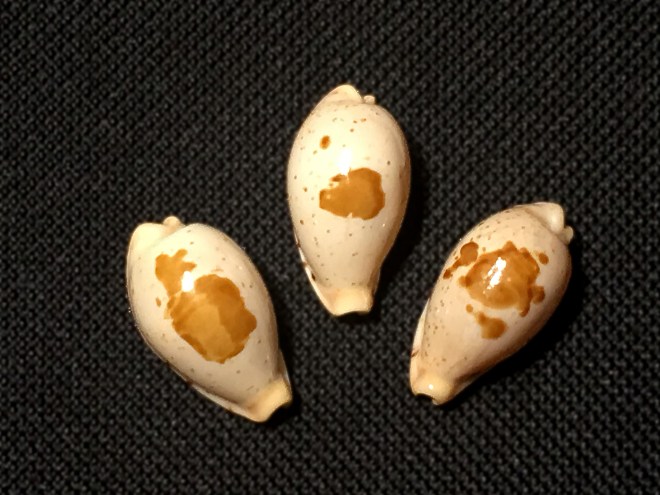
Cypraea saulae Gaskoin, 1843
under rock and coral by local divers at 10 meters
Balicasag Island, Bohol, Philippines

Miss Jane Saul was a famous British shell collector who was born in 1807 and lived to be 98 years old. In 1843 J. S. Gaskoin named this lovely little cowry after her. There does not appear to be a record of their relationship, if any.

Cypraea saulae is a collector favorite, scarce and not that easy to obtain. Most specimens come from the Philippines although the occasional few are found in Indonesia, New Guinea and off the north coast of Australia.

The shell is pyriform in shape, about an inch in size, cream in color on the dorsum with a white base. The dorsum has pale brown freckles and a blotch in the center of the dorsum. Often there are additional blotches that flank the main blotch. In rare instances there is no blotch at all. The margins are finely spotted. In some populations the intercises between the teeth are yellow, in others, white. Several varieties have been named but none are recognized today.

Cypaea saulae lives under coral slabs and rock, in shallow water and at depths up to 150 meters.

Three gem specimens are offered in this raffle to give collectors a sample of the never ending variety of patterns on this attractive little cowry. Donated by Richard Kent

August Program

Synopsis:

The relationship between corals and Symbiodinium dinoflagellates is sensitive to elevated sea-surface temperatures, which are projected to increase 2.6 to 4.8°C by 2100. One mechanism that may allow corals to persist through ocean warming is an association with thermally-tolerant symbionts. During early life stages, many coral larvae or juveniles will uptake multiple phylotypes of Symbiodinium through horizontal transmission. This diversity is maintained for months or years, but over time the juvenile coral will select a dominant Symbiodinium phylotype reflective of the local environment. It is unknown at what age or size selection occurs, and whether environmental factors drive this selection. To determine this, field and laboratory studies will be conducted using the massive starlet coral, Siderastrea siderea

Bio:

Sarah is a native Rhode Islander and earned her bachelor’s degree in Biology from Southern Connecticut State University in 2015. While studying temperate corals as an undergrad, she was also a collegiate athlete, playing DII softball for the Owls. In 2016, she moved to Florida to start her M.S. in Marine Biology at Nova Southeastern University. When not working under the guidance of Dr. Joana Figueiredo in the Marine Larval Ecology lab, Sarah can be found teaching in the Department of Biological Science or working at Gumbo Limbo Nature Center.

SHELL OF THE MONTH – JULY 2018

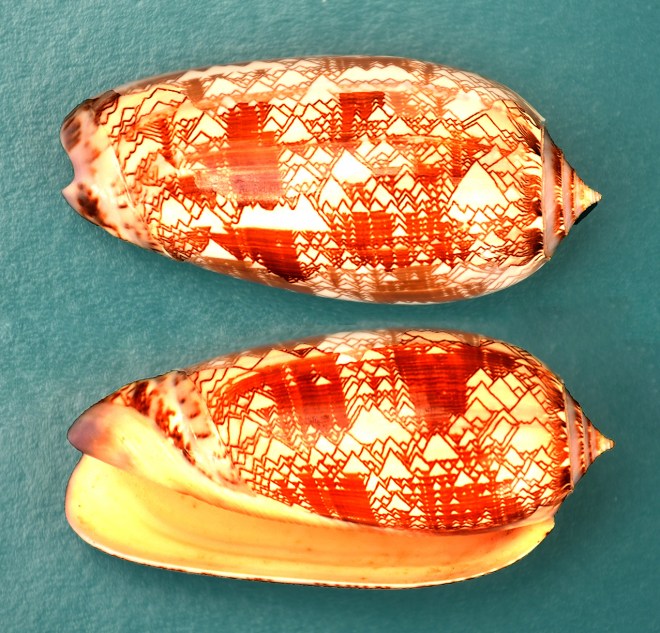
Oliva porphyria (Linnaeus, 1758) Diver at night on sand at 80-90 feet near Loreto, Baja Sur, Mexico, 2005

Oliva porphyria Linne, 1758 is the king of the olive family. It grows to the largest size and is stately in shape and pattern. Although not rare it is dif cult to obtain as it lives in deeper water far away from the shore line. Beach specimens are rare to nd. Most specimens come from off the coast of Mexico though its range goes south beyond Panama. The common name is the Tent Olive. When looking at the pattern one can see whole cities of tents or maybe the tents might appear to be mountain tops. The shell is two tone cream and chestnut brown although freshly collected specimens have a purple tinge to the base. The Tent Olive is incredibly consistent in color with virtually no variation. The tented pattern does vary but not to any great extent. It grows up to 5.5″ in size but 3.5-4″ is the common size. The price skyrockets for the larger shells from $80 to over $200 or more for a 5″ specimen. Our specimen is slightly over 3.5″ and is close to gem. At that size it would fetch at least $40 retail making it a valuable addition to any collection. Donated by Richard Kent.

Wayne Harland Remembrance

~ wayne harland ~

gone too soon!

Wayne Harland died quietly near Charlotte, NC with family at his bedside. He bore his lengthy illness with nobility and courage.

His contributions to our hobby were manifold and substantive, but his friends will better remember the devout camaraderie he fostered and insightful wit he wore on his sleeve.

Just a few minutes in his company were an experience to be treasured. He will be mourned by many, but as Jerry Harasewych said: “I will bet that toasts to Wayne will be raised in Moscow, France and Argentina tonight, and many other places as well.” That’s the way Wayne would want it.

Harry Lee

July Program

Our presentation for the July 11th, 2018 program will be by one of our scholarship recipients from last year Doors open at 6:30 PM at which time the Library, Raf e Table and Sand Flea Market start business. The main program commences at 7 PM.

Title: Using a functional group approach to monitor invertebrate diversity in red macroalgal mats, Deering Estate, Biscayne Bay.

Synopsis: In shallow coastal systems, macroalgae is fundamental as both an indicator of environmental conditions and a contributor to habitat complexity. Biscayne Bay, localized close to a metropolitan area in south Florida, is undergoing heavy management and restoration activities outlined by the Coastal Everglades Restoration Project (CERP). Among the effects of CERP-planned activities and water

management, the bay is impacted by freshwater ‘pulses’ that can cause periodic changes in salinity, and subsequently, macroalgae community composition. However, the invertebrate epifauna that inhabit macroalgae are very little studied. The vast diversity of invertebrates that live in macroalgae also poses a challenge as to how they should be classi ed. These invertebrates would not only be sorted at an appropriate taxonomic scale, but should also answer ecological questions effectively. While this research is an opportunity to survey the diversity of invertebrates that reside in red macroalgal mats, I also propose a functional group approach to classify and monitor these invertebrate epifaunal groups. We want to investigate whether changes in salinity can change species composition and distribution of macroalgae and their associated invertebrate epifauna.

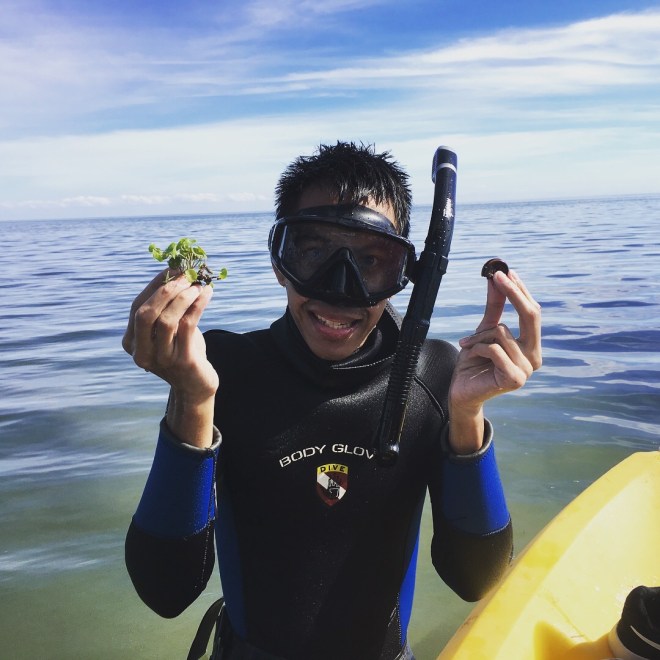
Biography: Lowell Andrew Iporac is a Ph.D Student at Florida International University’s (FIU) Biology Doctoral Program. Lowell obtained his B.A. in Biology from California State University, San Bernardino, where he completed four different undergraduate projects. Among those four research projects, it was an internship at Shannon Point Marine Center, Washington State that sparked his interest in marine biology. Upon transitioning to FIU, he joined the Marine Macroalgae Research Lab (MMRL) with Dr. Ligia Collado-Vides in 2016. His dissertation focuses on marine plant-animal interactions, and strives to understand the characteristics of macroalgae and invertebrates that drive these interspecies interactions. When not reading scienti c literature or conducting bench work, Lowell likes to snorkel at the beach and walk along botanical gardens.

SHELL OF THE MONTH – JUNE 2018

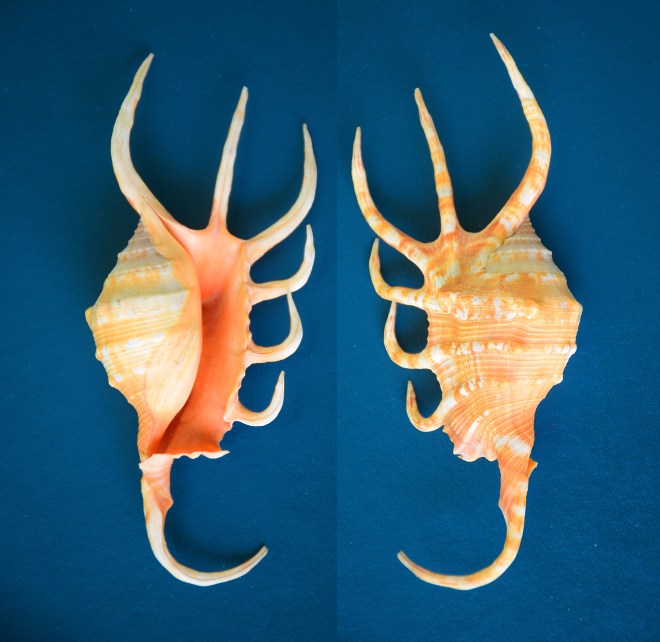
Lambis crocata (Link, 1807)
in sea grasses 15-20 meters
Kinbu Bay, Okinawa, Japan

The Spider Conchs are a small genus in the Strombidae family all of which inhabit the tropical seas of the Indo-Pacific region. The genus – Lambis – originally had the exotic name of Pterocera, so today Pterocera crocata Link, 1807 is now Lambis crocata Link, 1807.
An interesting feature of this genus is that the species have different numbers of fingers or arms or whatever one chooses to call the appendages that distinguish the spider conchs from the true conchs
Lambis crocata has the common name of Orange Spider Conch although the shell is rarely orange in color; the common color being tan or beige, but they do have an orange or peach colored aperture.
Lambis crocata has long, curved and delicate appendages making it one of the most attractive species of the genus. It is quite different from the large and heavy chunky, bland Lambis truncata Lightfoot, 1786 that has little interest to most collectors. There is a rare and expensive subspecies named Lambis crocata pilsbryi Abbott, 1961that has exceptionally long arms and is spectacular in appearance.
Most of the spider conchs are common, crocata being scarce, however the beautiful and prized Lambis violacea Swainson, 1821 is quite rare and very costly making it near impossible to collect the the complete genus.
Our specimen is very attractive, orangish is color with an intricate pattern on the dorsum and long graceful fingers. It is close to gem in quality, collected from a desirable location. Donated from the collection of Richard Kent.

May Program

My name is Bradley Rosendorf. I have been living near the Arthur R. Marshall Loxahatchee National Wildlife Refuge since 1993. I have spent tremendous amount of time in my life hiking and photographing at the Refuge.

My discussion with your group will focus on the following:

1. The origins of the National Wildlife Refuge system. What is a public land? The importance of citizen involvement with public lands. The upcoming public meetings at the Refuge regarding current and future public use and management of natural resource.

2. I will provide general overview of range of native and invasive species present at the Refuge and what species can be seen and photographed on a usual day spent at the Refuge trails.

3. The main subject of my discussion will be “Rapid species adaptation in the Everglades”, an exciting discussion about the Everglades Snail Kite biology and the impact of invasive apple snail.

4. The final part of my discussion will be on the really nice and meaningful range of activities the shell club can get involved with at the Refuge including special guided tours for specific species such as Snail Kite, night walks, tram tours, and exciting volunteering opportunities with US Fish and Wildlife.

Our Refuge Rangers are very hardworking people who are a pleasure to interact with. Volunteering can be a very meaningful life experience and i will discuss how much I cherish the opportunity to wear a US Fish and Wildlife volunteer shirt and how my experience of volunteering has been an important part of my life.

The Arthur R. Marshall Loxahatchee National Wildlife Refuge is a very very special and truly MAGICAL place, i am very excited to meet your shell club and talk about the Refuge!!! :)

Bradley Rosendorf

SHELL OF THE MONTH – MAY 2018


It’s a wonder of nature how a simple snail can create such a masterpiece of a house for itself. The spirals of the Sundial shells, family Architechonicidae, are always perfect. Architechonicidae is a small family with members in topical seas around the world. There are only three, possibly four species that attain a size of over 2 inches, however there are numerous species that are quite small and rarely collected.
The Sundials are all very similar in appearance. It is not easy to tell them apart. Architectonica perspectiva (Linnaeus, 1758) is the most common Indo-Pacific Sundial. Adult specimens are normally about an inch and a half. Smaller ones were often collected and sold in bulk for the craft market, but nowadays these are not so easy to come by. We have two specimens, the smaller is typical and the two and a quarter inch one a prize catch from Thailand.
Architectonica maxima (Philippi, 1849) is the largest of the Sundials growing to a maximum of three inches. Occasionally one that big is collected in Viet-Nam. This specimen is about as big as one is likely to encounter.
The most obvious differences in the two specie is, one: A solid line in perspectiva that encircles the shell as opposed to to the mottled line in maxima, though as the shell grows in size the line will break up and, two: The more intense colors of perspectiva. There are other differences such as the spacing of groves, nodulues, and color pattern. Examine closely with a magnifying glass and one will see they are quite different.
In the Caribbean we have the Common Sundial, Architectonica nobilis (Roding, 1789,) which is anything but common recently. It also will grow to over two inches. Additionaly as in the Pacific there are numerous small species.
Donated from the collection of Richard Kent

Architectonica perspectiva (Linnaeus, 1758)
by diver on sandy bottom 15-20m depth
off Phuket Island, Andamen Sea, Thailand

Architectonica perspectiva (Linnaeus, 1758)
netted by fishermen, 10m,
grass and sandy bottom
Manila Bay, Phillipines

Architectonica maxima (Philippi, 1849)
netted by local fishermen
Nago Bay, Okinawa, Japan