SHELL OF THE MONTH – FEBRUARY 2020

             Around the world with cone shells. We welcome our new members with a selection of seven different cone shells from seven different countries.  The cones are venomous and are predators. Most live among the coral reefs in tropical waters. While many species have a natural gloss, others are flat with barely a shine. Cones are a collector’s favorite.
   The collection includes from top left to bottom right the following:
   Conus omaria Hwass in Bruguière, 1792. This popular tent cone is from north west Australia, the southern extent of its range. One could make a huge collection of tent cones as there are so many species. Conus omaria is most typical.
   Conus ebraeus Linn, 1758 is named the Hebrew Cone because the regularly spaced black markings on white resemble Hebrew writing.  This specimen, which is very large for the species, is from Hawaii.
   Conus pupurascens Sowerby, 1833 is the Purple Cone. Unfortunately the purple mottling eventually fades. This one is from an offshore island in Panama.
   Conus janus Hwass in Bruguière, 1792 is an Indian Ocean cone from the island Madagascar. It comes in to two distinct varieties., one with dark brown flamules and other with gold.
   Conus terebra Born, 1758. This plain whitish cone has horizontal striations that completly encircle the shell and that along with its usual shape makes it quite distinctive. This is a Philippine specimen.
   Conus achatinus Gmelin 1791 is called the Agate Cone. It has a striking pattern of clouds and spiral dashes and is quite colorful.  This one comes from the hard to get nation of Myanmar and is the scarcest one in this collection.  
   The final cone is a local representative of the family, Conus regius Gmelin, 1791, and was collected off Key West. The Crown cone has a range that goes down the Caribbean Islands all the way to Brazil.
   All the specimens are in excellent condition; growth lines are natural in cone shells as they grow is spurts and the line marks the end of each growing period.  All shells have a data slip with collection details.  The seven specimens were donated by Richard Kent and should have a combined retail value of $60 or more in today’s market.

February Meeting

Title: Ecological interactions between marine macrophytes and small invertebrate epifauna in tropical shallow coastal systems

Synopsis: Marine macrophytes form biogenic habitats that maintain the biodiversity of marine coastal systems, especially for small invertebrate epifauna that maintain essential ecosystem functions. These macrophyte-invertebrate interactions are prevalent in shallow coastal systems, including subtidal seagrass beds and intertidal sandy beaches. These shallow coastal systems are also challenged with periodic influxes of pelagic Sargassum, a region-wide issue affecting much of the Caribbean, including South Florida, since 2011. Though these Sargassum influxes occur periodically, we know very little about how these influxes affect the local macrophyte and invertebrate epifaunal communities. This upcoming meeting will provide an update on research related to macrophyte-invertebrate interactions in shallow coastal systems. Current findings of ongoing research and further opportunities of investigation, particularly with effects of Sargassum influxes, will be discussed. 

Biography: Lowell Andrew Iporac is a Ph.D Candidate at Florida International University’s (FIU) Biology Doctoral Program. Lowell obtained his B.A. in Biology from California State University, San Bernardino, where he completed four different undergraduate projects. Among those four research projects, it was an internship at Shannon Point Marine Center that sparked his interest in marine biology. Upon moving to FIU, he joined the Marine Macroalgae Research Lab (MMRL) with Dr. Ligia Collado-Vides in 2016. When not doing his research, Lowell likes snorkeling, diving, hiking, and playing with his Nintendo Switch. 

Black Water Diving by Linda Ianniello. 


Back by Popular Demand

You asked and Linda answered yes. Linda Ianniello gave us a magnificent program on Black Water Diving in May of 2017 and you wanted more. 

What is Black Water Diving you ask? A group of divers go out in the dark of the night and dive over 500 feet of water where the largest daily migration takes place. Small sea creatuures come from the depths to feed closer to the surface and the underwater photographers are waiting. In a holding formation 40 feet deep and drifting with the currents, the photographers take photos of minute sea creatures that come to the surface. Tiny veligers of shrimp, lobster, fish and mollusks. Most under half an inch.  Linda has a new program and I guarantee you will be awed at the photography and the beautiful creatures captured by her camera. 

Since she was here last, Linda, along with her dive buddy Susan Mears has written a book Black Water Creatures. She will have a few copies of her book with her to sell.  

Please join us for an unforgettable program 

SHELL OF THE MONTH – OCTOBER 2019


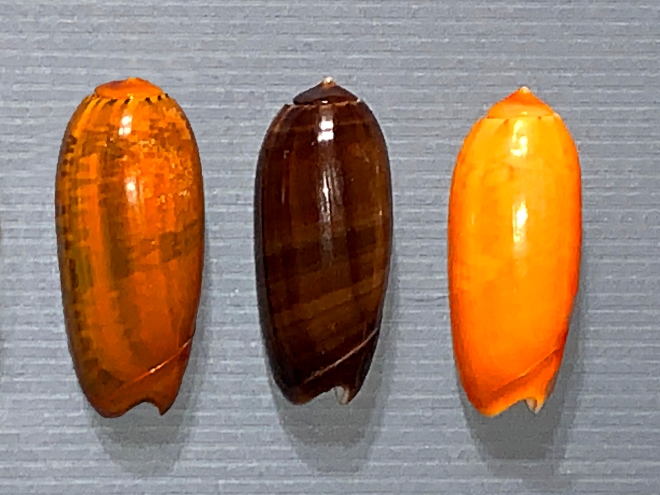
A big mystery in the shell world is why do certain olives cover their pattern with a layer of color, most always black or orange? It is as if they are getting ready to celebrate Halloween! 

   For our October Shell of the Month we have three specimens of Oliva irisans Lamarck, 1811, one orange, one black and an unusual one overlaid with brown yet revealing the pattern underneath. Typical specimens, if there is such a thing, are whitish with faint overall mottling and big bold streaks of brown. Possibly the typical pattern has two interrupted brown bands instead.     

   Olives are scavengers, generally found burrowed in sand with just their siphon exposed.  They are communal by nature and will share a meal.  Up until anout10  years ago olives were abundant off the coast of Broward County.  They were easily collected on the off shore sandbars that weould be exposed at low tide.  After a heavy storm dozens would be found washed up on the beach.  Wiith all the beach reconstructions and dredging in recent years, they are no more.  On the west coast olives are still abundant.

    Olives are fun to collect as there are so many species. Most are colorful, the patterns are interesting and varied and most all are small in size.  Identifification is another story all together as olives are all so similar. Olives have been named and renamed so one needs a very current book to have the latest name. There is a good chance the name on the label of a specimen one bought few years ago is no longer valid. 

   Oliva irisans Lamarck, 1811is sometimes mislabeled as Oliva lignaria Marrat, 1868 as they are quite similar.. Irisans is distinguished by the heavy callous on the apex and spire. The color varieties of irisans all have individual names which are not currently recognized, but still used in the trade.

   Two of the specimens are from the Philippines and the third is from Indonesia. They are matched in size and about gem in condition.  Donated from the collection of Richard Kent


August Club Program

Phillip Gillette, Aplysia

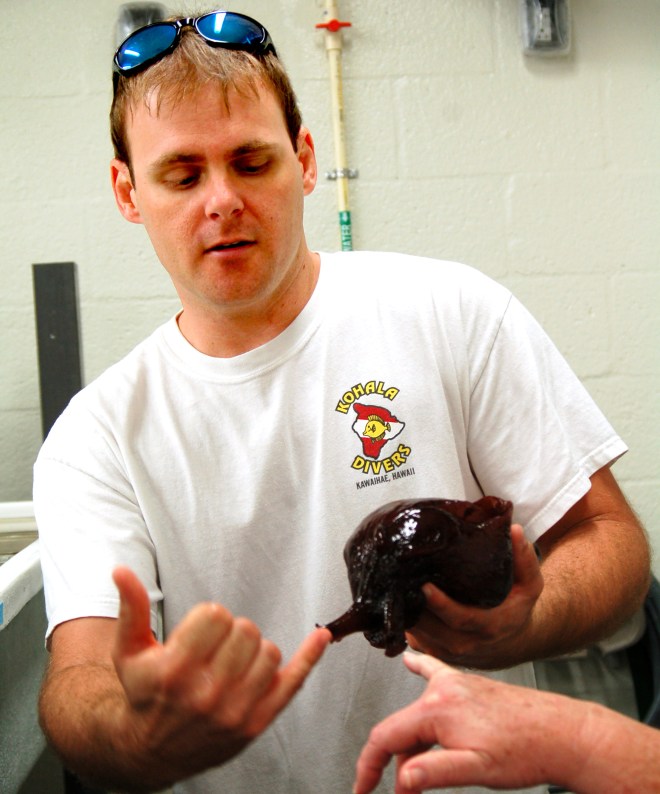
Our program for August is returning Phillip Gillette. He is the resource manager at the University of Miami’s Aplysia Resource Facility. He is originally from Central Florida. He writes, “ I went to the University of Miami for my undergrad degree, graduated in 2004 with a double major BS in Marine Science and Biology.  During undergrad, I interned one year at Harbor Branch working on Queen Conch and Florida fighting conch aquaculture, which got me interested in invertebrate aquaculture.  After graduating, I took a job in the late summer of 2004 at the UM Aplysia Resource Facility (where I’ve worked ever since) as a larval culture technician.  While working, I completed my Master’s in Marine Biology (from UM) in 2012.  My research interests include invertebrate culture, larval culture, coral husbandry, coral reef ecology.

I became interested in Marine Science as a child because of shells actually.  My grandfather was in the Navy, and as a result my dad spent 4 years living in Guam as a teen, and he amassed an impressive shell collection.  I used to make him spend hours in the garage going over all of his shells, identifying them, telling me the stories of how he found them.  We would spend a week every summer in the Keys, snorkeling and shelling, and that fueled my interest.  I have a modest shell collection of my own, with my favorite group being cowries”.

Phillip will be telling us about the work that is being done at the UM facility, the importance of Aplysia californica, the mollusk being studied and used and how important it is to medical research. We will also discuss another possible field trip to the research facility. The club was invited to tour the facility a few years ago and it was a big hit with

SHELL OF THE MONTH – APRIL 2019

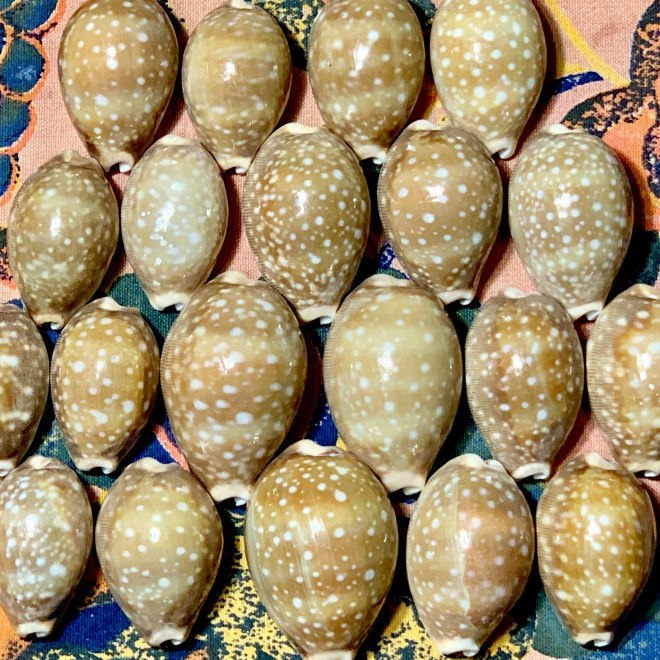
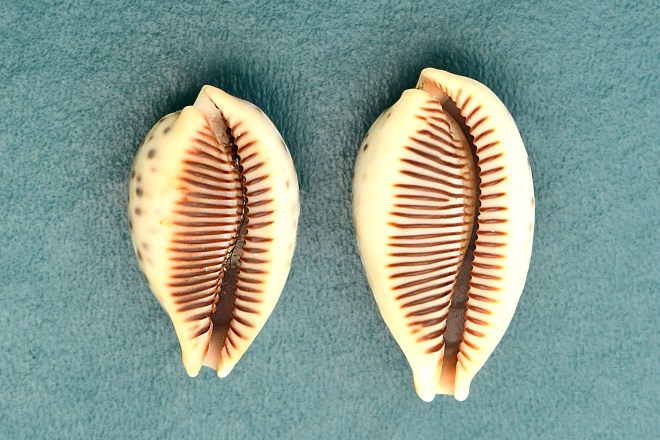
Our April Shell of the Month is for the shell crafters. It is a set of 20 Cypraea vitellus Linn, 1758 commonly know as the Calf Cowry. Cypraea vitellus is one of the most common medium sized cowries, It inhabits the reef in shallow water throughout the entire Indo-Pacific region. It’s a fawn colored shell  covered with white spots. The margins have closely spaced thin vertical whitish lines. T here is little variation in size and pattern. The shell is immediately recognizable. Juveniles are banded, the banding covered over as the shell matures.
These shells were purchased in bulk and came with no collection date. I imagine these twenty will be turned into wonderful little critters or whatever the shell crafter may imagine.
Donated by Richard Kent. Next month we shall return to specimen shells.

SHELL OF THE MONTH – FEBRUARY 2019

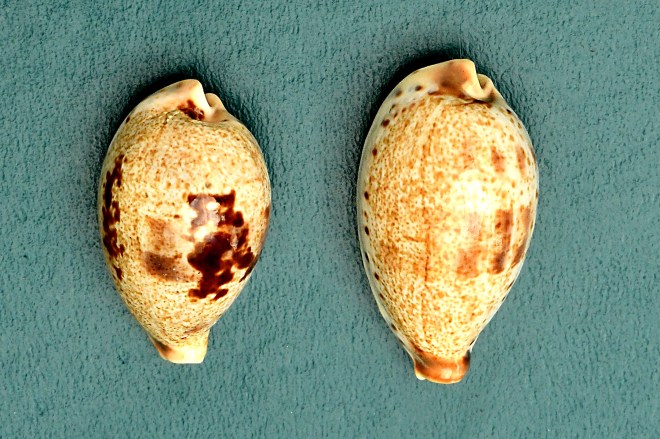
Cypraea pulchella (Swainson, 18230, Mergui Archipelago, trawled 100 meeters by fishing boats, Andaman Sea, Myanmar
Cypraea pulchella (Swainson, 18230, trawled by commercial fishing boats @100-150Meters off Hainan Island, South China Sea, China

Not only is Cypraea pulchella (Swainson, 1823) one of the most sought after cowries, it is also one of the most distinctive. Its deep brown teeth that extend across the base make it impossible to confuse with any other. The common name for this elegantly pyriform shell is the Pretty Cowrie and pretty it is.
The dorsum is pale, faintly mottled with light brown and typically has a large dark chocolate colored blotch on both the right and left side of the dorum, but not always. Less attractive specimens have the blotch on only one side or the other. The most interesting specimens have multiple blotches or one huge one in the center and they bring the highest prices. The occasional specimen has no blotch at all! (specimen #2 in our raffle). Normal size is between 35-45mm. Shells retail in the $15-25 range and two to three times that for the exceptional spectacular specimen.
Originally the north-western Indian Ocean variety, Cypraea pericalles (Melvill & Standen, 1904) was a distinct specie, separate from the more common Pacific one, but recently Cypraea pericalles has been downgraded into a subspecies. When the names were first described there was a gap in the range, but this was due to the nonexistence of shelling in Burma and Thailand. Specimens that come from the Andaman Sea (this area) often appear to be an intermediate of the two, but are usually sold as pericalles. The difference is that the original pericalles has shorter teeth, is less callus, and is of smaller average size, with a less pronounced blotch. Possibly the two subspecies fully intergrade.
Cypraea pulchella favors deep water, is variable in size and pattern and is widespread though uncommon in distribution. Most specimens on the market come form the Philippines, South China and Thailand. There are two other distinct subspecies, one unique to the southern Philippines and the other quite rare from New Guinea. The true pericalles from the west coast of India is currently very difficult to obtain.
Today with revisions of nomenclature the proper name is Ficadusta pulchella (Swainson, 1823). For old time collectors these revisions in Cypraea are hard to accept.
Donated from the collection of Richard Kent.

February Program

Our Program for February is Dr. Thomas Annesley,

Thomas Annesley is “Active Professor Emeritus” at the University of Michigan and Deputy Editor of the journal Clinical Chemistry. He has always had an interest in oceanography and spent summers in California, where his uncle dropped Tom off at the coastal tidepools on his way to work and the picked Tom up on his way home.

Tom has been listed in Who’s Who in Medicine Academia, Who’s Who in Science and Engineering, and Who’s Who in America. He has published more than 200 articles and presented more than 175 invited lectures in 10 countries.

At the Bailey-Matthews National Shell Museum Tom does public lectures, beach walks and the live tank talks. He is also President of the Sanibel-Captiva Shell Club.

The title of his talk is “Cone Snails, Tennis Rackets, Pain Medications, and the Broward Shell Show”

Tom’s presentation will focus on scientific discoveries involving cone snails and their toxins. But as with many advances in science, there are elements of luck, happenstance, intrigue, mistakes, and creating lemonade out of lemons that contribute to the story. Dr. Annesley will show us how the supposedly unrelated topics of tennis, pain medications, and even the Broward Shell Show fit into the story of cone snails.