SHELL OF THE MONTH – NOVEMBER 2013

Murex melanoleucus Morch 1860

Our feature shell for this month is supplied by Emmett and James Redding with a shell(s) from the Jean Redding collection.  The beautiful Murex melanoleucus Morch 1860 was collected live on the rocks leading out to Vernado Island, Vernado Beach, Panama on January 28, 1986. Vernado Beach is/was an extraordinary collecting site.  The normal tide range is some 14 to 20 feet between high and low tides.  To achieve that vertical drop the tides at Verando go out a half mile or more.  By using sand bars and a rocky bar you can walk out to Vernado Island a mile off shore.  This pair of Murexes were collected on the rocky bar about half way up the sides of the rocks.  They were feeding on barnacles and bivalves exposed by the falling tides.  Their coloration and shapes matched the background color/shapes.  M. melanoleucus can grow up to 7 inches, but the larger ones are frequently worm eaten towards the apex.  Other than removing the animal no exterior cleaning was done, but after 20 plus years one of the operculums has been lost.

There is one hazard to collecting these alive – getting them off the rocks without tearing most of the skin off your fingertips! Those spines do a number on flesh and newspaper. And, yes – you don’t want to play catch with them!

Our thanks to Steve Braska and Anne Kennedy for their donations to the Raffle Table in September, and to Richard Kent, Steve Braska and Heather Strawbridge for donations at the October meeting.
SHELL OF THE MONTH OCTOBER 2013

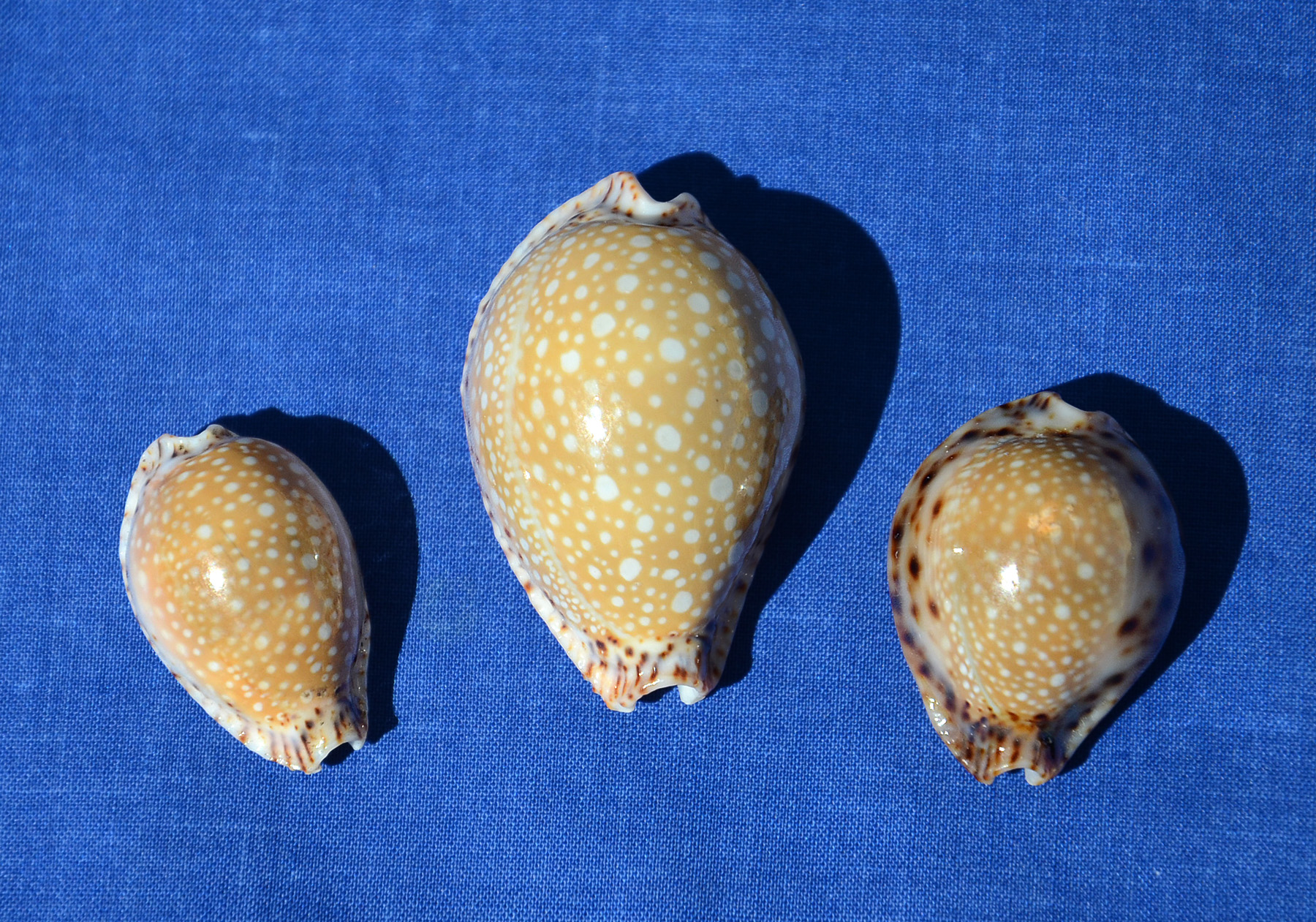
DSC_4394Cypraea (erosaria) lamarckii Gray, 1825 is named after the French naturalist Jean-Baptiste Pierre Antoine de Monet, Chevalier de Lamarck, who is commonly known simply as Lamarck.

Lamarck’s cowrie is a very attractive medium/small shell, typically 25-40mm, fawn or gold color and covered with small white spots of varying size. The margins are whitish with dark brown spots that distinguish it from the similar Cypraea miliiaris Gmelin, 1791 which has solid white margins. Although the coloring is relatively constant there is much variation of shape and size. The largest shells come from the African continent and are globose, relatively light in weight. Here Cypraea lamarckii is found in shallow water where it burrows in muddy sand, emerging at dusk to feed. This is unusual as cowries do not burrow! In Tanzania there is one population with a purple base named Cypraea lamarckii fainzilberi Lo. & Ho., 1993 and a very pale variety Cypraea lamarckii sharoni Walles, 1980. Deep water populations from the Andaman Sea tend to be considerably smaller and lack the mantle line that is universal on the African specimens.

Cypraea lamarckii reditima Melville 1888 is found in Thailand. Here it’s habitat is more typical of other cypraea, under rock and in corals. It is relatively flat, heavy with a well developed callous, large dark marginal spots and a very rounded base.

Cypraea lamarckii is an Indian Ocean species though the occasional population is found in the Philippines and beyond. It appears that in the South China Sea and Pacific Ocean lamarckii is replaced by its cousin miliiaris.

Our three specimens are illustrative of the variety lamarckii is found. This reditima along with five others, are freshly collected and just arrived this past week in a package from Phuket, Thailand. These three shells are donated from the collection of Richard Kent.

DSC_4391Six freshly collected Cypraea lamarckii reditima Mellville, 1888 from Raya Island, Thailand

SHELL OF THE MONTH SEPTEMBER 2013

Siratus beauii (Fischer & Bernardi) 1857. Richard Kent is getting a break this month. And what we mean by that is James and his Dad, Emmett Redding are supplying this month’s feature shell. And what a shell it is. Siratus beauii used to be somewhat easy to get, but no more. In the early 1970s Dr. Riley Black was very famous for his dredging excursions in the Gulf of Mexico….and one could buy a bushel basket of dredged mud and goodies, set up a big tub of water, grab a sieve of some sort and have a ball. Nothing was guaranteed with each bushel but it was a wonderful gamble to see what might be discovered from the mud. I, myself got enough rubles together to

purchase one and found cones, murex and so much more.

Jean Redding, our past president from 1973 purchased many bushels and this month’s shell is the result of that, being from her collection.

Siratus beauii is now very hard to find, and especially in this condition. The varicies are just about all intact and it has its operculum. For you Heavy-Duty collectors, this shell has not had its exterior cleaned and oiled which gives you the opportunity for either cleaning it (a very easy task with this specimen) or leaving it as is!

Dredged by Dr. Black June 1971. It was taken in 125 fathoms (750 feet) west of Cape San Blas. This would put it near/in the Desoto Canyon.

SHELL OF THE MONTH – AUGUST 2013

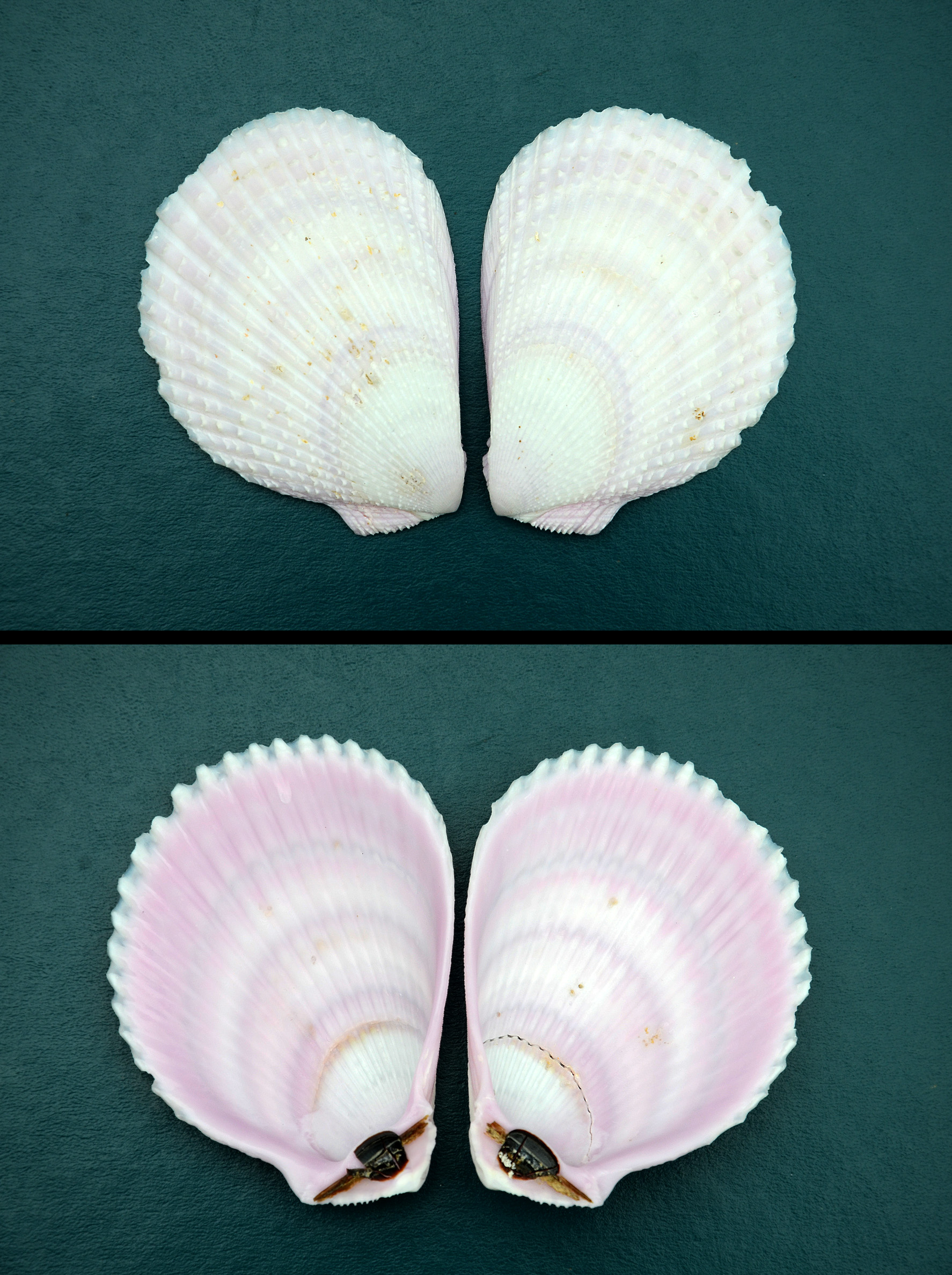
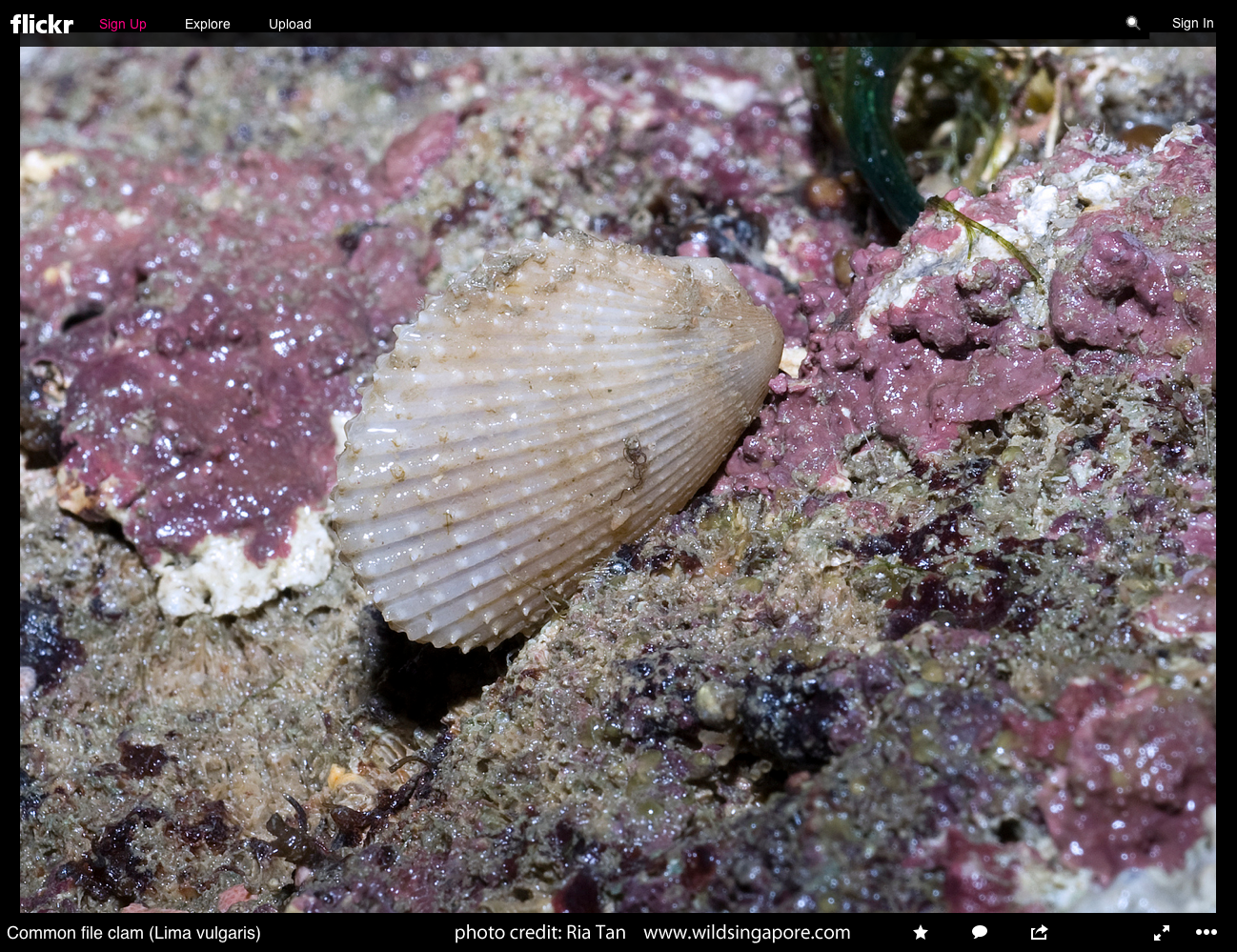
LimaVulgarisLima vulgaris Link, 1807 is a bivalve from the order Limoida, family Limidae. Its common name is File Clam or Spiny File Clam.  It is world wide is distribution in tropical waters. Originally our shell was named Lima lima Linnaeaus, 1758 and Philippine dealers used the name Lima lima vulgaris Link. 1807 to differentiate the populations with a pink interior from those with a white interior. Today Lima lima is reserved for Caribbean and Mediterranean shells while Lima vulgaris to those from the Indo-Pacific. There is no difference in the shells and not all vulgaris have pink interiors.

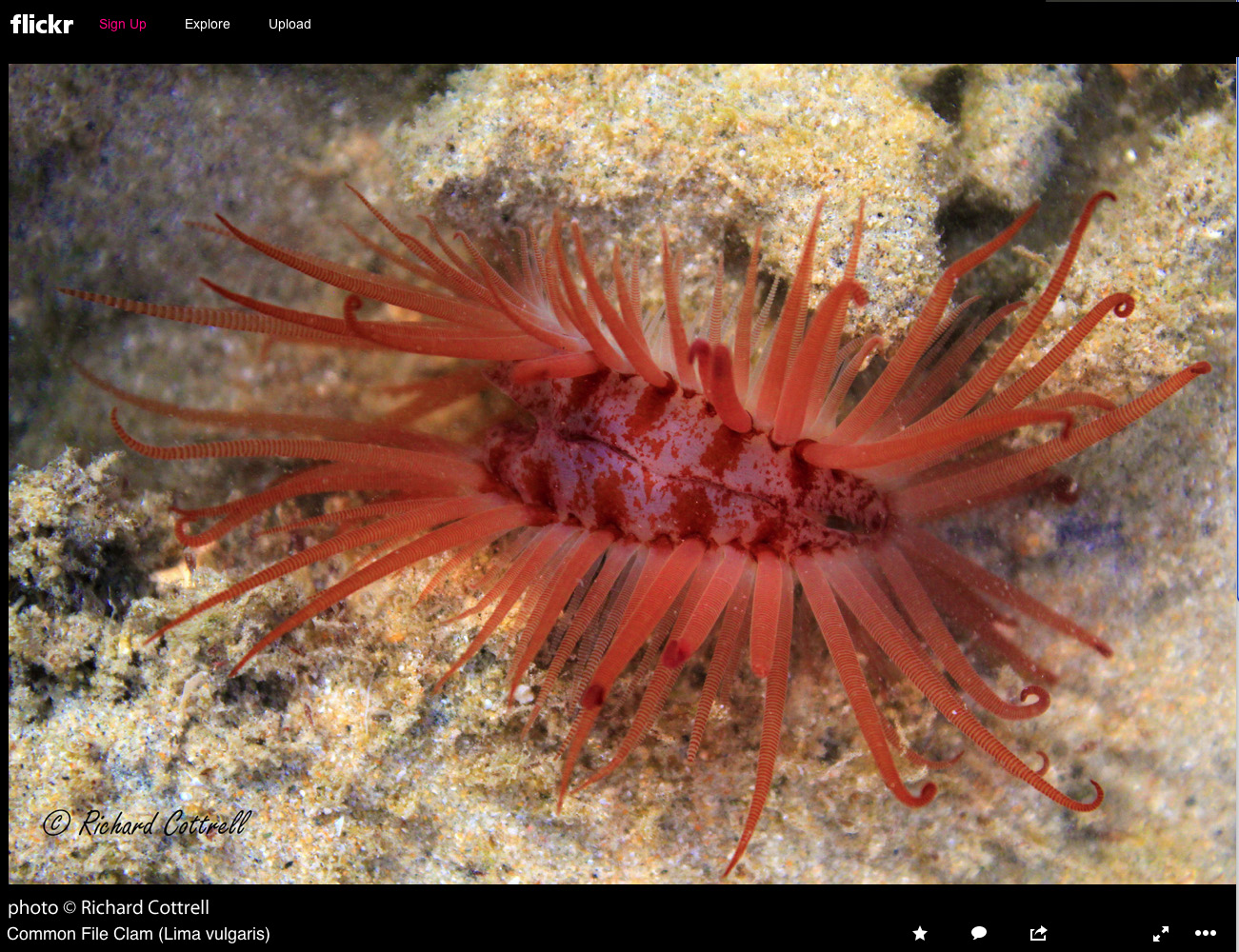
Lima vulgaris is a filter feeder and is capable of free swimming propelling itself by clapping its valves open and shut expelling water.  Normally they settle down between rock or reef rubble where they display their long tentatcles. The live animal is very attractive.

The top and bottom valve mirror each other and according to the literature the interior color comes from the pigment hemoglobin.

This specimen is a giant being over 4 1/2″ (113mm) and is about as large they come.  It was collected by Philippine divers nestled in rocks off Dawaho Island, Leyte, Philippines. It was donated by club member Richard Kent from his collection.

limavulgaris Screen shot 2013-07-14 at 2.28.28 PM

SHELL OF THE MONTH – JULY 2013

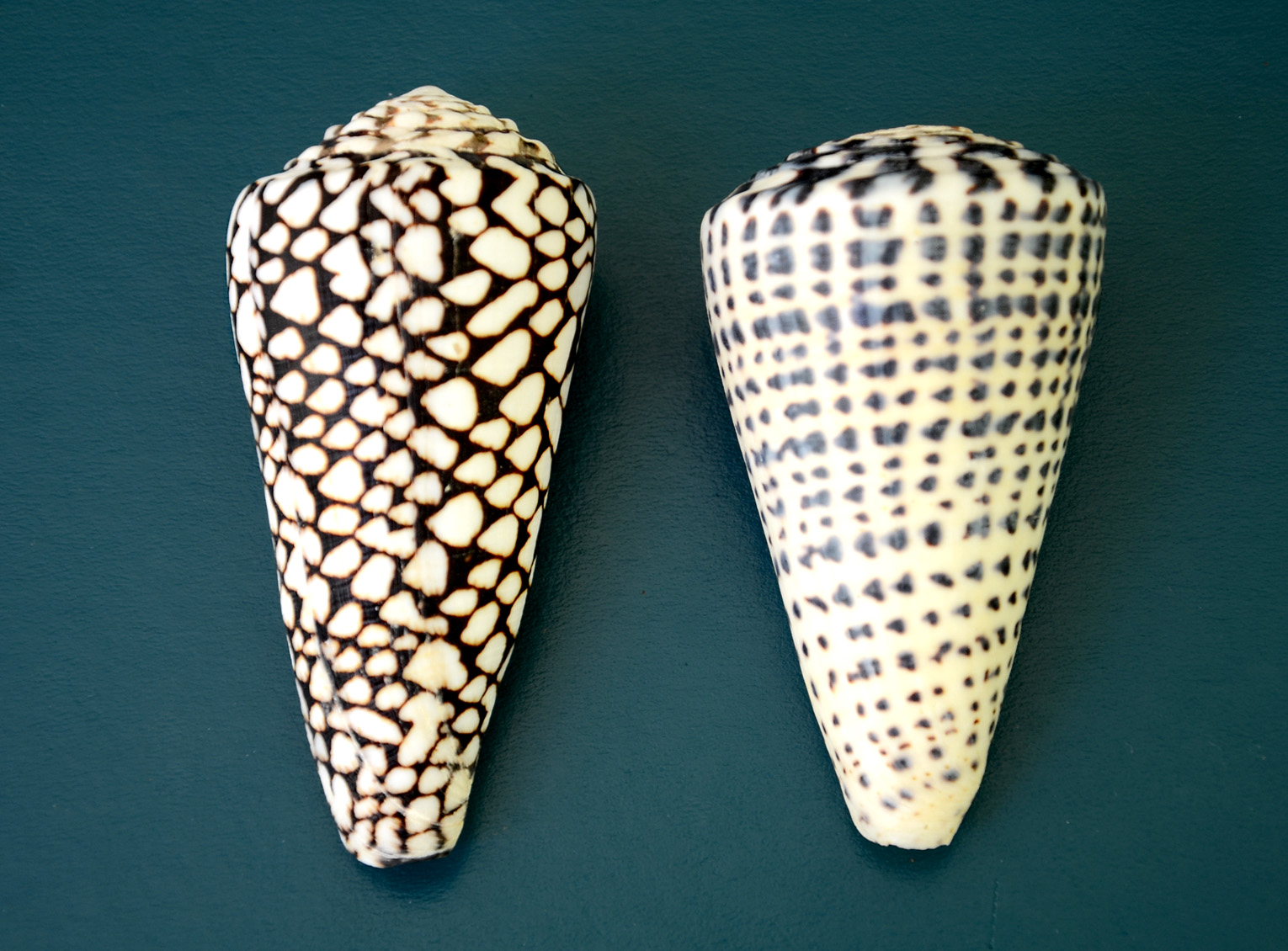
DSC_9964This month we have two large cones which are almost opposites. Both are favorites of collectors and artists alike. Any still life of shells is likely to include one or both!

Conus marmoreous is one of the classic shells described in Linnaeus’s monumental 1758 “Systemtema Naturae.” The marbled cone is about the most striking of all shells, black in color covered with uniformly sized white tents. It has an elegant ice cream cone shape. Younger shells up to about 60mm are especially beautiful with a high gloss but as the shells grow in size the surface changes from waxy to dull.  Conus marmoreous is predatory, living on other molluscs and inhabits the coral reefs in shallow waters across the Indo-Pacific range. This specimen is a larger shell of about 100mm.
Conus Leopardus was named by Roding in 1798. The shell has a cream colored waxy surface and is uniformly banded, top to bottom, with evenly sized and spaced black spots. Sadly larger specimens tend to loose the regularity of pattern making most specimens over 120mm less attractive. The leopard cone is one of the largest growing up to 200mm. Giant specimens today are quite rare and then they look like they have gone to war and lost, having lost their spots, turned chalky, and are marred by irregularly spaced growth lines plus heavy spire and body erosion. Conus leopardus too is predatory and is found across the entire Indo-Pacific range. Our specimen is small for a leopardus but is quite attractive and clean.
Both specimens are from the Philippines and were collected by local divers in sand pockets, inside coral reefs and in shallow water.

SHELL OF THE MONTH – JUNE 2013


DSC_7616

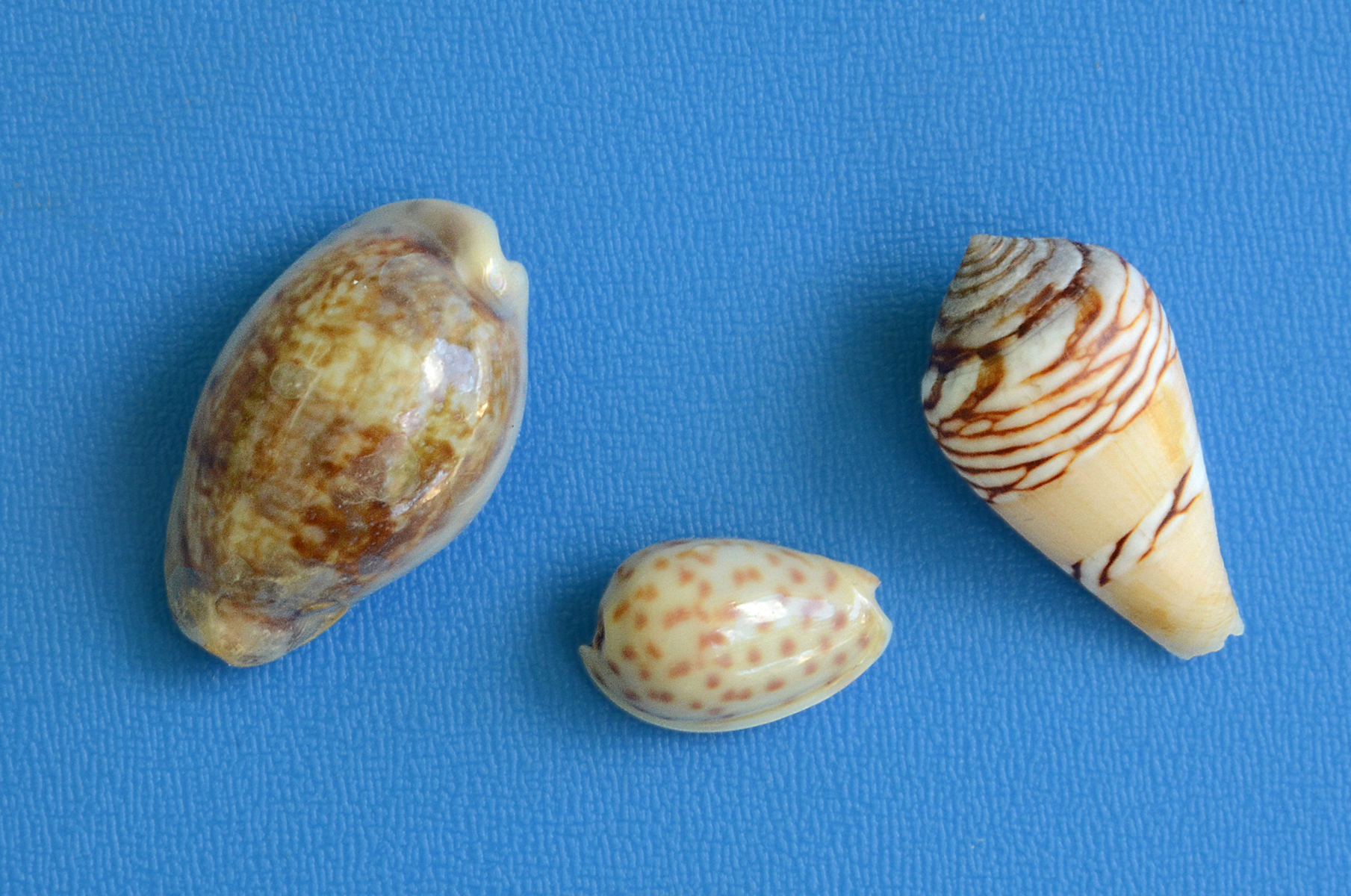
Conus mercator Linnaeus, 1758
Cypraea zonaria Gmelin, 1791
Persicula persicula Lamarck, 1822
   This month our shells come from Senegal, located on the “Bulge of Africa” – the westernmost point of the continent. Senegal is midway between the Tropic of Cancer and the Equator. The Portuguese were the first Europeans to reach the bulge in 1444. In 1677 the French took control of Gorée Island, in the harbor of what is now Dakar, and used it as a base in the slave trade. Senegal then became a French possession and remained so until it gained independence.
   Senegal is home to many desirable shells, but unfortunately for us, due to the ties with France, very few specimens come our way. Unlike in the Indo-Pacific Oceans where species have extended ranges, in the Atlantic virtually no species of shells are found across the ocean. The coast off Senegal and neighboring countries have their own distinct shells and most are endemic to the area.
   Conus Mercator is named after the great cartologist Geradus Mercator who was the creator of the first atlas.  It is very variable in pattern and that makes it fascinating to collect. Most specimens on the market come from the offshore Cape Verde Islands but ours in from the mainland. Conus Mercator typically has spire and body erosion; this is a very clean specimen. It small for a conus and this specimen is just barely 30mm.
   Cypraea (zonaria) zonaria is indigenous to West Africa. It is quite variable in size, shape and color. Unlike Conus Mercator that exhibits great variety from the same location, zonarias tend to vary according to location.
   The marginella family is exceptionally well represented on the Atlantic  of Africa with an extensive list of specie in many different families.  Perisicula periscula is quite attractive with its evenly spotted pattern.


   Recent sales on ebay would put the combined value of these three shells at between $40 and $50.  They were donated by Richard Kent.


SHELL OF THE MONTH – MAY 2013

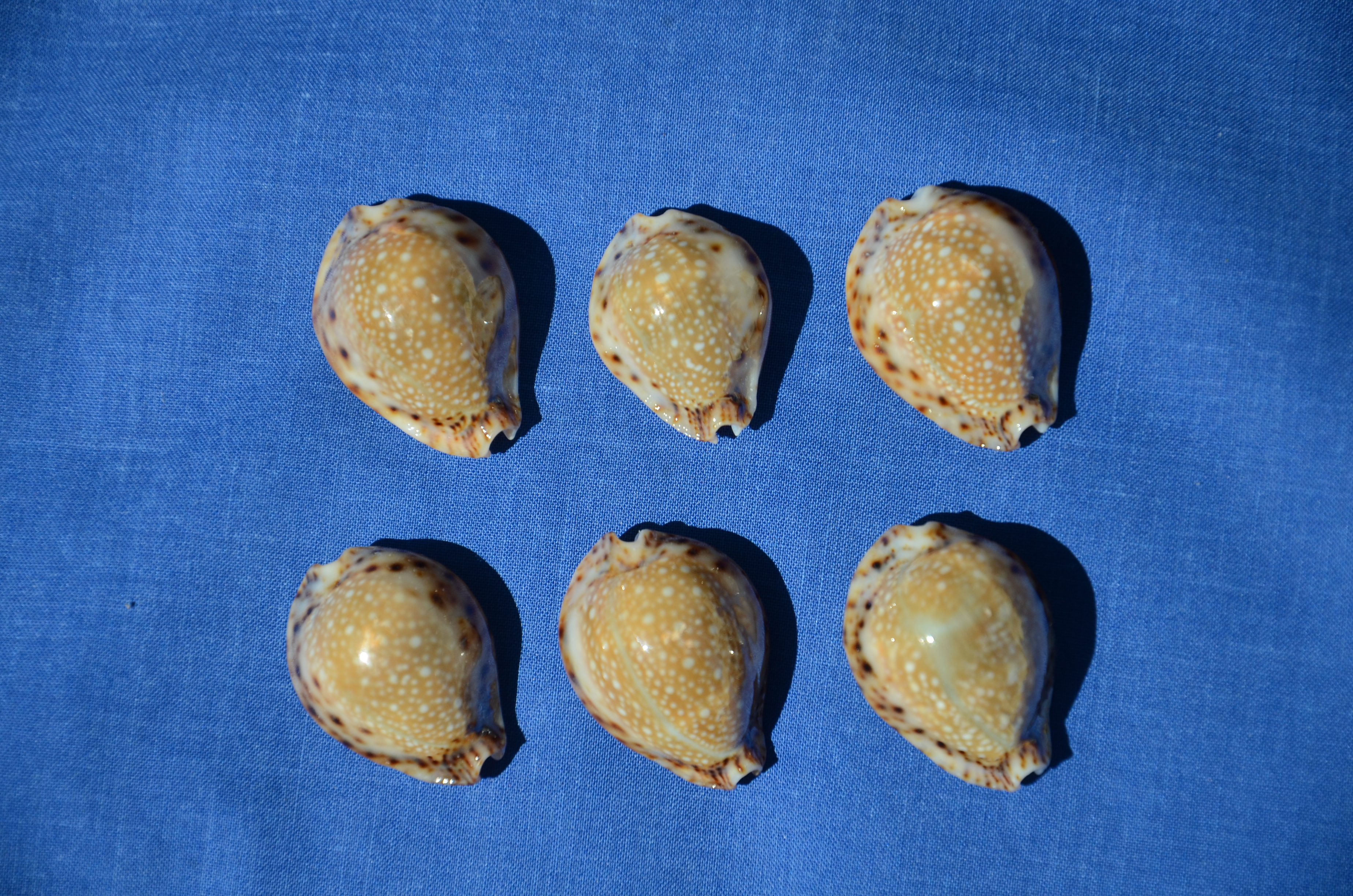
Cypraea Boivinii Kiener 1843

Cypraea (Erosaria) boivinii (Kiener, 1843) Beautiful hand selected set of 6 from the Philippines. Bottom right is the typical most common color form. Specimens with full length colored mantle lines are very scarce. The French naturalist Amedée Boivin, 1797- 1881, who collected Conidae and published at least one paper on Conus in 1864, is honored in the gastropod names Erosaria boivinii (Kiener, 1843), Anachis boivini (Kiener, 1841) and Conus boivini L. C. Kiener, 1845. A few other molluscs are also named after this person. (Andrew Vik, Tampa, Florida, kindly provided this information). Our thanks to Linda Ebeling and Richard Kent (as always) for their donations to the Raffle Table at the April meeting. Richard also supplied this month’s feature shell….as always, and they are always superb shells.


SHELL OF THE MONTH – APRIL 2013

DSC_3987

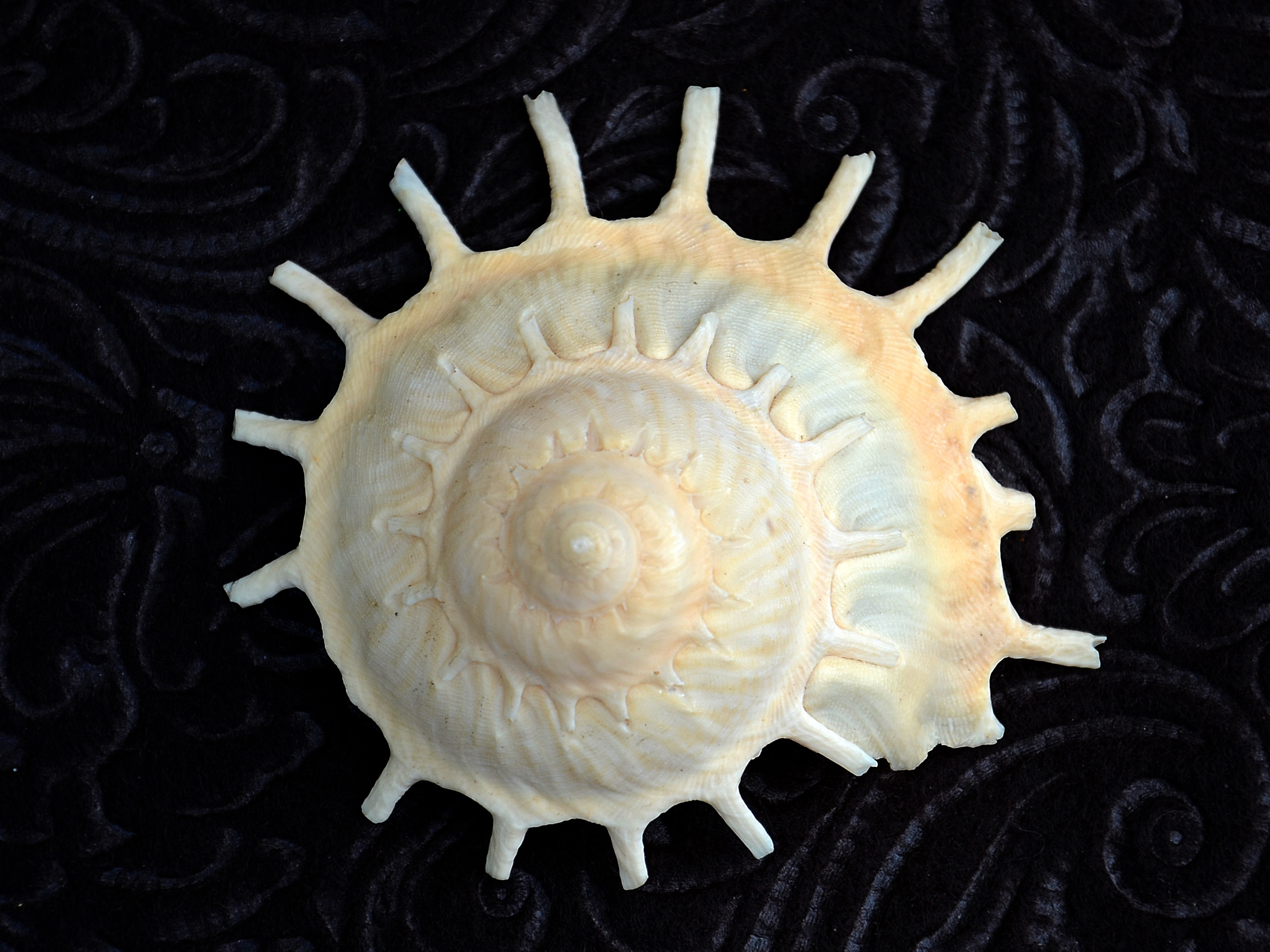
Stellaria solaris Linne, 1764 Netted in sand and mud bottom off Phu Quoc, Vietnam Size: about 3 1/2″ including spines. (90mm)


Although they are a member of the carrier shells, Stellaria solaris does not collect and attach to its shell. Commercial trawling has made thiese shells more available however perfect specimens are near impossible to obtain. According to author and Viet Nam shell expert Nguyen Thach most all specimens are damaged in collecting. Too bad. Stellaria solaris is usually collected from offshore waters  in either South-East Asia or the Philippines.


Our thanks to Linda Ebeling and Richard Kent for their generous donations to the Raffle Table at the February meeting. All items are always welcome!


SHELL OF THE MONTH – FEBRUARY 2013


Oliva irisans Lamarck, 1811

  Olives are one of the most fascinating families of shells to collect. Although any olive is immediately recognizable, these glossy shells come in an infinite variety of color patterns, shape and size. Here in Florida, olives are one of the easier shells for the beginner to collect as they often live in shallow water, burrowed in the sand. They are scavengers and predators. They are communal and will share a meal with others. Empty shells are common in beach drift.


   Olives present challenges. Scientists disagree on the nomenclature and the name that appears in the dealers list and shell books is often different than the currently accepted scientific name. These five specimens can often be found identified as Oliva lignaria Marrat, 1868. Recently it was decided that lignaria is a synonym for a different shell named Oliva ornata Marrat 1867. Oliva ornata may not even be a species, itself a variety of Oliva irisans Lamarck 1811 which is now the currently accepted name. Hold on, these may also be identified instead as Oliva concinna, Marrat, 1870. No concinna is a form based on structure of irisans –  Oliva irisans forma concinna Marrat 1870. Very confusing! To become an expert on olive identification one must learn all about filament channels, columellar callosity, and fasciole. It gets technical! The color varieties too all have been named, such as Oliva irisans forma oldi Zeigler 1969 which is the heavily mottled shell.


   These shells were donated from the collection of Richard Kent. They came from Australia, Indonesia and the Philippines. It took much time and searching to assemble a couple of color sets. Interestingly, the common plain pattern shells are now hard to obtain as only the scarcer color patterns are collected by divers as these bring the highest prices. ps: still searching for the very rare albino variation.

DSC_9908

SHELL OF THE MONTH JANUARY 2013

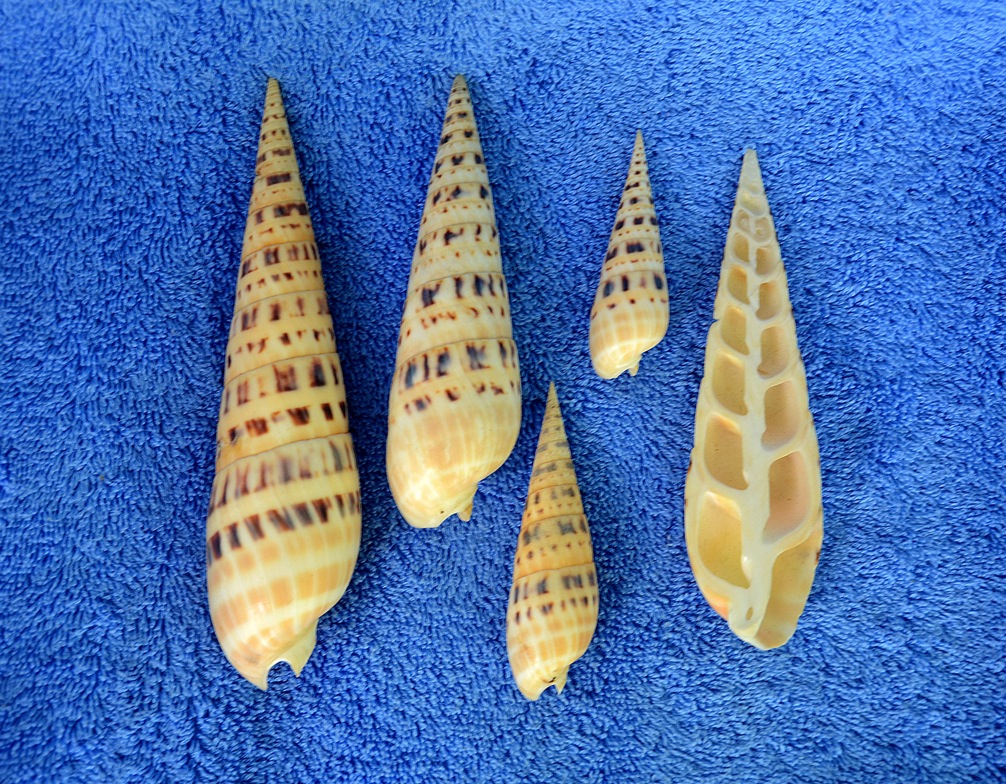
DSC_9468Acus maculata, Linneaus 1758. “The Marlin Spike”. Growth series from under 3″ to over 6″ including one cut to show growth spirals. From Guam!

Richard Kent has yet again supplied us with another shell…or should I say shells as our feature shell for this month. Terebras are a marvelous family of shells whose shapes never vary unlike some other families. They are always that wonderful long-tapering “spike” shape. Size, color patterns and such may vary…but never their shape. What makes this feature special is the cut-away shell so you can see the internal structure. You will want to take a chance on these!