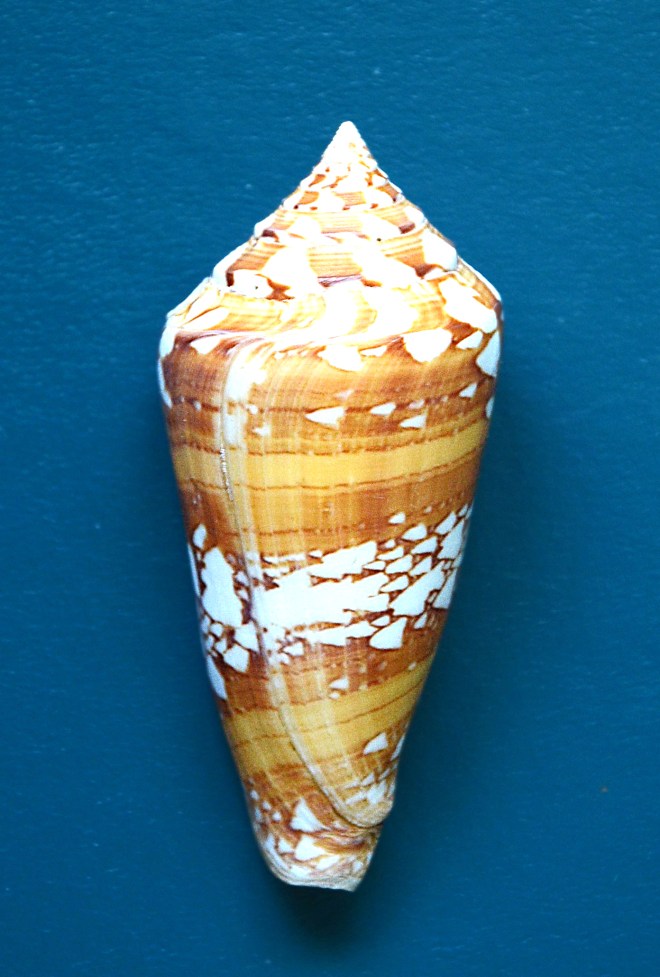
 Conus amadis castaneofasciata Dautzenberg, 1937 is an attractive and highly desirable subspecies of Conus amadis Gmelin, 1791, One could easily say it is its own species as it is collected off the coast of Myanmar and Southern Thailand while Conus amadis is found in India. The differences are many, Conus amadis castaneofasciata has a higher gloss, a taller spire, lighter in weight, more erratic tenting, different coloration, and pronounced banding.
Conus amadis is a mid-sized cone typically about 75mm though they do come much larger. Evidently they grow in rapid spurts, then rest, as virtually all specimens have pronounced growth lines.
Conus amadis castaneofasciata is quite variable. Deep water populations have very tall spires, some populations are al golden in color while another is chocolate brown with minimal tenting.
This specimen, donated by Richard Kent, was trawled off the Andaman Islands in Myanmar.
Category: Shell of the Month
SHELL OF THE MONTH – SEPTEMBER 2016
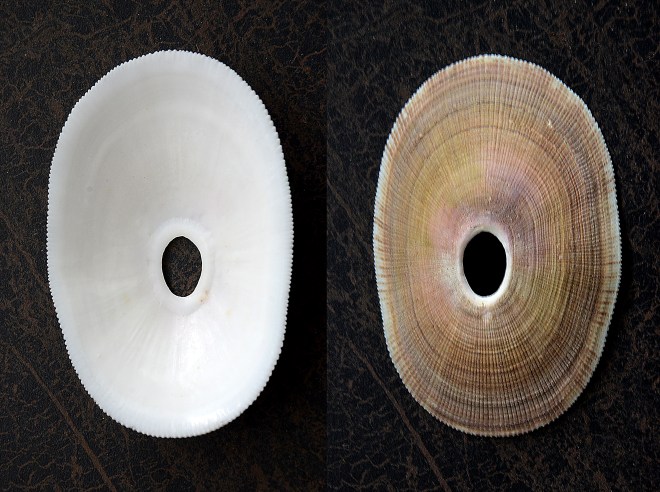
Megathura crenulata Sowerby, 1825 by Scuba diving at 35’ on side of large rock pinnacle, Monterey, California
Keyhole limpets are a primitive type of gastropod that live fastened on rocks. They have a slimy grey skin that covers the shell and have a central hole which is used to expel waste away from the gills and mouth. Limpets feed off of algae with a radula that scrapes the algae into their mouths. By using the muscular foot, the limpets are able to form such a tight bond to their home rocks that it makes it very dif cult to pry them off, offering protection against predators and collectors. The at shell protects it from crashing waves and coastal currents.
Megathura crenulata Sowerby, 1825, known at the Giant Keyhole Limpet, is found on the west coast of California in temperate waters. In the past, keyhole limpet shells were used as currency and decoration by Native Americans. This shell, about 4.5″ in size, was donated by Richard Kent.
SHELL OF THE MONTH – AUGUST 2016
SHELL OF THE MONTH – JULY 2016
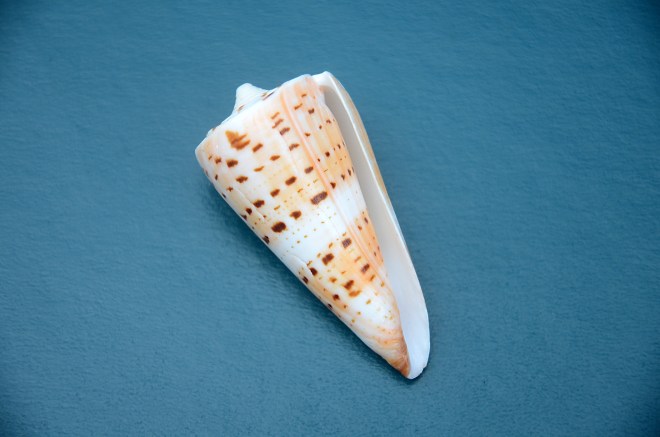 Conus monile Hwass 1792
Trawled, Mergui Archipelago
Myanmar (Burma)
The Necklace Cone is a very attractive shell. It has the classic “ice cream cone” shape. It has a nice gloss and an interesting variable pattern. Typical specimens are white with a rows of brown necklaces. Certain populations especially those from the south of Burma are suffused with salmon.
Adult specimens range are typically 2-2.5″ in size, though they do grow larger. As typical with cones the spire suffers from erosion, especially in the biggest specimens. This specimen is 2.5″.
Conus monile is an Indian Ocean specie restricted to the Bay of Bengal and Andaman Sea. Most specimens come from either the southern tip of India or the west coast of Burma and Thailand. Although a shallow water specie, mosts pecimens come from the fishing boats. Its habitat is reported as “on sand with clay and shell rubble.”
SHELL OF THE MONTH – JUNE 2016
SHELL OF THE MONTH – MAY 2016

Homalocantha pele (Pilsbry, 1918) Taken by diver on ledges at 80 feet North coast, Oahu, Hawaii
Homalocantha pele (Pilsbry, 1918) will never win a beauty contest, that’s for sure! It is however a very popular shell to collect to do it’s extreme variety in size, shape and color. Typical specimens are an off white in color and rather bland, but there are those that exhibit, lavender, purple, yellow, and most desirable bright orange or red. The shape of the fronds are much wider and more developed in the better specimens. Sometimes there is even a double row of fronds.
Homalocantha pele (Pilsbry, 1918) is a reef dweller, well camou aged in life. It is a member of the Muricidae family and a fairly small genus called Homalocantha. It has a very close relative in Homalocantha anatomica (Perry, 1811) and for years they were considered one and the same. H. anatomica is found in the Philippines and H. pele is indigenous to Hawaii. Side by side they are recognizably different and even amateur collectors will have no trouble distinguishing the two.
Our specimen, donated by Richard Kent, is typical in size and color. Collectors looking to acquire the most exotic colored pele need to be prepared to pay outrageous prices as a bright red and white specimen can bring up ten times the price as an ordinary one in auction.
SHELL OF THE MONTH – APRIL 2016
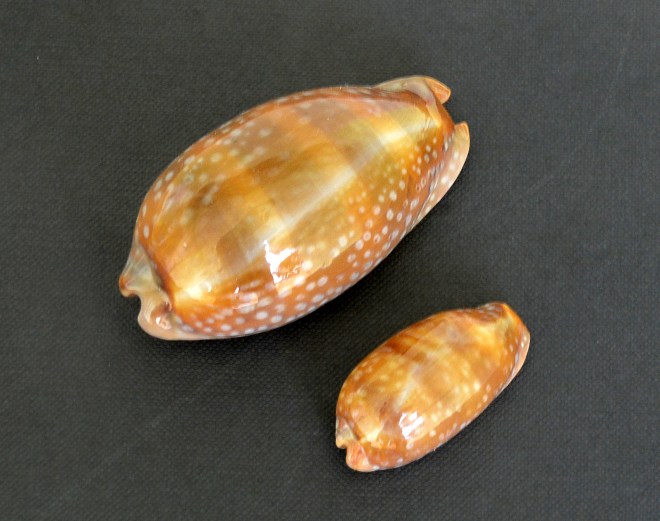
Macrocypraea cervinetta (Kiener, 1843), the Litttle Deer Cowrie, is a very close cousin to our own Macrocypraea cervus (Linne 1771), the Deer Cowrie. Both are among the largest growing of all cowries, however both are extremely variable in size, especially cervinetta as both dwarf populations and giant populations do exist. Size ranges from 130mm down to 35mm. Our specimens are approximately 72 and 40mm.
Both cervus and cervinetta are light in weight, and have an overall fawn color with a greyer base. They are heavily spotted with white. Often there is a gap in the coloring to expose dorsal banding and sometimes a mantle line. The teeth are stained dark. The pattern is very constant. The main difference is in shape where cervinetta is elongated and flattened and cervus is globular.
Cervus and cevinetta lives on opposite sides of our continent. Cervus in the Caribbean specie and cervinetta the Pacific. Although cervinetta has an extended range from Mexico south to Peru, virtually all specimens come from the coast of Panama. Cervinetta lives in shallow water, is nocturnal and if often found exposed in the moonlight.
Both specimens are donated from the collection of Richard Kent
SHELL OF THE MONTH – FEBRUARY 2016
 Cymbiolacca pulchra houarti, Poppe 1985
The Volutes are among the most beautiful of all shells. The reason they are not more popular here is that none have extensive distribution, a very few come from our hemisphere, with majority indigenous to Australia – and are those Aussie shells ever fantastic! Cymbiolacca is one of the finest with about seven species recognized. What makes the genus Cymbiolacca most exciting and collectible is that each species has several subspecies or forms. It seems every region of Queensland, Australia has its own variety.
All are glossy and have a relatively similar size, shape and pattern. All are white, with a pinkish or rose overlay, revealing small white areas, each with its own brown to black spot. Some varieties are smooth, some have shoulder tubercules with or without small sharp spines or not. Some shells are way more elongate than others. A few are heavier in mass. Some have two darker color bands. One thing they all have in common are rows of short vertical dashes on the apex end of each whorl. They makes for a fascinating study.
The snail itself it very attractive with a very large brightly colored foot.
Cymbiolacca Pulchra Sowerby, 1825 has several varieties including Cymbiolacca pulchra houarti, Poppe 1985 which is our shell of the month It is about 72mm, a descent size and a very pretty specimen. It was donated from the collection of Richard Kent and acquired from Australian sheller Doug Thorn, who goes by the business name of Peristicta, which is one of the species in this genus.
Note: Recent changes in accepted nomenclature now have the name as Cymbiola (cymbiolacca) houarti Bail & Limpus, 1998
SHELL OF THE MONTH – JANUARY 2016
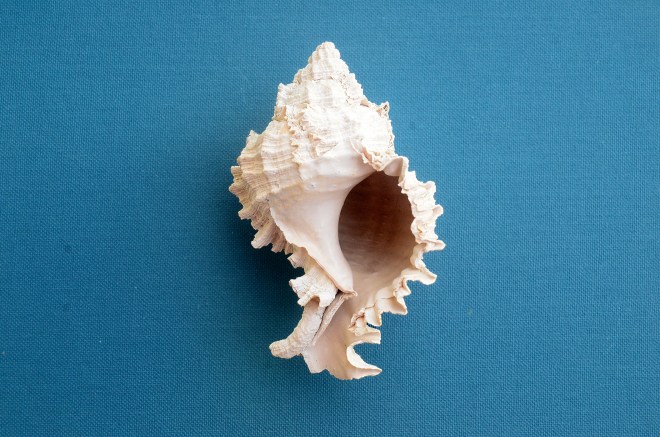 Species: Phyllonotus globosus (Emmons, 1858)
Size: 82mm
Remarks: This is a GORGEOUS, rare specimen excavated in Sarasota, FL. It dates from the Pliocene and more specifically from the Piacenzian Age, around 3.6-2.588 million years ago. In the ancient sea that covered Florida, this species would have lived on open sand areas and among turtle grass. This is a beautifully preserved specimen, and a must have for the serious fossil collector. Incredibly, this species still lives on to this day and can now be found in Venezuela. I have to say though, this fossil is honestly much more ornate than the vast majority of live taken globosus specimens I have seen. Better spines, better detail…an all around amazing fossil!
(descriptive text that came with fossil – donated by Richard Kent)
SHELL OF THE MONTH – NOVEMBER 2015
 Cypraea achatidea Sowerby, 1837 Trawled by fishing boats 50m, mud and sandy bottom, Dakar harbor, Senegal 2006
Cypraea achatidea Sowerby,1837 – the Agate Cowry – is a seldom seen attractive mid sized cowry. It is usually trawled in moderately deep water. Its scarcity in collections is due to its range which goes from the western Mediterranean down along the cost of Africa. Mediterranean specimens are almost impossible to attain. Most offered come from Senegal.
The shell is pyriform, light in weight with fine indistinct teeth on a whitish base. The dorsum is banded in immature specimens but this gets covered over in adults and is hardly visible. The adult dorsum is cream, freckled and mottled with brown. The shell is quite consistent in color and size with the main variation being the degree and intensity of mottling. The size is typically around 35mm.
Scientists placed Cypraea achatidea in the genus Schilderia. It is the one and only species. The African specimens are named Cypraea achatidea longingua Sch & Sch 1938 however many dealers prefer the name Cypraea achatidea inopinata Sch 1930.
This specimen is donated by Richard Kent and was acquired from an Italian dealer who specializes in cypraea.
 Broward Shell Club
You must be logged in to post a comment.