SHELL OF THE MONTH – NOVEMBER 2017

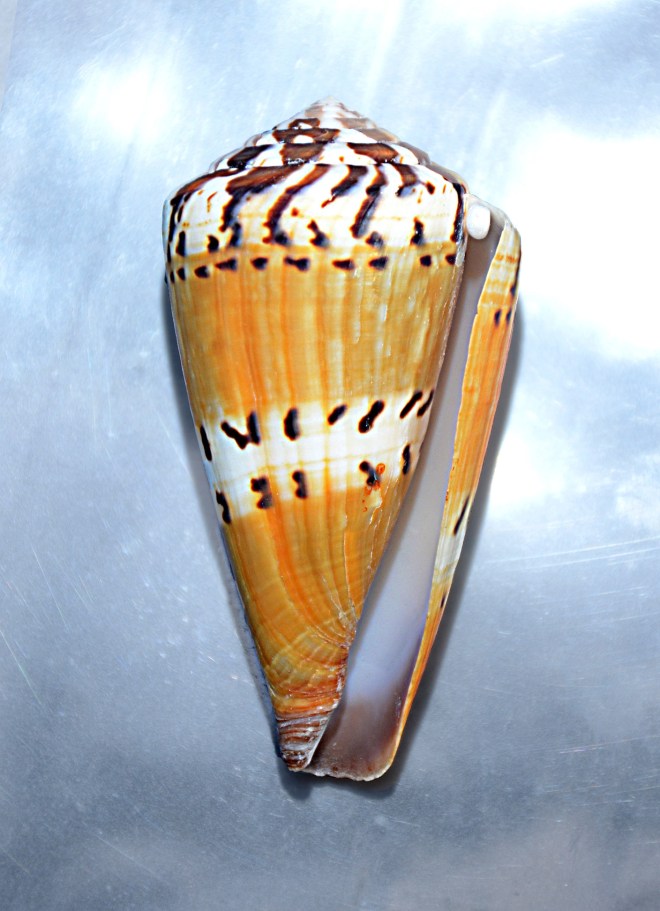
Conus (Rhizoconus) mustelinus Hwass in Bruguière, 1792
by native diver in sand patch among coral reef at 5-7m
Off Samar Island, Phillipines

Its attractive coloration and classic cone shape make Conus mustelinus a favorite among collectors. One would think because of its mustard color it would be called the mustard cone, but no, its popular name is ermine cone or weasel cone. We’ll never know what Hwass had in mind when he gave the shell its Latin name!
Conus mustelinus is widespread across the the Western Pacific Ocean. It is easy to collect as it favors shallow water and dwells exposed in the sand at the base of corals.
The shell is solid in color and comes in various shades of mustard with occasional populations greenish or maize. There is a narrow white band about midbody and occasionally a second closer to the shoulder. There are black dots on the edge of the bands and black chevrons on a white crown. The pattern is fairly constant from one to the next, but there is enough variation to make it fun to collect a series Young specimens have a nice gloss, mature ones do not.
This specimen is large in size at approximately 83mm in length. The lip is natural. The shell exhibits the minor scars that one would expect in a fully grown specimen, however the condition is as good as they come. Donated from the collection of Richard Kent.
SHELL OF THE MONTH – OCTOBER 2017

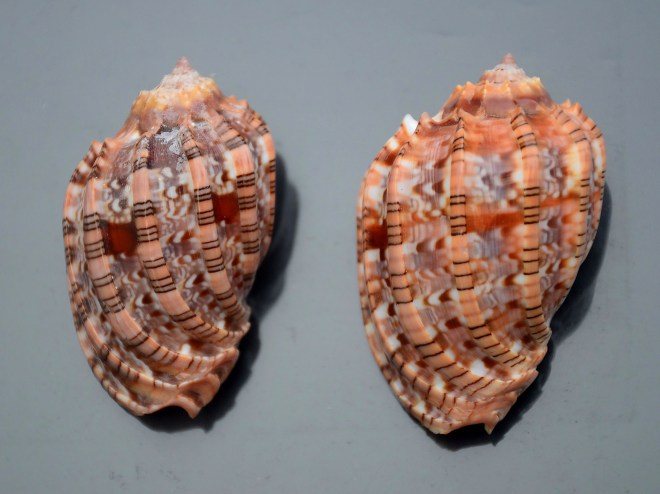
Harpa harpa (Linnaeus, 1758) in sand at 10m by local fishermen, Pag Asa Island, Palawan, Philippines (left) inside reef at 10-15m by local divers, Bohol, Philippines (right)

Many collectors consider the harps to be the most beautiful of all shells. With their stately shape, complex sculpturing, intricate patters, coordinated color scheme and mid size, they live up to the claim.
The Harps are a small family that inhabit tropical waters, with the majority found in Philippine and Pacific waters. Harpa harpa, Linnaeus 1758, commonly called the Noble Harp is the namesake species and our shell of the month. We have two specimens, similar in size and although at first glance they appear nearly identical a close inspection will reveal many differences. Harpa harpa has about a dozen ribs with spines on the posterior end. Between the spines are fine groves with rows of chevron patterns. Distinguishing marks from the other harps are the groups of 2 or 3 fine black lines hat cross the ribs and the three brown blotches on the base.
Harps are carniverous and feed on small crabs and shrimp. They burrow in the sand and live in moderate depths.
These specimens, are both in gem condition with mature lips. They are from the collection of Richard Kent.
SHELL OF THE MONTH – AUGUST 2017

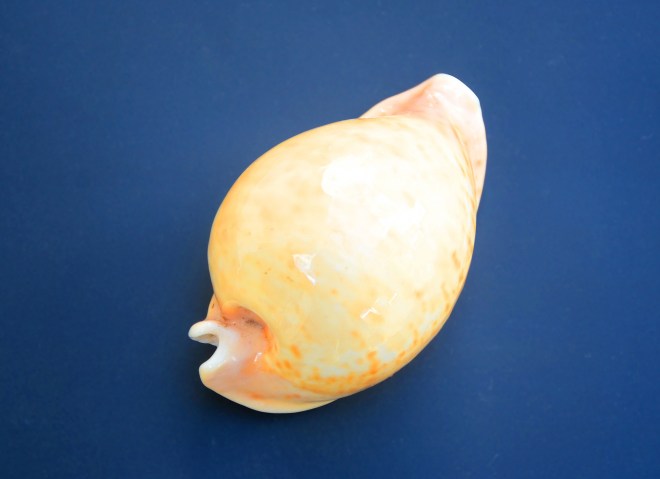
Umbilia armeniaca Verco, 1912
Trawled 150m
Great Australian BightSouth Australia, 2015

Once a prized extreme rarity, Umbilia armeniaca Verco, 1912, became available on the market due to very deep water trawling off the South Coast of Australia starting about five years ago. Although no longer rare specimens bring a hefty price.

The genus Umbilia is a small one with only three specie. All are deepwater and from Southetn Austalia. They are Umbilia armeniaca Verco, 1912; Umbilia capricornica Lorenz, 1989 and Umbilia hesitata Iredale, 1916.

Umbilia do not look like other Cypraea, with thier huge globose hump, extreme rostration, and curved aperture. Although it’s called the Tangerine Cowry, many populations are cream and beige. Most have a large variable botch of color that surrounds the hump, some do not. Specimens range for about 80-110mm in size with the majority falling on the smaller end of the range. This specimen is typical in size and does have stress (growth) lines.

Beige colored specimens of  Armeniaca may look very similar Hesitata, but are distinguished by the surface texture.  Armenia ae smooth and glossy whereas mature specimens of Hesitata ar porous and waxy.

This specimen is donated by Richard Kent, acquired from Australian dealer Doug Thorn.


SHELL OF THE MONTH – JULY 2017

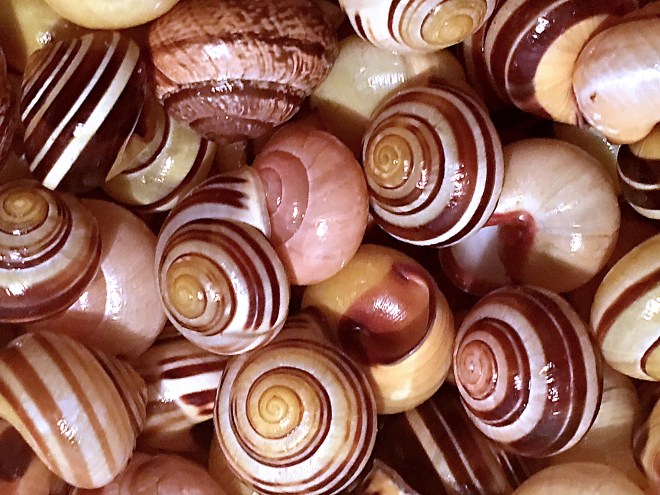
LANDSNAILS – SET OF MINIMUM 100 BELGIAN LAND SNAILS

Quality: Great quality.

Collected: ARIANTA ARBUSTORUM (minimum 20) On the ground between dead leaves at the edges of the forest.

CEPAEA HORTENSIS & CEPAEA NEMORALIS (minimum 80) On the ground and on trees.

All collected in the forest on the left bank of the river Schelde, Antwerp, Belgium.

Comments: Self collected Belgian soil land snails by Willy Van Damme

SHELL OF THE MONTH – JUNE 2017

Tutufa rubeta Linnaeus, 1758
by divers on coral reef at 15-20m
Poro Island, Camotes, Cebu
Philippines

Shells from the family Bursidae are commonly known as “Frog Shells.” The inhabit the tropial seas and live in the coral reefs. As such, they can end up encrusted with coral growths making them well camouflaged and difficult to cleanup. Tutufa rubeta, Linne, 1758 is but one of the many varieties of frog shells found in the Philippines. Relatively few specimens reach the market making Bursa a challenging family to collect.
Bursa are heavy for their size, are beige or tan in color and interesting detail in their mouth or aperture. Tutufa rubeta is named for its red mouth, although only young specimens exhibit the red coloring. The larger the specimen, the paler the mouth. This specimen is about 4″. Occasional specimens grow to just over 5″. This one was live collected and comes with the preserved operculum.
The most sought our member of the family is Tutufa Bubo Linne, 1758 which grows to a whopping 10″.
Donated from the collection of Richard Kent

SHELL OF THE MONTH – MAY 2017

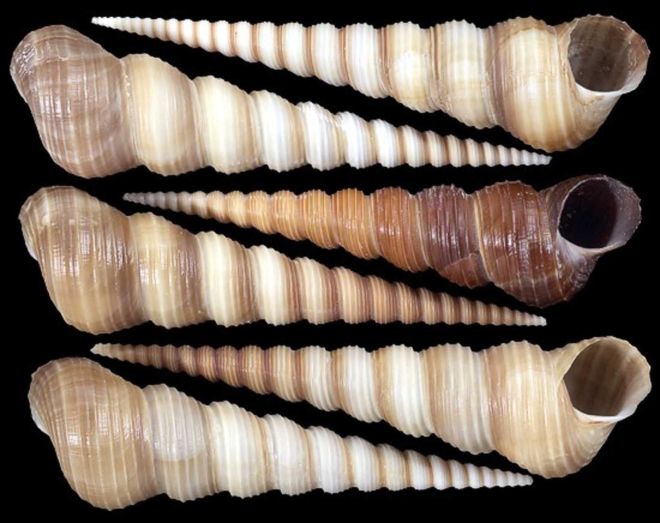
Turritella terebra (Linnaeus, 1758)

Lucky is the shell crafter who wins this raffle. Imagine all that can be created with two dozen (24) of these magnificent shells!

Commonly 5-7cm, they can can grow to 15-17cm long. Turritella terebra is a very tall elegant shell with regular spirals which are finely ridged. The color ranges from cream to chocolate brown with all shades in between. It is the largest of Family Turritellidae where most are small and seldomly collected.

Turritella terebra is herbivorous and lives on sandy and muddy areas of the intertidal zone. In the northern Philippines, they are regularly collected and marketed as food.

Although these are offered as craft shells they are of high quality and not seconds. They are from the Philippines. Donated by Richard Kent

SHELL OF THE MONTH – APRIL 2017


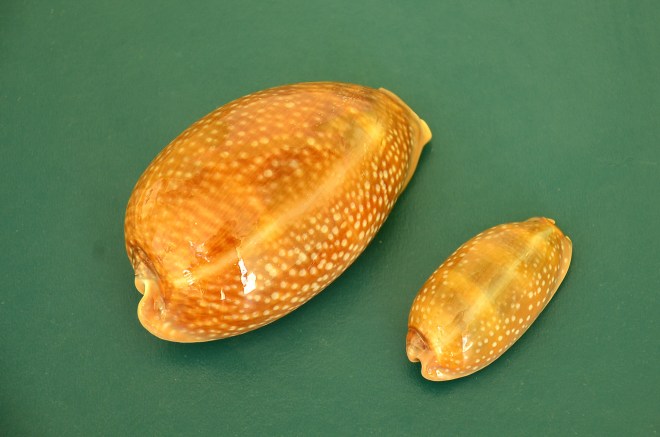
Cypraea cervus Linne 1758
under ledge by diver at 60′
Off Madiera Beach, Florida 2004

Cypraea cervinetta Kienner, 1843
under dead coral slabs,
shallow water at low tide
Pedro Gonzales, Panama


Deer Cowrie and Little Deer Cowrie. This month’s specimen shells are very closely related. They are near identical in color and pattern, both having fawn colored dorsums covered with hazy white spots and a clear area formed by the mantle line. Looking at the two side by side they are easy to separate. Cypraea cervus Linne 1758 is “plump” whereas Cypraea cervinetta Kienner, 1843 is “lean”. As a rule cervus is the much larger of the two. Cervinetta’s teeth are more strongly defined. Cervus is found in the Florida keys, the Florida gulf coast, Cuba and the Yucatan. Cervinetta lives on the west coast of Central America, most commonly found in Panama.

Both are noted for their extreme wide range in size. Cypraea cervus grows to the largest size of all cypraea, reaching a whopping 190mm (7.5″). Giant specimens which are very few and far between bring jaw dropping prices as they just don’t grow so large anymore. Today, typical specimens are 80-100mm. Cypraea cervinetta has dwarf populations going down to just under 30mm in size. Juveniles of both are banded. The banding gets glazed over in adults although most specimens of cervinetta will show some banding on the top of the dorsum. Fresh specimens have brown dorsums that fade rapidly to fawn even when stored in darkness.

The two specimens are close to “gem” in quality and are typical in pattern. They are donated from the collection of Richard Kent.

SHELL OF THE MONTH – FEBRUARY 2017

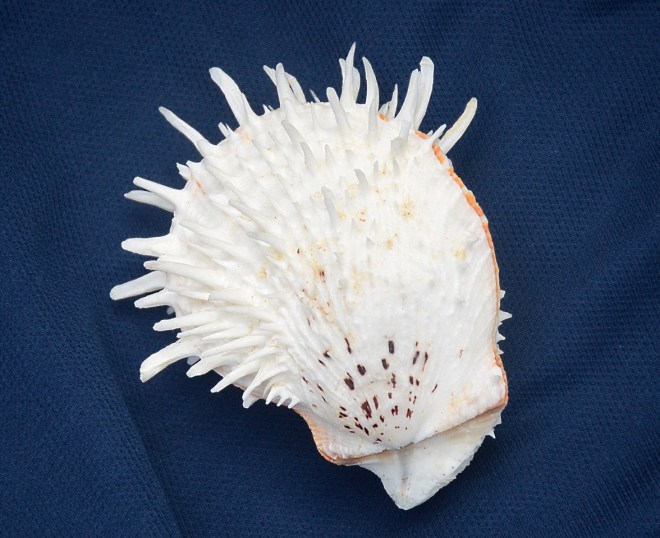
dsc_6983Spondylus versicolor Schreibers, 1793 by diver on rock and coral wall. Racha Islands, Thailand, 2014

Thorny oysters do not have much in common with the the true oyster. They hardly resemble each other. True oysters live in huge colonies whereas the thorny oyster tends to be a loaner. One is collected to be consumed as a delicacy. The other because of its attractive and delicate spines. They do have two things in common. Both attach themselves to a solid surface with a byssus. Both have a ball and socket that joins the two valves together rather than a toothed hinge as in other bivaves.
Spondylus in the only genus in the family Spondylidae. There are about fifty members in the genus and often are very confusing to classify. They are found in tropical waters around the world. Spondylus versicolor Schreibers, 1793 is called the “golden thorny oyster” though the color is more likely to be orange and never golden. This specimen is an albino but a look at the margin where the valves come together and one will see orange color.
Spondylus are highly collectible and eagerly sought out. Anyone who has collected live specimens can attest to how challenging many specimens are to clean.
This very attractive specimen came from the Phuket Islands area of Thailand and is about three and half inches across. Donated by Richard Kent and originally purchased from a Thai dealer.

SHELL OF THE MONTH – JANUARY 2017

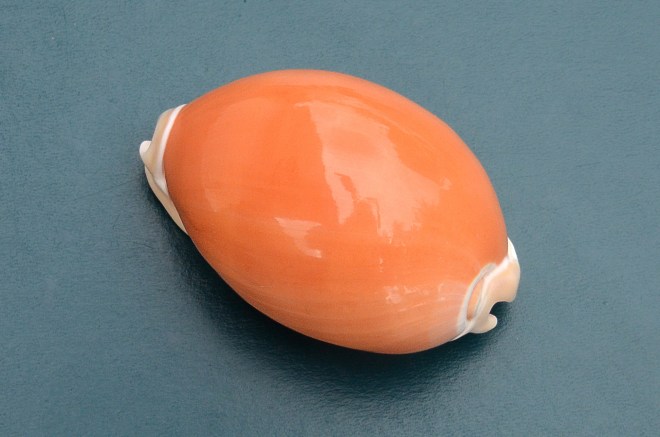
aurantiumCypraea aurantium Gmelin, 1791 was until recently the most prized of all cowries and the centerpiece of a collection. Today, now that its habitat is known, the Golden Cowry is available to collectors. This however does not diminish in any way its beauty or desirability.

The current taxon is in Lyncina Troschel, 1863 whose type shell is the common yet beautiful Cypraea lynx Linn,1758. A comparison of the bases makes the relationship obvious. Lynicina includes the ultra rare Lyncina broderpii, lucodon and porteri, along with such common specie as carneola and vitellus.
Lyncina aurantium is a big, heavy and beautiful globose shell with a solid orange dorsum and white base. It is Indo-Pacific found in the Philippines and Fiji with an apparent gap in between. They grow up to 100MM and slightly larger.  A giant one is is spectacular. Unfortunately, the majority of specimens are marred by stress growth marks. The marks are readily obvious to the person harvesting and should have been left alive to reproduce, but since these inferior specimens will still bring a fair price, they are taken.

Lyncina aurantium is a nocturnal, deepwater reef species and we’re giving away a secret here, a cave dweller that likes to hang upside down suspended on the roof of the cave. As SCUBA divers most often looked straight ahead, they failed to observe to aurantium above their heads! Most specimens today are collected by hookah divers who stand rather than swim. It is virtually impossible to get specific collection data and maybe that is a good thing so as to protect from over collection.

This specimen is a fine example, though not quite gem as it has faint growth lines that are only noticeable upon close inspection. Its size of three and a had inches is slightly below average. It will be a prize shell to the person that wins the raffle! Donated by Richard Kent

Cypraea aurantium Gmelin, 1791
collected by hookah diver
50 meters deep, Albay Gulf
Philippines. 2011
.

SHELL OF THE MONTH – NOVEMBER 2016

dsc_6650-copyCypraea guttata azumai, Schilder 1960

Cypraea guttata, Gmelin 1791 is one of the most exquisite of all shells. Until recently it was also one of the rarest. When Burgess wrote his monumental book “The Living Cowries” in 1970, he stated that there were fewer than 20 known specimens. Today due to the Asian commercial fishing fleets trawling in deep water, specimens consistently come to the market. Cypraea guttata has an orange dorsum with white “drops”; The extremities are rostrate and spiny. The prominent teeth extend the width of the base and are deep brown stained contrasting to a white base.

The variety Erosaria guttata azumai was not known until Schilder described two dead collected specimens from off the coast of Japan in 1960. Today specimens collected in the East and South China Seas are the ones most likely to be offered by dealers. Cypraea guttata guttata, Gmelin 1791, the Philippine variety and first described is the hardest to acquire. They grow to the largest size and these big specimens are incredibly striking (and super expensive too!) Cypraea guttata surinensis, Raybaudi 1978 which comes from the Andaman Sea is the most vibrant with a richer color and almost black teeth. It also tends to bring the highest prices. Because most specimens come from commercial trawling, too many substandard and immature specimens reach the market. This specimen though is in gem condition, average in size, and exemplifies the reduced spotting that is typical of the azumai variety. It was trawled in 2008 at 200 meters deep off the coast of Zhejang Province near Ningbo City in the East China Sea. The shell was purchased direct from China and donated by Richard Kent.