Category: Shell of the Month
SHELL OF THE MONTH – OCTOBER 2019

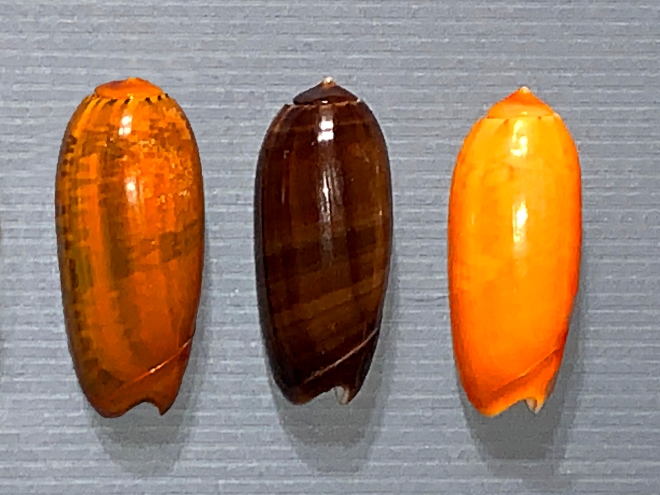
A big mystery in the shell world is why do certain olives cover their pattern with a layer of color, most always black or orange? It is as if they are getting ready to celebrate Halloween!
For our October Shell of the Month we have three specimens of Oliva irisans Lamarck, 1811, one orange, one black and an unusual one overlaid with brown yet revealing the pattern underneath. Typical specimens, if there is such a thing, are whitish with faint overall mottling and big bold streaks of brown. Possibly the typical pattern has two interrupted brown bands instead.
Olives are scavengers, generally found burrowed in sand with just their siphon exposed. They are communal by nature and will share a meal. Up until anout10 years ago olives were abundant off the coast of Broward County. They were easily collected on the off shore sandbars that weould be exposed at low tide. After a heavy storm dozens would be found washed up on the beach. Wiith all the beach reconstructions and dredging in recent years, they are no more. On the west coast olives are still abundant.
Olives are fun to collect as there are so many species. Most are colorful, the patterns are interesting and varied and most all are small in size. Identifification is another story all together as olives are all so similar. Olives have been named and renamed so one needs a very current book to have the latest name. There is a good chance the name on the label of a specimen one bought few years ago is no longer valid.
Oliva irisans Lamarck, 1811is sometimes mislabeled as Oliva lignaria Marrat, 1868 as they are quite similar.. Irisans is distinguished by the heavy callous on the apex and spire. The color varieties of irisans all have individual names which are not currently recognized, but still used in the trade.
Two of the specimens are from the Philippines and the third is from Indonesia. They are matched in size and about gem in condition. Donated from the collection of Richard Kent
SHELL OF THE MONTH – SEPTEMBER 2019
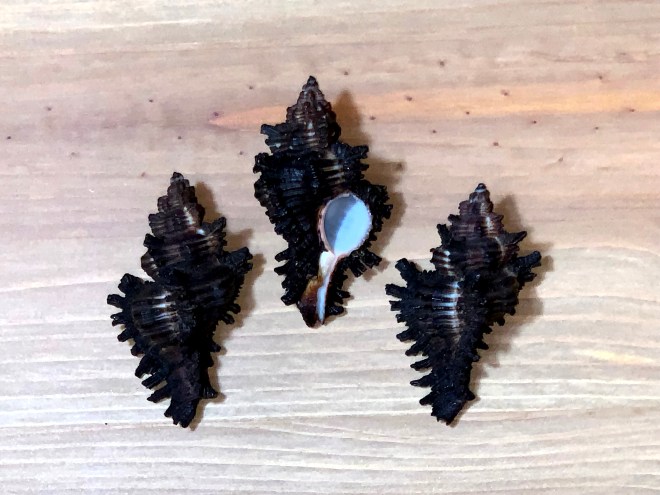
Chicoreus brunneus, Link 1807 by diver at 10m in coral rubble, Mactan Island, Cebu, Philippines 2010
The Muricidae is one of the largest, varied and most confusing of all families of mollusks. Within Muricidae, Chicoreus is the most popular and widely collected. Worldwide in tropical waters, we have many here in Florida and the Caribbean. The Philippines have the greatest number of varieties and of those Chicoreus bruneus is one of the more popular and readily available. Its popularity comes from its deep brown, almost black color that overlays a white shell. All black and albino specimens are only moderately scare. Orange specimens are rare and quite likely another Chicoreus mislabeled. A common color variety seen mainly in larger specimens is a predominately white shell with black fronds, quite striking!
Another factor that makes Chicoreus so interesting are the the fronds on each varicy. Sometimes short, sometime long, and sometimes fanned out. Chicoreus brunneus varies too in adult size from under two inches to giant and now scarce specimens of four inches.
Murex are predators and can be found in any waters where there is an abundance of food.
These three beautiful specimens were obtained from a Philippine dealer. At first glance they may appear identical but further examination will reveal differences. Sizewise they are on the smaller range, about two and a quarter inches, which seems to be what is most often seen nowadays. Donated by Richard Kent
SHELL OF THE MONTH – AUGUST 2019
SHELL OF THE MONTH – JULY 2019
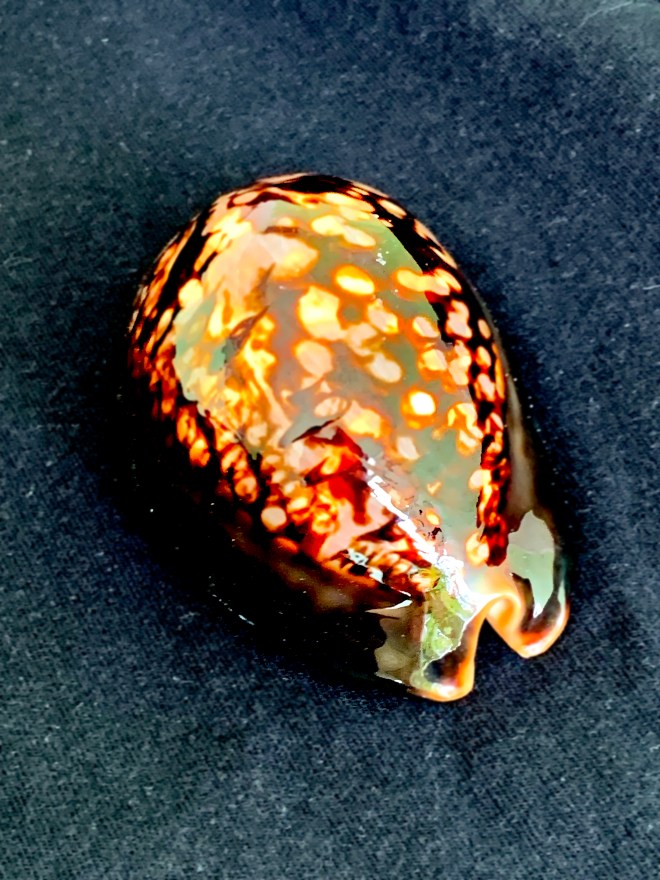
Mauritia mauritania Linn, 1758 is an impressive unmistakable cowry. It grows to over four inches and is decidedly a heavyweight.
It is a member of the Arabian complex although it hardly resembles its siblings. Mauritania is the only specie in the group with a solid color base and a dorsum that lacks all over fine reticuations. Its flanged callus is distinctive as is its tall hump.
Mauritania is brown to black/brown in color on both base and dorsum. The dorsum has large irregular white spots that vary in number with the very rare specimen virtually lacking in spots. Hawaiian specimens are as a rule darker in color than the more readily available Philippine ones. Dwarf specimens are found in the Andaman Sea.
Mauritania has a very wide distribution across the Indo Pacific region but apparently only lives in areas of high surf pounding against a vertical wall. It is nocturnal. In Hawaii it is associated with lava. Although not scarce its habitat makes it difficult to collect and due to the rough surf many specimens have scratches and dings. A true gem from Hawaii is scarce.
This specimen came from the small island of Lanai that sees little collection. It was collected this January and has a gorgeous glassy surface. It is a real treasure. Donated by Richard Kent and obtained from the diver who found it.
SHELL OF THE MONTH – JUNE 2019
Tellina Foliacea Linne, 1758
netted burrowed in sand at 30 meters deep
Bantayan, Phillipines 2018
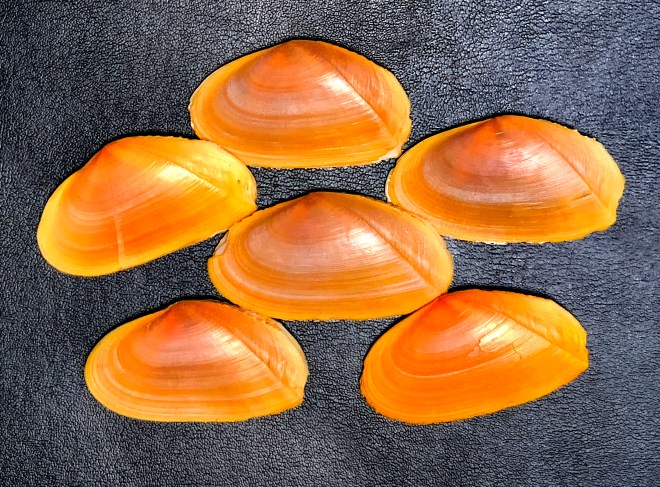
The genus Tellina is a widely distributed marine mollusc and a member of the family Tellinida. Tellins are filter feeding bivalves that inhabit tropical waters around the world. They are edible. All together there are about one hundred species, most of which are rather bland, solid whitish in color. Tellina Foliacea Linne, 1758 is one of the few exceptions with its bright uniform orange color.
One of the most beautiful bivalves is Tellina radiata Linne, 1758 which comes from the Caribbean Sea. It is called the Sunrise Tellin because of its colorful radiating bands of purple on a yellow and whitish shell. Unfortunately it is rather hard to come by recently. Large specimens over three inches are impressive.
Here in Florida we have Tellina lineata W. Truton,1819, the Rose Colored Tellin, which is a shell crafters favorite. It is white with rose color overtones and often about an inch and a half in size.. It can be found burrowed in sand bars at low tide in the Keys and on both coasts. Halves often wash up on shore.
The most commonly available Tellin is Tellina virgata Linne, 1758, a Philippine shell widely wholesaled for shell crafting. It is similar to the Sunrise Tellin but the bands lacks the colorful yellows.
We are offering in this raffle a half dozen pairs of Tellina foliacea, large in size of about 3″. They are very fresh specimens, collected by native divers in 2018. Donated by Richard Kent and recently obtained from a Philippine dealer. Tellina foliacea is not an easy shell to obtain, making this a very desirable raffle to win, whether the shells are won by specimen collectors or shell crafters.
SHELL OF THE MONTH – MAY 2019
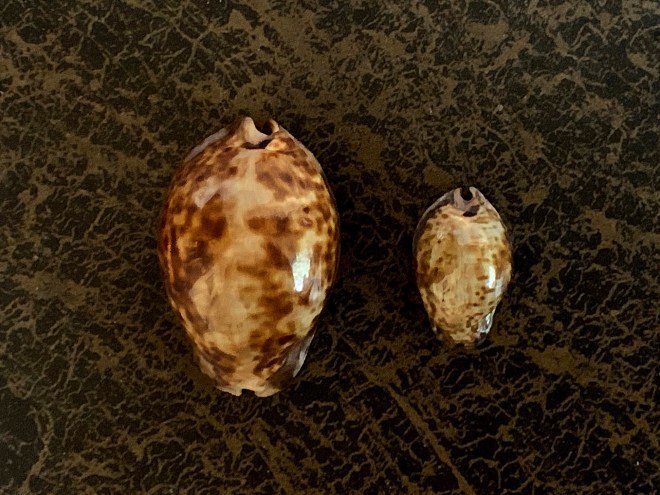
Trona stercoraria (Linnaeus, 1758) by diver at night, low tide in seaweed at 3 meters, M’bour, Senegal
Trona stercoraria (Linnaeus, 1758) dwarf. by diver on rocks at 10 meters, Gulf of Guinae, Limbe, Cameroon
Trona stercoraria (Linnaeus, 1758) is a popular cowrie among collectors due to its extreme variability in size, shape, color and even pattern. Its common name the Rat Cowry or Droppings Cowry. Certain populations have overcastings that make for bizarre specimens which may look as if they were infected by disease (and possibly they are). These are common in some locations.
Even with all the variation stercoraria is easily recognized and can’t be confused with any other cypraea. Its coloration could be considered drab (mousy, hence the name Rat). It is certainly not flashy. Typical specimens have a mocha colored base with dark brown chiseled teeth. The dorsum is similar in color and covered with blurred brown blotches. Some specimens are light, others dark in color. Scarce specimens have a largely clear dorsum, others with an irregular pattern while the occasional one has the blotches fused to almost sold and even scarcer almost black. The margins are calloused and both extremities are rostrate. Sizes run from extreme dwarfs of 1″ to giants of about 3.75”. The majority fall between 2 and 2.5″. While typically rhomboid, sone specimens are oval.
There are populations with an extreme hump that were named Trona stercoraria rattus (Lamarck, 1810). Linnaeus call the dwarfs “minima”. Even with all the variation the vast majority have the patterns and shape of the two offered here.
Trona stercoraria is a West African cowry with a restricted range below the Bulge of Africa. Most specimens come from the Gulf of Guinea. It is fairly common in this area and lives in a variety of shallow water habitats.
The two shells were donated by Richard Kent and were obtained from European dealers. Average sized specimens retail for $20-25, dwarfs though much scarcer somewhat less. Large ones go for over $30. Giants and unusual specimens can be found on eBay from $60 to over $300. In fact there is one very dark 95mm specimen with blueish borders listed for sale at $520!
SHELL OF THE MONTH – APRIL 2019
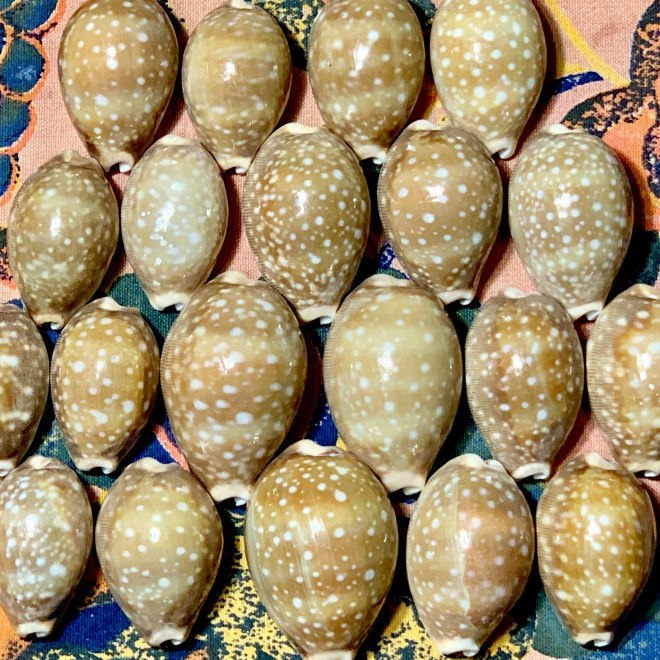
Our April Shell of the Month is for the shell crafters. It is a set of 20 Cypraea vitellus Linn, 1758 commonly know as the Calf Cowry. Cypraea vitellus is one of the most common medium sized cowries, It inhabits the reef in shallow water throughout the entire Indo-Pacific region. It’s a fawn colored shell covered with white spots. The margins have closely spaced thin vertical whitish lines. T here is little variation in size and pattern. The shell is immediately recognizable. Juveniles are banded, the banding covered over as the shell matures.
These shells were purchased in bulk and came with no collection date. I imagine these twenty will be turned into wonderful little critters or whatever the shell crafter may imagine.
Donated by Richard Kent. Next month we shall return to specimen shells.
SHELL OF THE MONTH – FEBRUARY 2019
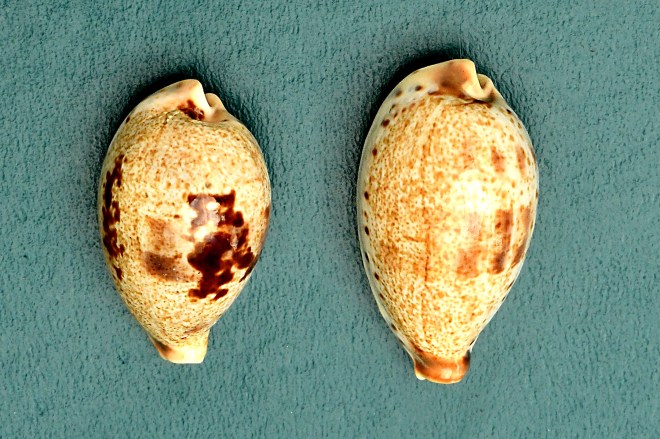
Cypraea pulchella (Swainson, 18230, Mergui Archipelago, trawled 100 meeters by fishing boats, Andaman Sea, Myanmar
Cypraea pulchella (Swainson, 18230, trawled by commercial fishing boats @100-150Meters off Hainan Island, South China Sea, China
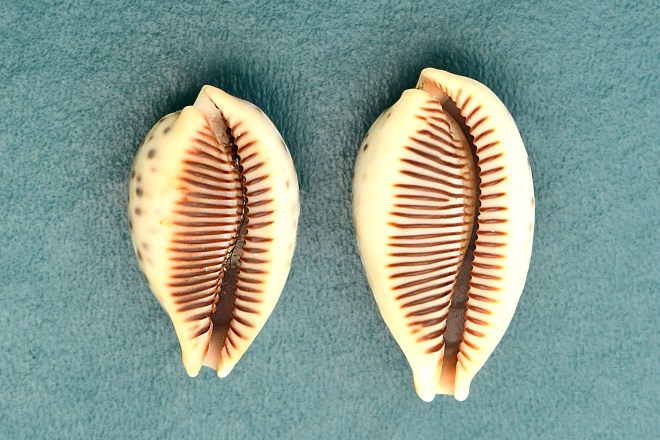
Not only is Cypraea pulchella (Swainson, 1823) one of the most sought after cowries, it is also one of the most distinctive. Its deep brown teeth that extend across the base make it impossible to confuse with any other. The common name for this elegantly pyriform shell is the Pretty Cowrie and pretty it is.
The dorsum is pale, faintly mottled with light brown and typically has a large dark chocolate colored blotch on both the right and left side of the dorum, but not always. Less attractive specimens have the blotch on only one side or the other. The most interesting specimens have multiple blotches or one huge one in the center and they bring the highest prices. The occasional specimen has no blotch at all! (specimen #2 in our raffle). Normal size is between 35-45mm. Shells retail in the $15-25 range and two to three times that for the exceptional spectacular specimen.
Originally the north-western Indian Ocean variety, Cypraea pericalles (Melvill & Standen, 1904) was a distinct specie, separate from the more common Pacific one, but recently Cypraea pericalles has been downgraded into a subspecies. When the names were first described there was a gap in the range, but this was due to the nonexistence of shelling in Burma and Thailand. Specimens that come from the Andaman Sea (this area) often appear to be an intermediate of the two, but are usually sold as pericalles. The difference is that the original pericalles has shorter teeth, is less callus, and is of smaller average size, with a less pronounced blotch. Possibly the two subspecies fully intergrade.
Cypraea pulchella favors deep water, is variable in size and pattern and is widespread though uncommon in distribution. Most specimens on the market come form the Philippines, South China and Thailand. There are two other distinct subspecies, one unique to the southern Philippines and the other quite rare from New Guinea. The true pericalles from the west coast of India is currently very difficult to obtain.
Today with revisions of nomenclature the proper name is Ficadusta pulchella (Swainson, 1823). For old time collectors these revisions in Cypraea are hard to accept.
Donated from the collection of Richard Kent.
SHELL OF THE MONTH – JANUARY 2019
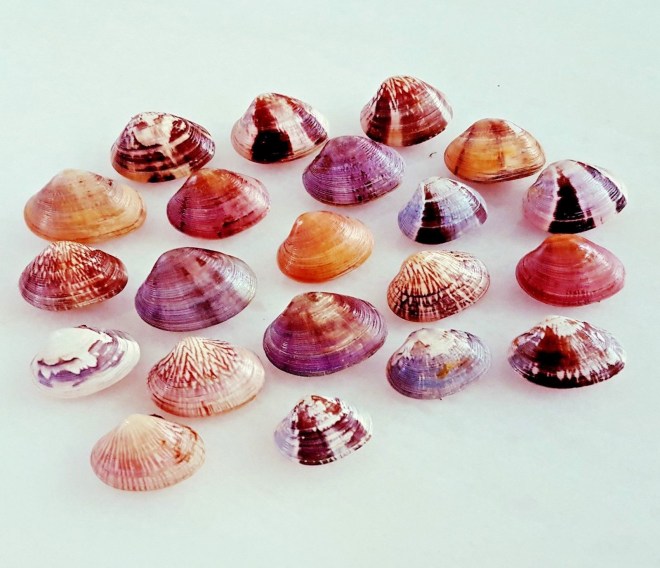
Venerupis philippinarum (A. Adams and Reeve 1850)
by divers 10m in muddy bottom
Ha Long Bay, Vietnam 2018
Interesting large collection of assorted colors and patterns!
21 specimens size 29-42mm
Venerupis philippinarum (A. Adams and Reeve 1850) is commonly know as the Manilla Clam or Japanese Cockle. The Manilla clam is a popular edible clam and is enjoyed around the world. Originally found on the coasts of the Philippines and India, it has been introduced worldwide and is now one of the important bivalve raised in aquaculture.
It is a burrowing clam, adaptable to various habitats. These specimens were living in shallow waters on a muddy bottom in Viet Nam.
The shell is oval and sculptured with with radiating ribs. What makes philippinarum interesting is that it paints its shell in varying patterns. It is species like this that exhibit such variety that makes shell collecting a fascinating hobby. This fascinating assortment in the raffle is representative of the wide variety of patterns and colors of the shells.
We have no idea if these clams had been consumed first. They were purchased from a dealer in Singapore who stated he obtained them from Vietnamese fishermen. Donated by Richard Kent


You must be logged in to post a comment.