Conus (Rhizoconus) mustelinus Hwass in Bruguière, 1792 – The Weasel Cone
This attractive cone shell is solid mustard or maize in color with a central white band bordered by blackish dots above and below. The should has flames that spill over to cover the spire. It reaches an an average size of about 3” and is poisonous as are all cone shells. The sides are straight. There is little variation from one to the next. Color my vary slightly. The band is always in the center. It is a clean shell with a low gloss. A growth line or two is normal.
It is an Indo-Pcific specie found in and by the coral reefs.
How it got the common name of Weasel Cone is a good question.
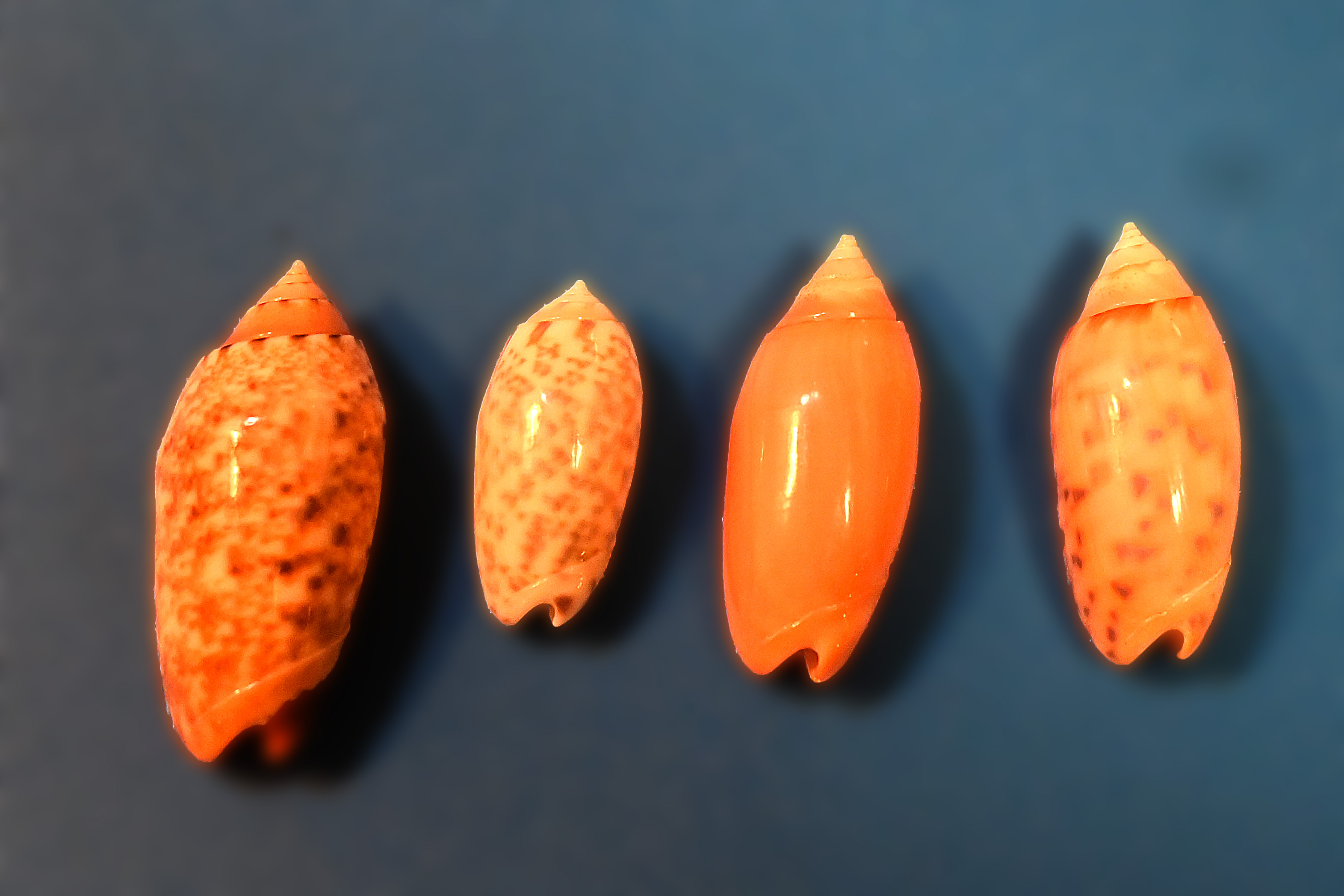
Oliva annulata Gmelin, 1791. 5 meter by diver, Sulu Island Philippines
Oliva mantichora Duclos, 1840. 15 meters by dive, Olango Island, Philippines
Oliva annulata amesthyna Rpding 179. 8’ in sanNego Bay, Okinawa
Oliva annulita carnicolor Dautzenberg 1927, 20 meters in samd. Sulu Archipelago, Philippines
The olives are attractie glossy shells and easy for us to collect. They are commonly found burrowed in the sand just outside of sand bars that are often exposed at low tide with just their siphon exposed. They leave behind them a trail that is easy to spot. They are gregarious and like to hang out together. They are scavengers who will share a meal. If you find one you should find a half dozen near by.
Oliva annulata Gmelin, 1791 is known as the Amethyst Olive due to the purple triangular markings that cover this colorful shell. There are numerous named varieties or forms that make it fun to collect.
Oliva annulata Gmelin, 1791 is cursed. Its name is a nomen duben which makes it a dubious name and therefor invalid.
At the moment Oliva amesthyna Rpding 1798 is the accepted name leaving collectors with a new propel, This the name of a variety or form leaving original type without a name.
Oliva mantichora Duclos, 1840 has been elevated to a full species as it should be. The black bars on the columned and shoulder are constant and distinguishes it from the others in the group.
Oliva carnicolor Dautzenberg 1927 should be a full species too. This solid flesh color form is found in entire populations rather than individual specimens mixed in with other forms.
Eventually the scientists will work our the names but don’t let their confusion spoil your collecting.
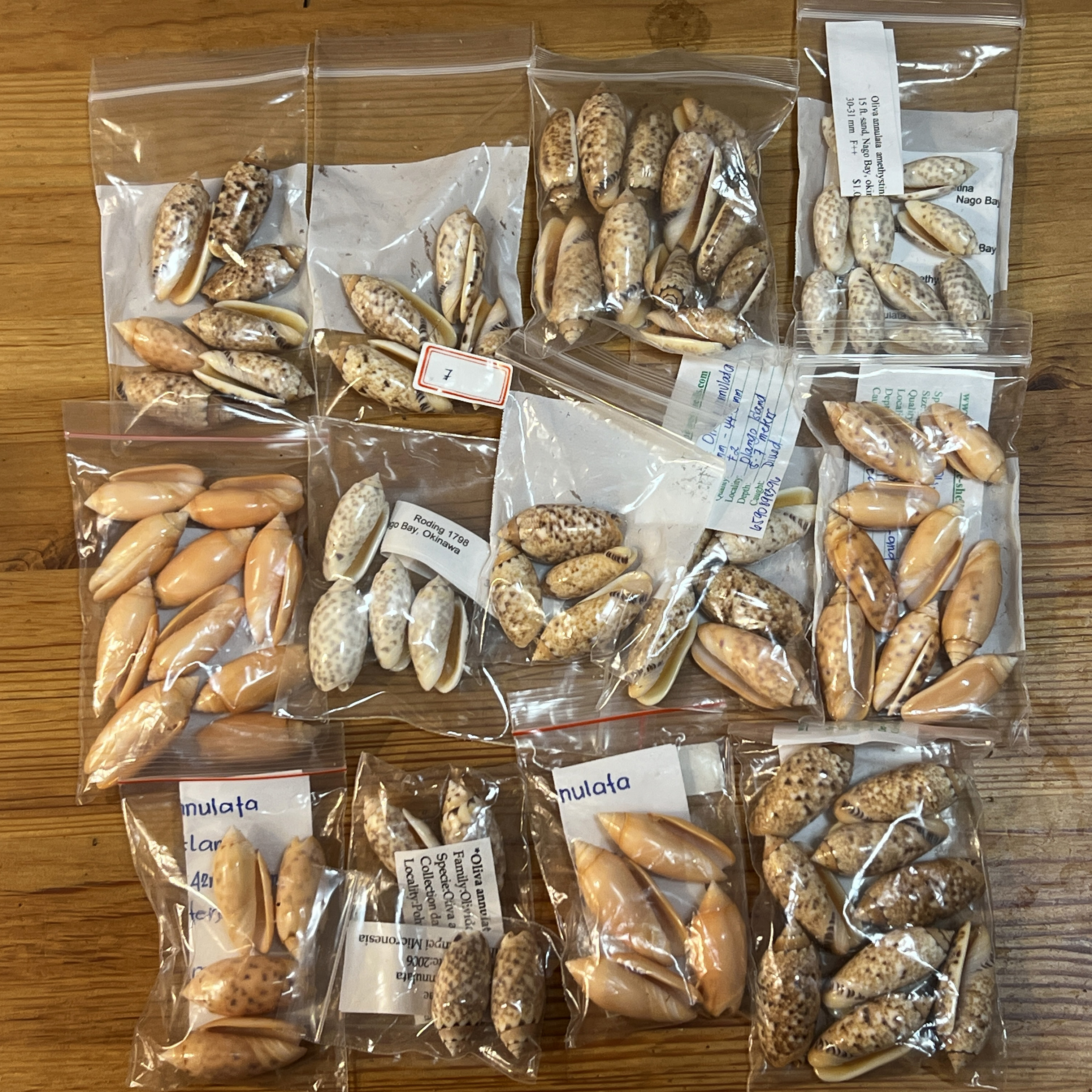
The photo below is of my collection of Amethyst Olivesfrom which these specimens were selected. The are Pacific Ocean shells found mostly in the Philippines. They range from Okinawa south to Indonesia and to the east to the Marshal Islands. .
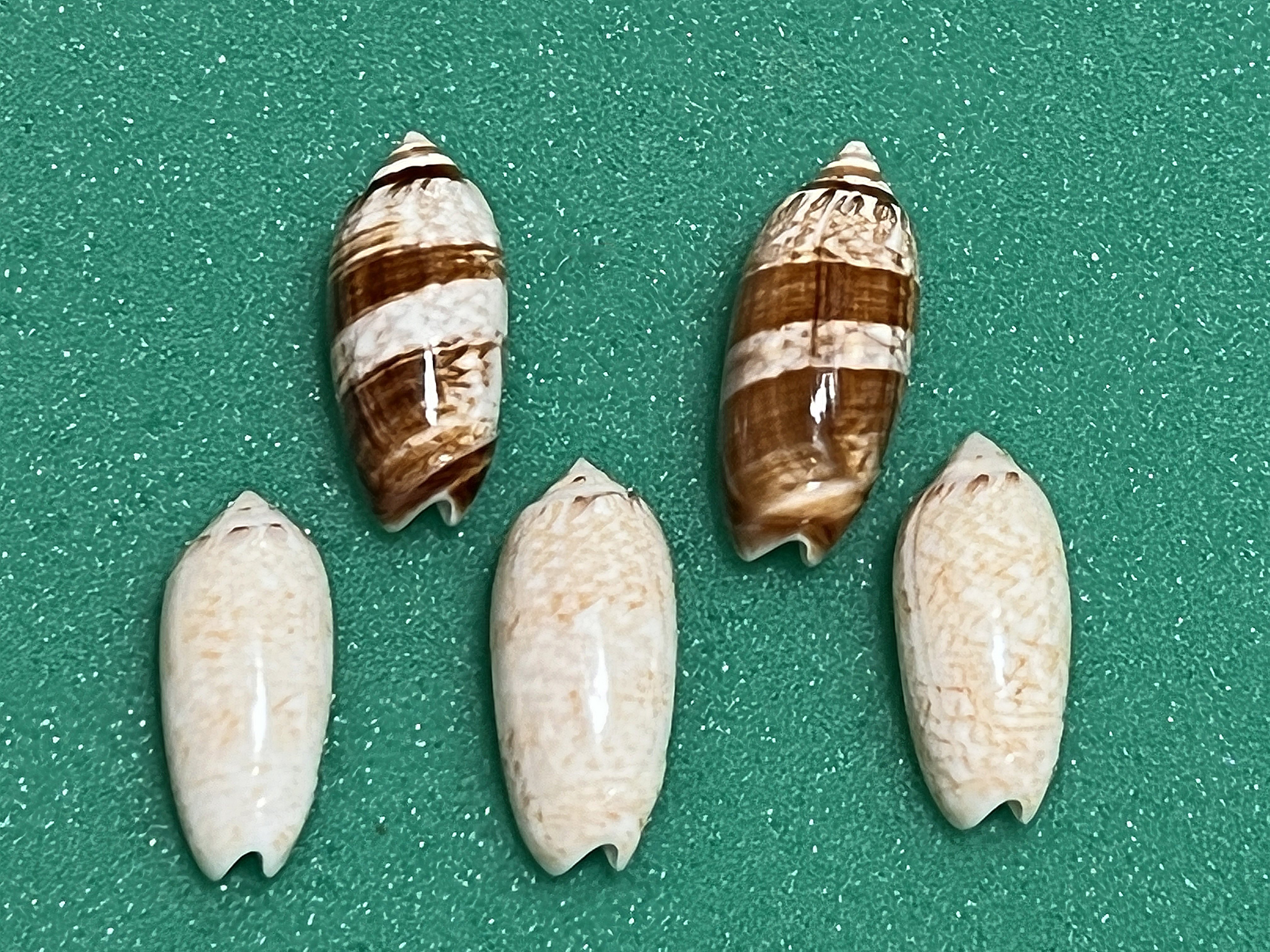
Oliva bifasciata Weinkauff, 1878is our Broward county olive. It’s range starts at the Palm Beach County line and goes south off shore through the Florida Keys. Of interest is that north of Browad County it is replaced by Oliva sayana. The two do not appear to overlap.
This attractive little olive of about one an a half to two inches in length comes in three varieties. The common is wheat colored and completely covered with fine dashes and lines. The second variety is milk white and almost void of decoration. The third has two chocolate brown bands that wide in width as the shell grows. The varieties appear to be location specific.
Until recently they were abundant living in sand near our Florida reefs. The receding tide would usually reveal a few fresh dead specimens and a tropical storm more than one could collect.
Sadly beach restoration projects and pollution have made these rather scarce
Oliva bifasciata is known as the Netted Olive although that name belongs to Oliva reticularis Lamarck, 1811 a very closely related species from the Bahamas. When R. Tucker Abbot wrote his then definitive “American Seashells” he called these shells Oliva reticularis, delegating bifasciata as a synonym along with several other names. It is common to see that name used in older collections.
As this is a local species, it would be interesting to hear our members’s collecting experiences. These specimens were dredged in a sand restoration project in Hollywood Beach in the early 1990s.
Not all shells are handsome. Not all shells are graceful. Not all shells look like wha we think a shell should look like.
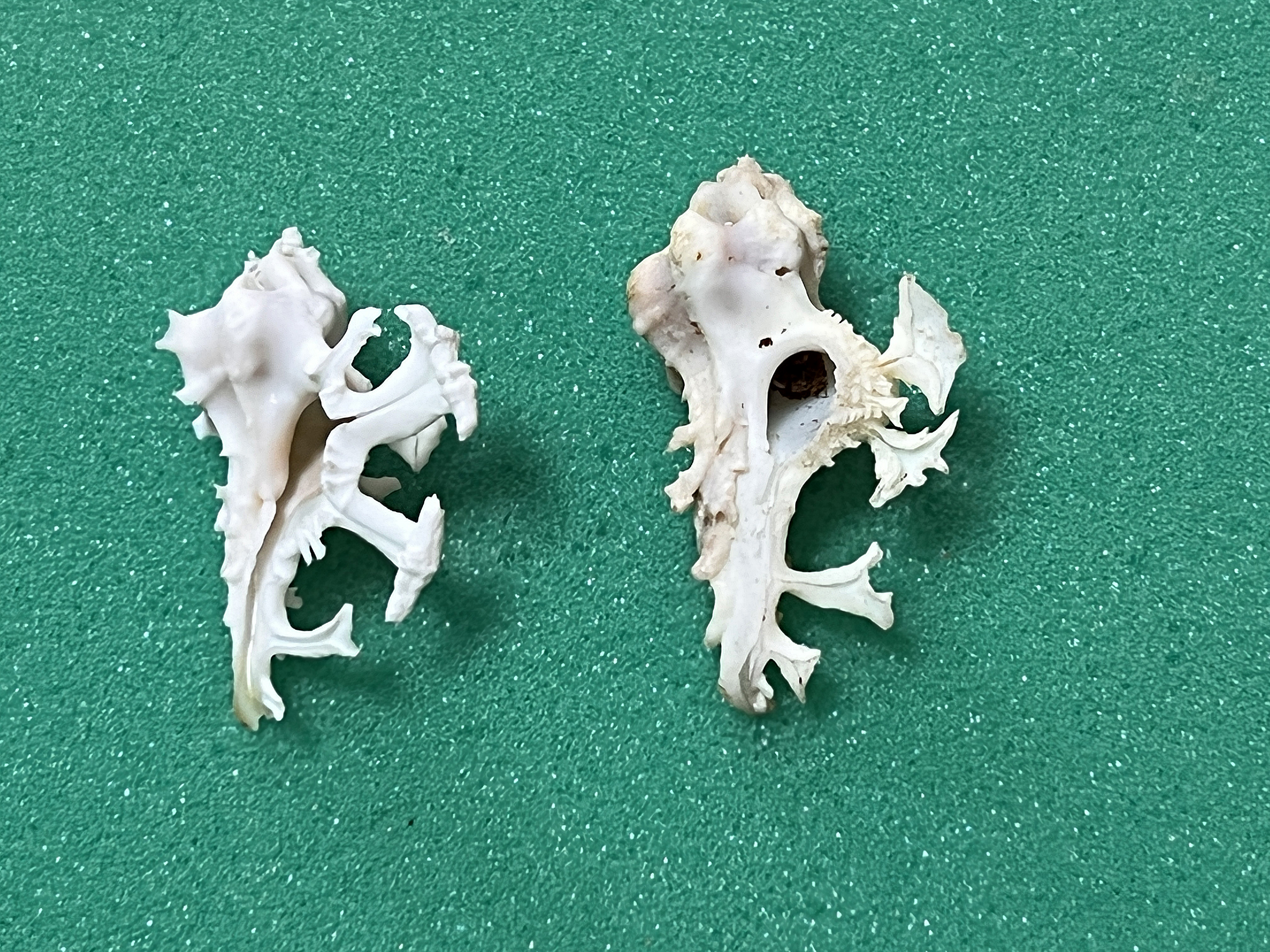
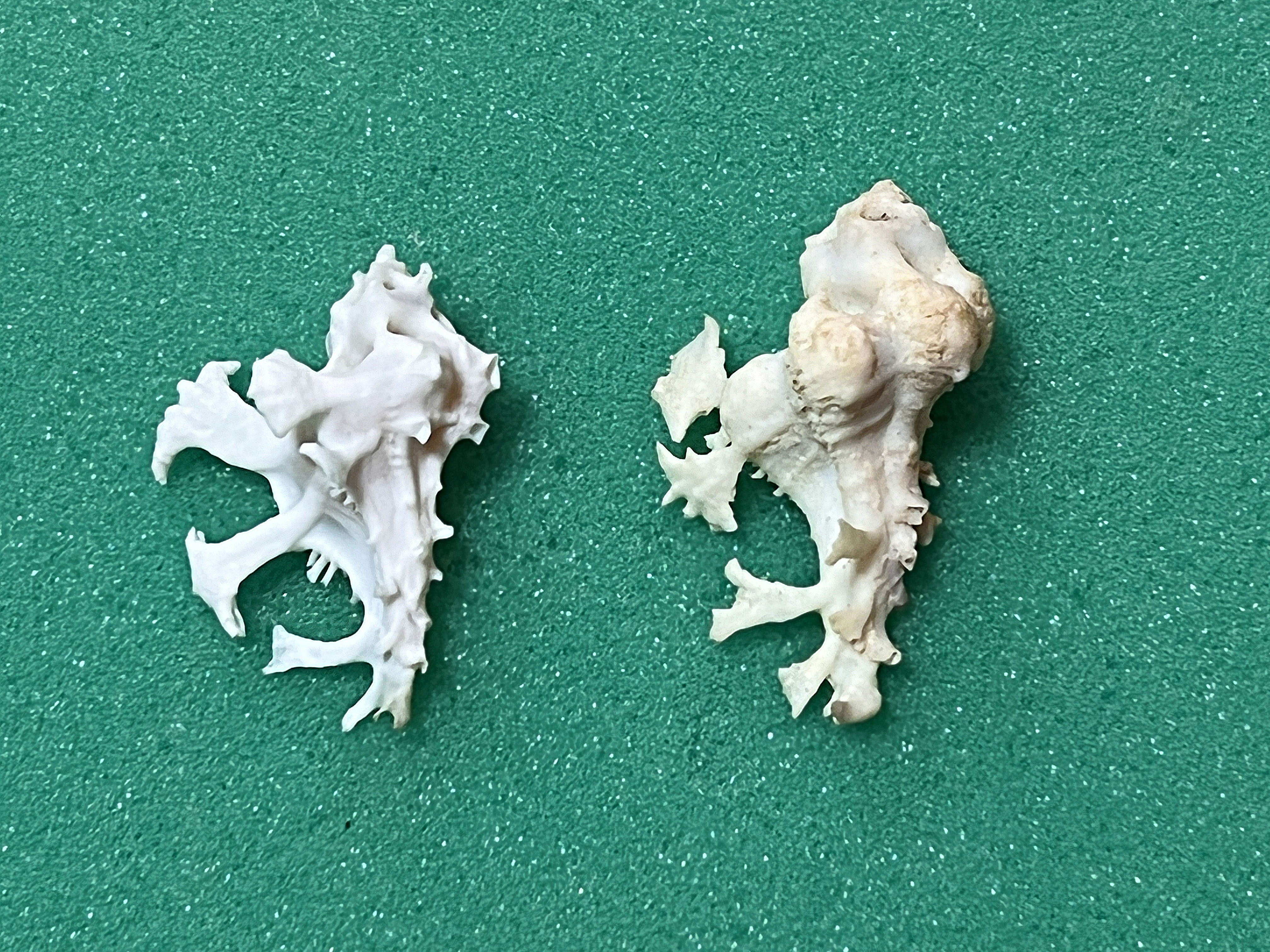
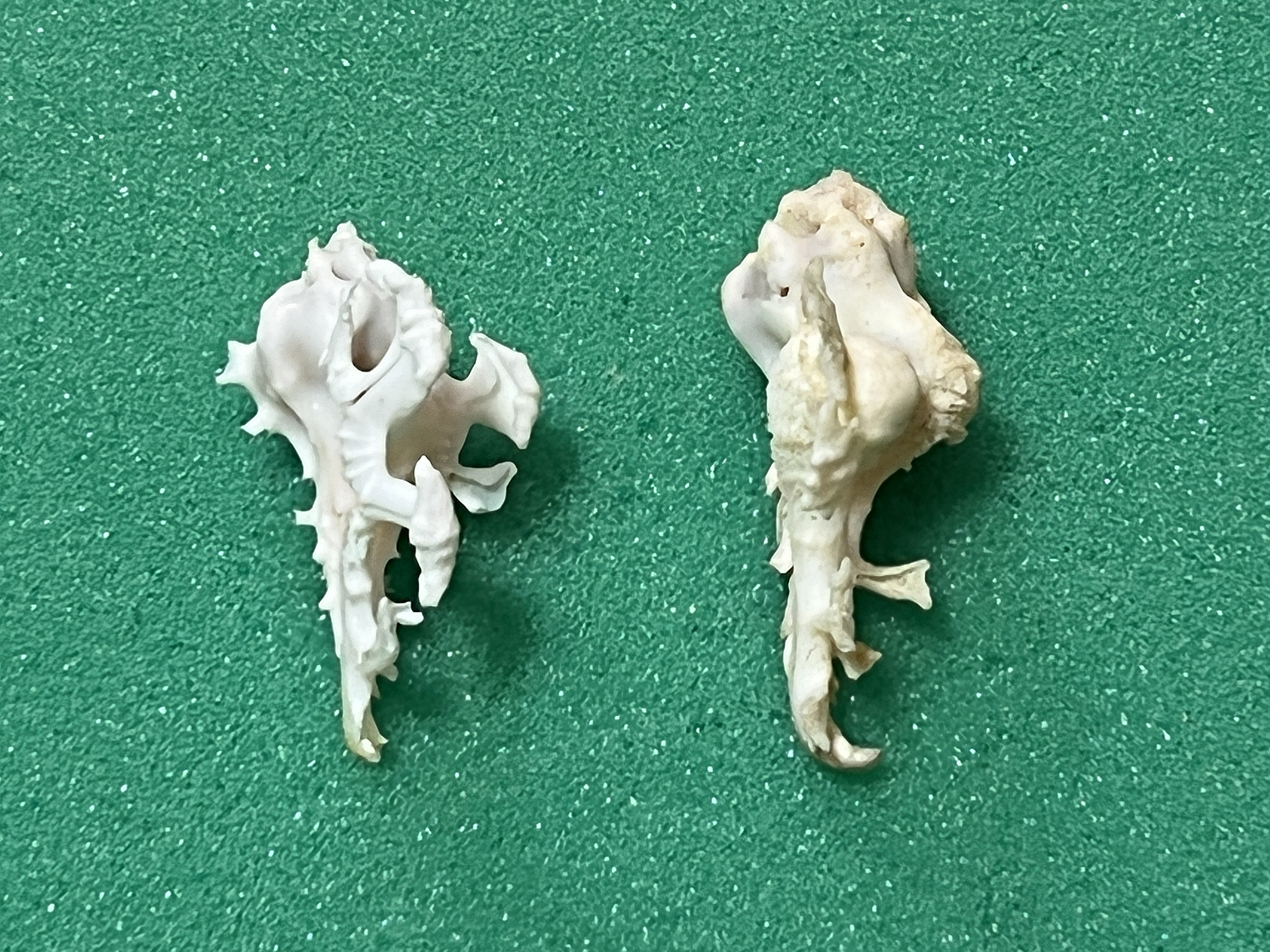
Homalocantha are Murex found in the tropics waters of the Pacific. They reside in coral heads. We have two varieties of Homalocantha anatomical this month, Homalocantha anatomica zamboi Burch & Burch 1960 and Homalocantha anatomica pele Pilsbry 1918. The first is from the Philippines The second is indigenous to Hawaii. Hawaiaans consider Pele to be full species Authorities disagree.
Both are extremely similar with a dominant body while and large varices that look like webbed feet at the termination of growth. The difference being that Zamboi shoot out varies at the end of each growth cycle and in Pele a knob is formed instead Pele is generally larger. This specimens small to make a a better comparison. Adult size is between 2 and 3 inches.
S second difference is that Zamoi is always white. Pele can have brilliant colors, especially on the body white. Intense reds and yellows sometimes occur. shades of lavender are common. The price for a bright red specimen spirals out of control.
The development of the body sculpture is very consistent from one specimen to the next.. Occasional specimens have additional or missing digits. The difference between the two species is clear in the final phot. Look closely!
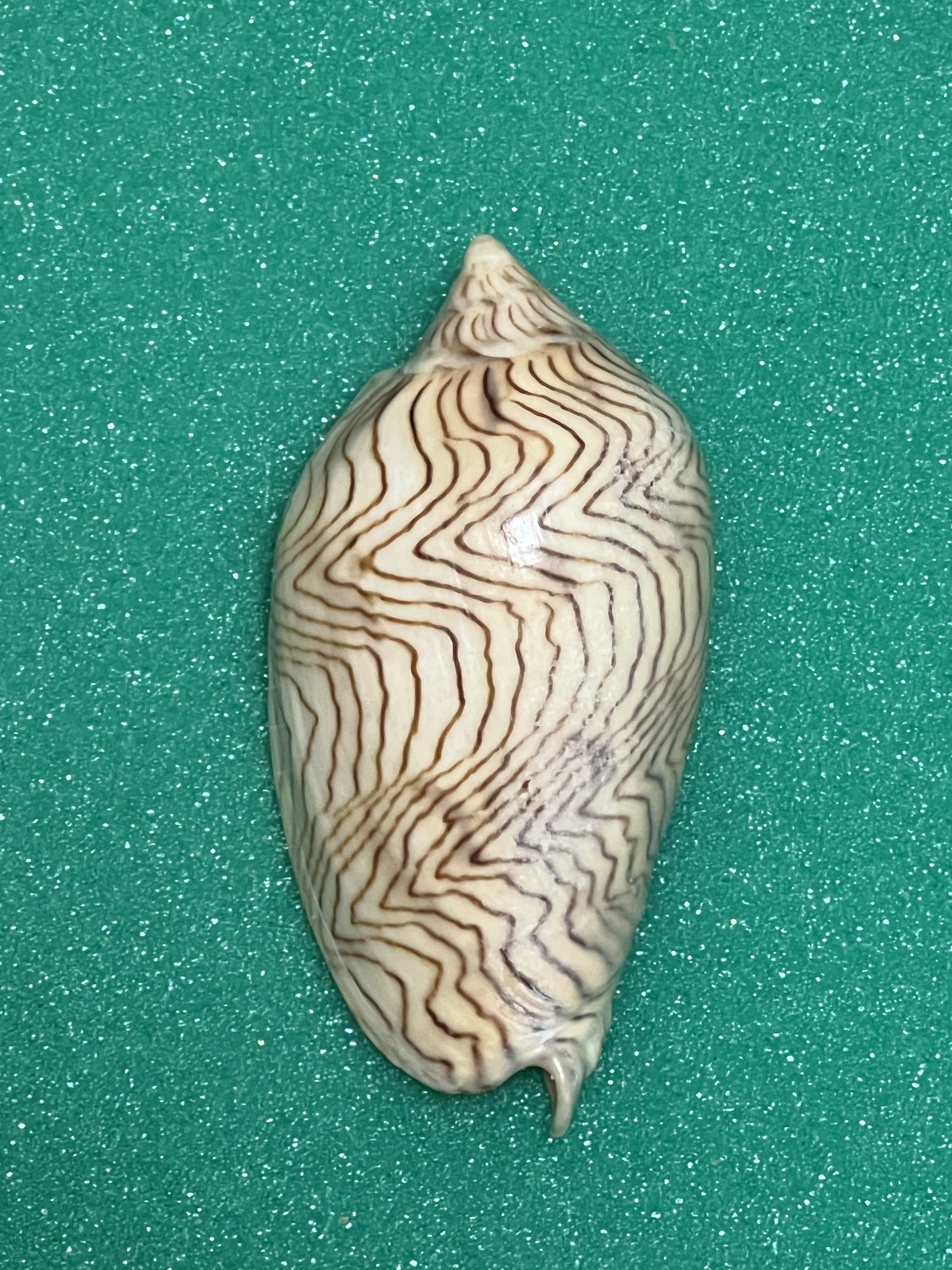
Amoria ubdulaata Sowerby 1864extreme low tide, St. Vincent Gulf, South Australia, Australia
With its elegantly proportioned curves and delicate undulating pattern of fine lines, a decentt size and high gold Amoria undulate is a most beautiful shell.
Amoriia undulate is a member of the family Volutidae. Its common name is Wavy Volute. It is carnivores eating mainly small sea snails.
There are multiple specie of Amoria that can be collected in southern Australia. where they inhabit the tidal flats where they breed. Australia is known for its extensive tides that leave huge amounts of the bottom surface exposed at low tide, even more so on the extreme low tides. Amoria undulate like many others in its family live at the far end of the tidal bank. They are not found close to the shore. After breeding season they migrate to deeper water.
To collect one has to watch the tide table and wade out a long distance in hopes to collect, alway keeping an eye on the cock so as not to get drowned by the surging incoming tie. Hence, these shells don’t show up all that often in collections.
This specimen was donated by Richard Kent who obtained it from a South Australian shell dealer/collector. It is solid and full adult. It would be graded as a gem. It would be a standout in any collection!
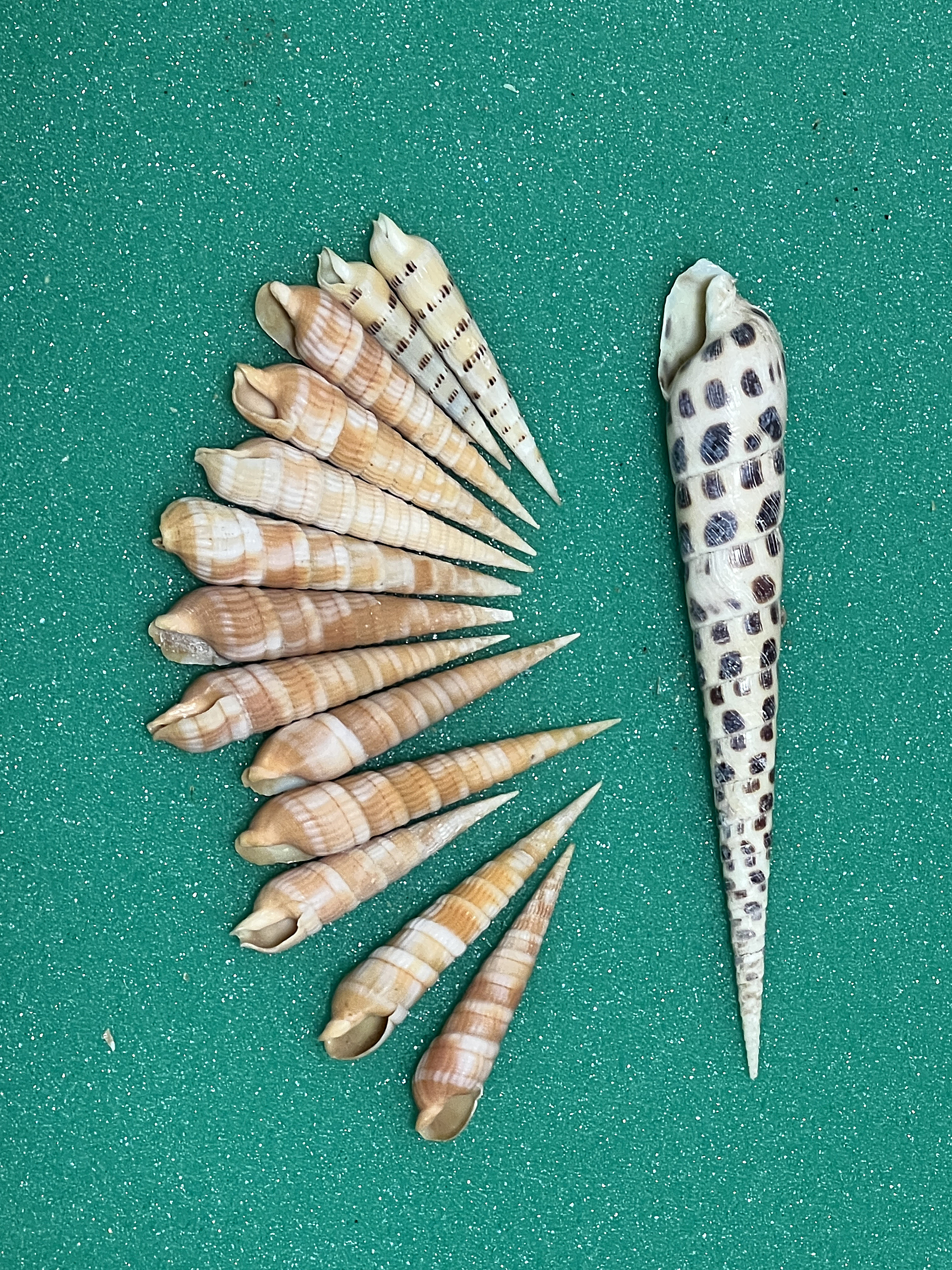
Terebra areolata (Link, 1807) by diver 20m in sand, Palawam Island, Philippines
Terebra pertusa (Born, 1778) hand dredged 4-8m, Olango Island, Cebu, Philippines
Terebra nebulosa (Sowerby, 1825) hand dredged 4-8m, Olango Island, Cebu, Philippines
The Terebridae are a very large family composed of over 400 species. They are world-wide in distribution and live in tropical waters. They prefer a sandy bottom where they feed on sea worms using a harpoon like attachment to poison their prey. They are commonly called Augers, named after a drill bit.
Most augers are small growing to a maximum size of3 2-3” with many species much smaller then that. There are a dozen or so species that reach 5+6”, one of which we have here. And then there is the heavy weight Marlin Spoke, Terebra maculata in a class bu itself. This sold, massive shell reaches 10”.
The Augers a re a colorful lot with an amazing amount of variety. One needs a magnifying glass to identify the smaller species and it would probably take an expert o do so.
The pretty rose colored Terebra nebulosa came out of a dealers lot of 30 that had a few others species mixed in..
All shells were acquired by Richard Kent from a dealer based in Cebu, Phillips.
When shelling in Florida waters, keep an eye open, we have augers here, though all are bland whitish in color.
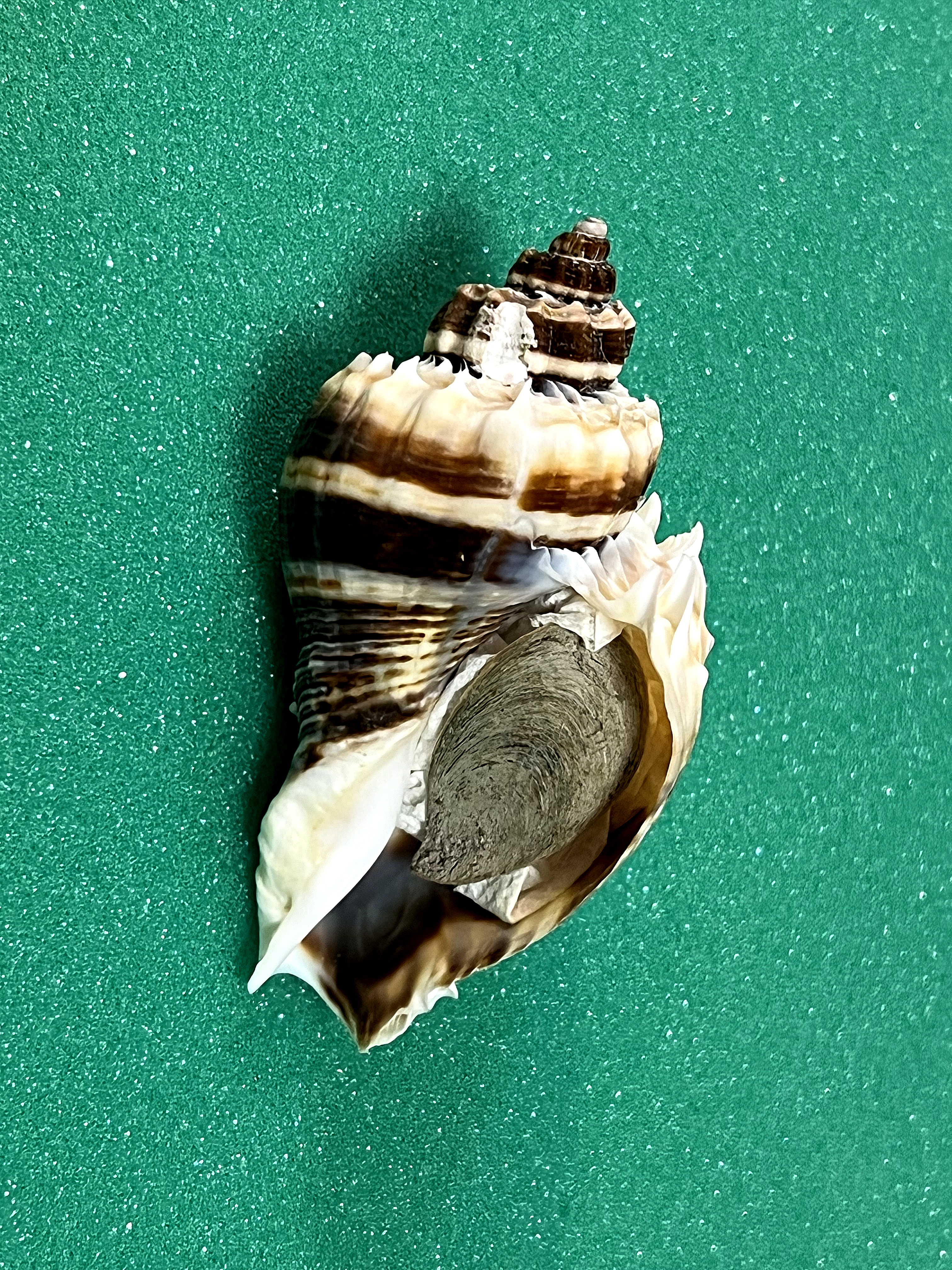
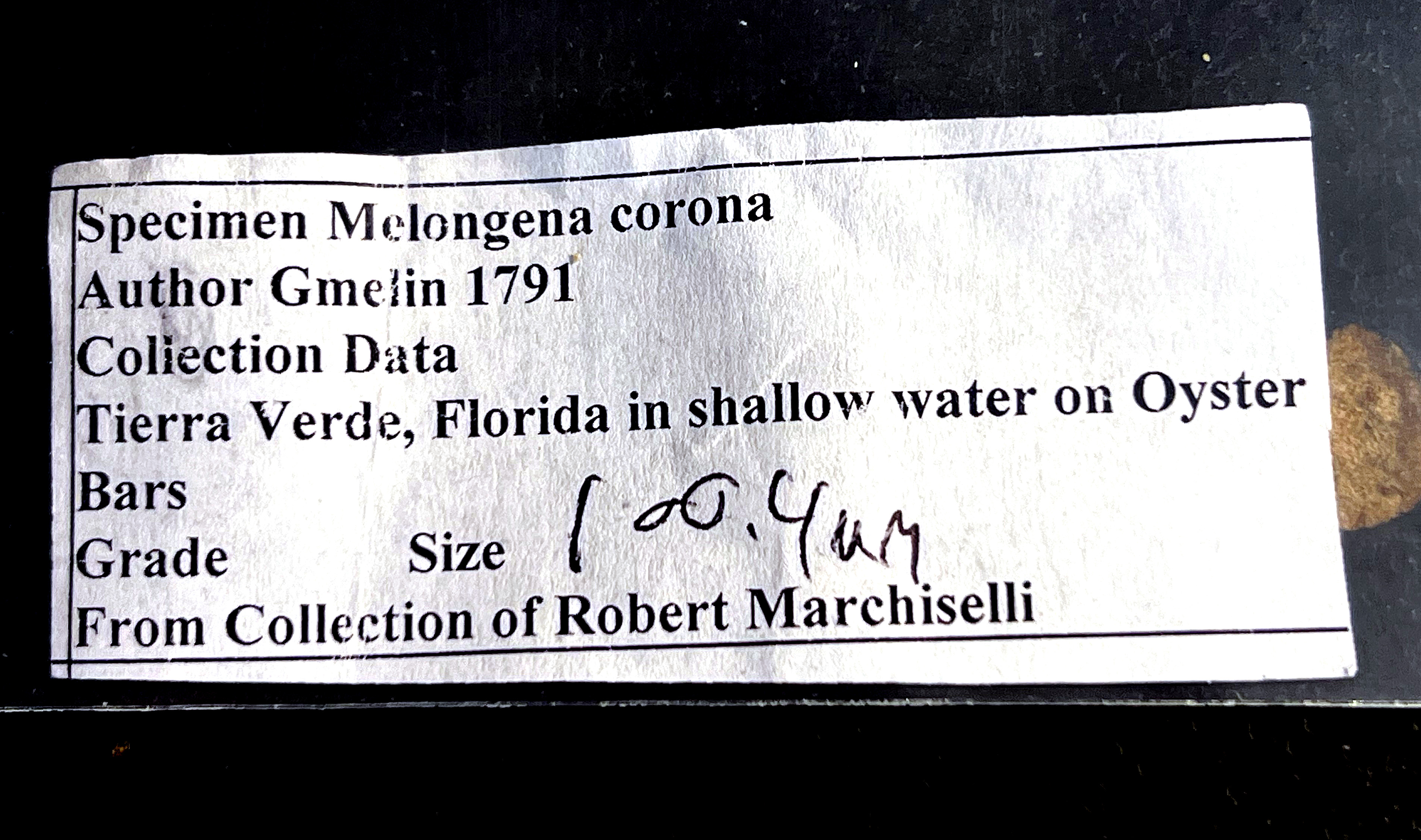
Melongena corona, the Crown Conch, inhabits the shore line of the Gulf of Mexico, especially the west coast of Florida. It has several closely related species and itself several named varieties. It is variable in size, shape, intensity of color an of particular interest the number and size of the should spines, its Crown of Thorns. Typical specimens reach an adult size of three inches, this one is about four and the rare well fed specimen may reach five inches.
The Crown Conch is cream in color encircled by light to dark brown bands. It has a wide mouth, a claw shaped operculum, and its shoulder is adorned with short atubby spines forming the crown. It is a predator, particularly fond of oysters but will eat any bivalve it comes across. Despite its name, it is not a conch.
This large distinctive specimen, with its outstanding crown, was donated by Robert Marchiselli, a Tampa Bay area shell dealer.
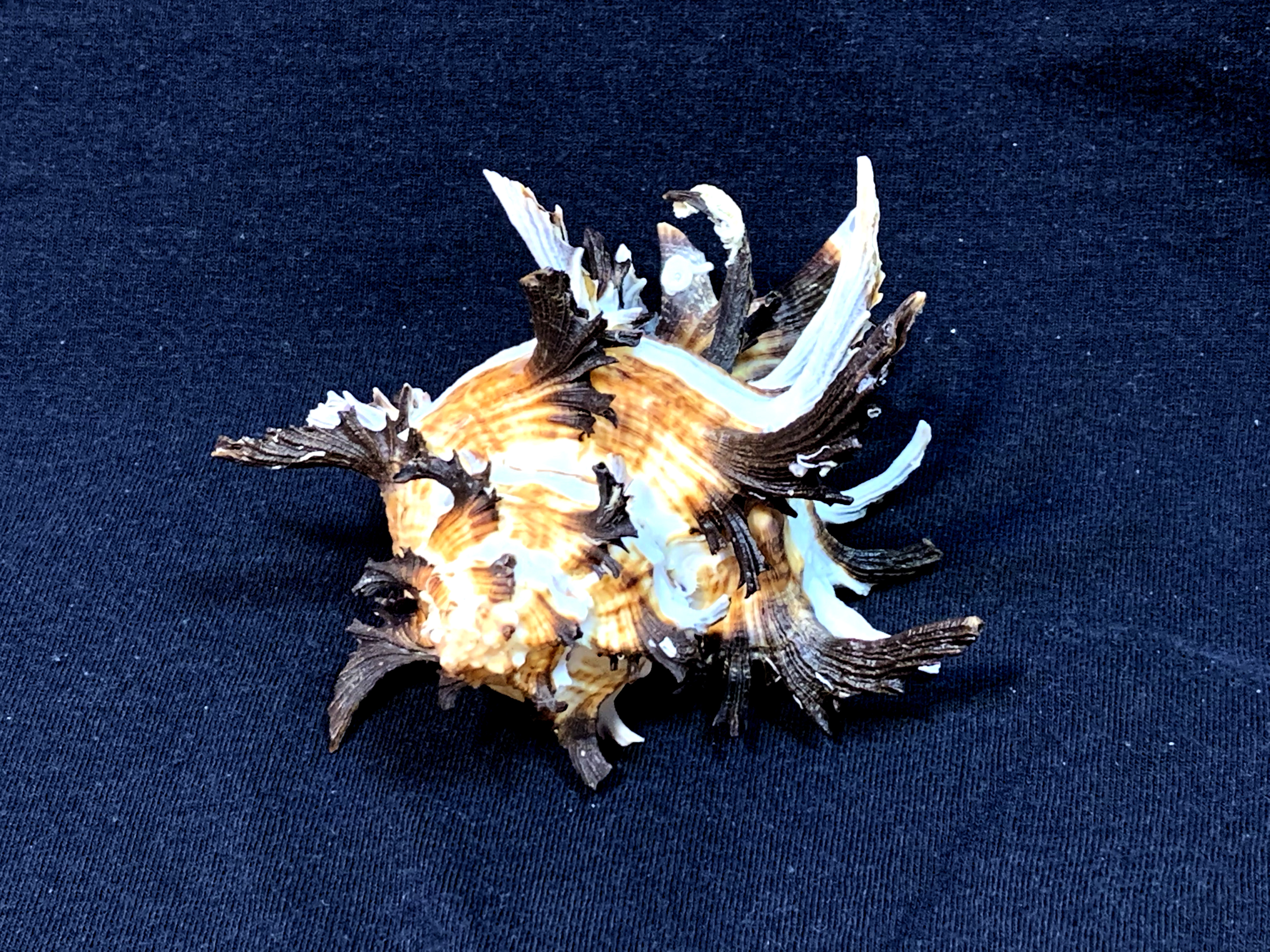
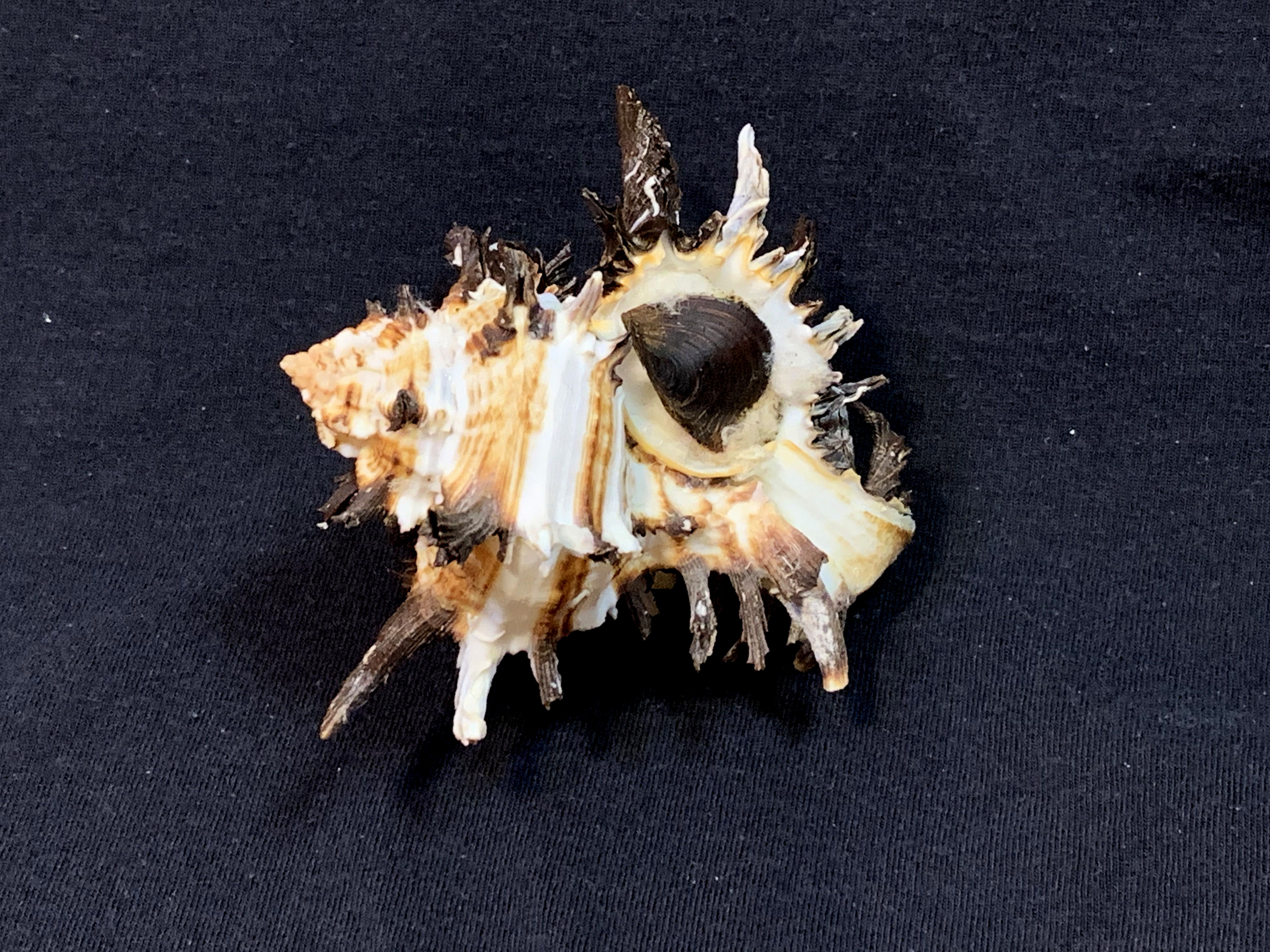
18Hexaplex cichoreum (Gmelin, 1791) iS a Western Pacific murex of medium to large size, known for its interesting and variable varices. In some specimens they are short and curled while in others stubby. Some populations have long varices (spines) as in this specimen. The shell is commonly white with orange brown bands and the varices are dark chocolate to black. Rare specimens are melanistic and others albino, The spire also varies from short too long.
This specimen is of good size, 4″ long and was collected in the coral reefs by SCUBA off Palawan Island, Philippines in 2018.
Around the world with cone shells. We welcome our new members with a selection of seven different cone shells from seven different countries. The cones are venomous and are predators. Most live among the coral reefs in tropical waters. While many species have a natural gloss, others are flat with barely a shine. Cones are a collector’s favorite.
The collection includes from top left to bottom right the following:
Conus omaria Hwass in Bruguière, 1792. This popular tent cone is from north west Australia, the southern extent of its range. One could make a huge collection of tent cones as there are so many species. Conus omaria is most typical.
Conus ebraeus Linn, 1758 is named the Hebrew Cone because the regularly spaced black markings on white resemble Hebrew writing. This specimen, which is very large for the species, is from Hawaii.
Conus pupurascens Sowerby, 1833 is the Purple Cone. Unfortunately the purple mottling eventually fades. This one is from an offshore island in Panama.
Conus janus Hwass in Bruguière, 1792 is an Indian Ocean cone from the island Madagascar. It comes in to two distinct varieties., one with dark brown flamules and other with gold.
Conus terebra Born, 1758. This plain whitish cone has horizontal striations that completly encircle the shell and that along with its usual shape makes it quite distinctive. This is a Philippine specimen.
Conus achatinus Gmelin 1791 is called the Agate Cone. It has a striking pattern of clouds and spiral dashes and is quite colorful. This one comes from the hard to get nation of Myanmar and is the scarcest one in this collection.
The final cone is a local representative of the family, Conus regius Gmelin, 1791, and was collected off Key West. The Crown cone has a range that goes down the Caribbean Islands all the way to Brazil.
All the specimens are in excellent condition; growth lines are natural in cone shells as they grow is spurts and the line marks the end of each growing period. All shells have a data slip with collection details. The seven specimens were donated by Richard Kent and should have a combined retail value of $60 or more in today’s market.
The Harp shells are among the nicest sculpted with the most intricate pattern of all gastropods. Today there are a dozen recognized species, all of which are very similar. All but one species are very affordable, making the Harps a favorite to collect. Placing the different specie on a table together is an excellent lesson in differentiation as they are very similar with only minor differences.
Harpa amouretta is the easiest to identify. It is the smallest harp, generally about 2”, and the only one that is elongate whereas all the others are globular. One element of its pattern, the two by two pairing of fine blackish lines that cross elevated ribs, is unique.
The common name is Lesser Harp. In times past it was know as Harpa minor, a name that is more fitting. It is extremely widespread in distribution across the entire Indo-Pacific region. Harpa Amouretta lives either in sand or under rocks and in proximity to reefs. There is a little variation in color and the pattern is consistent. Harpa amouretta does vary in weight, degree of elongation and thickness of lip. Also there are populations where the ribs are glossy but the space between is dull. Several subspecies have been named and generally rejected.
These three Philippine specimens are 1.5”, 2.25” and 2.5”. All are in gem condition and were donated from the collection of Richard Kent





 Broward Shell Club
You must be logged in to post a comment.