January Meeting

Our Program for this January is our own Tom Ball. Tom will be giving us a program on Musical Shells. Tom is a musician himself, playing piano, singing opera and appearing in at least two Florida Grand Opera productions a year. He has been in Barbershop Quartets, sings in Church Choirs and in many other choral groups. Tom also composes scores and writes music. 

It is no surprise then that Tom collects shells with musical connotations. Shells named for an instrument, a composer, a musician, a musical opera, score or anything musical. You will be surprised at all the shells he has encountered.

Tom gave us a similar program about 5 years ago but since we have so many new members, I thought it would be enjoyable for our new members and since he has much new material he has added, even those who have seen it once will enjoy seeing it again. 

November 2019 program

Dr. Tim Collins is a Professor and the Graduate Program Director in the Department of Biological Sciences at Florida International University. Dr. Collins received his B.S. degree from the University of Maryland, and his Ph.D. from Yale University. Dr. Collins is an evolutionary biologist working primarily on molluscs, and is particularly interested in applying his skills to solve practical problems.

I met Dr. Collins at the screening of the Changing Seas episode “Cryptic Critters” from Season 10,  with Dr. Rüdiger Bieler and his wife Dr. Petra Sierwald. Tim ran the DNA work on the new wormsnail from the Florida Keys, which turned out to be the new species, Thylacodes vandyensis Bieler, Rawlings & Collins, 2017.

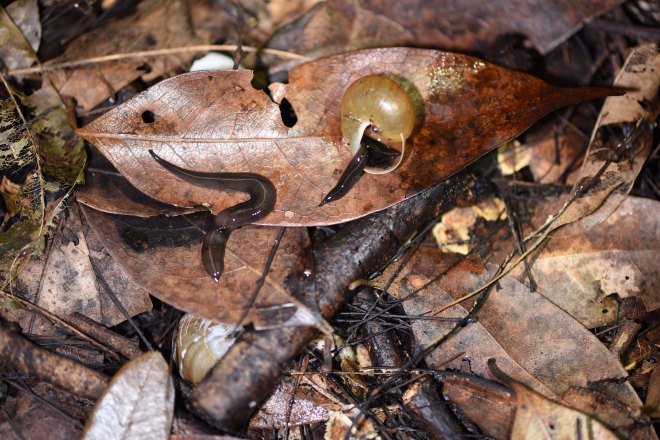
Dr. Collins is presently working on the invasive species of flatworm, Platydemus manokwari De Beauchamp, 1963, and tonight he will tell us about his studies with this flatworm and why it is dangerous to our local species.

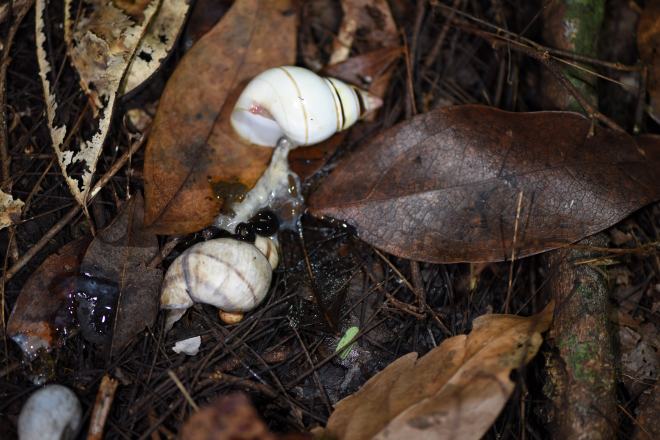
The non-native terrestrial New Guinea Flatworm (NGF, Platydemus manokwari) was discovered in Florida in 2015. In other parts of the world where it has been introduced, it has been considered the cause of extinction and/or dramatic decline of native species, particularly land snails, and for this reason is considered one of the World’s 100 worst invasive species. We have observed large-scale predation events on native Florida tree snails by Platydemus sp. for example, on our iconic native tree snails, Liguus and Orthalicus in the Castellow Hammock Preserve (see photos). In my talk I will discuss the possible effects of NGF on both native and non-native snails in Florida, as well as possible ways to limit the spread and effects of this new invasive species.

Please come and welcome Dr. Tim Collins to his first program for our club. Don’t forget to bring a snack if you have not done so this year.


Black Water Diving by Linda Ianniello. 


Back by Popular Demand

You asked and Linda answered yes. Linda Ianniello gave us a magnificent program on Black Water Diving in May of 2017 and you wanted more. 

What is Black Water Diving you ask? A group of divers go out in the dark of the night and dive over 500 feet of water where the largest daily migration takes place. Small sea creatuures come from the depths to feed closer to the surface and the underwater photographers are waiting. In a holding formation 40 feet deep and drifting with the currents, the photographers take photos of minute sea creatures that come to the surface. Tiny veligers of shrimp, lobster, fish and mollusks. Most under half an inch.  Linda has a new program and I guarantee you will be awed at the photography and the beautiful creatures captured by her camera. 

Since she was here last, Linda, along with her dive buddy Susan Mears has written a book Black Water Creatures. She will have a few copies of her book with her to sell.  

Please join us for an unforgettable program 

August Club Program

Phillip Gillette, Aplysia

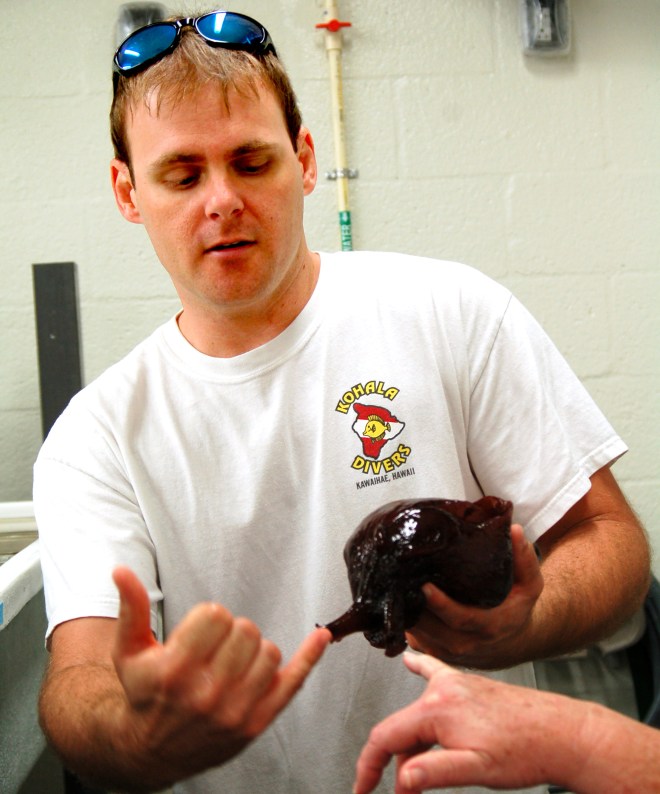
Our program for August is returning Phillip Gillette. He is the resource manager at the University of Miami’s Aplysia Resource Facility. He is originally from Central Florida. He writes, “ I went to the University of Miami for my undergrad degree, graduated in 2004 with a double major BS in Marine Science and Biology.  During undergrad, I interned one year at Harbor Branch working on Queen Conch and Florida fighting conch aquaculture, which got me interested in invertebrate aquaculture.  After graduating, I took a job in the late summer of 2004 at the UM Aplysia Resource Facility (where I’ve worked ever since) as a larval culture technician.  While working, I completed my Master’s in Marine Biology (from UM) in 2012.  My research interests include invertebrate culture, larval culture, coral husbandry, coral reef ecology.

I became interested in Marine Science as a child because of shells actually.  My grandfather was in the Navy, and as a result my dad spent 4 years living in Guam as a teen, and he amassed an impressive shell collection.  I used to make him spend hours in the garage going over all of his shells, identifying them, telling me the stories of how he found them.  We would spend a week every summer in the Keys, snorkeling and shelling, and that fueled my interest.  I have a modest shell collection of my own, with my favorite group being cowries”.

Phillip will be telling us about the work that is being done at the UM facility, the importance of Aplysia californica, the mollusk being studied and used and how important it is to medical research. We will also discuss another possible field trip to the research facility. The club was invited to tour the facility a few years ago and it was a big hit with

July Program

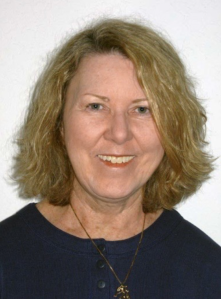
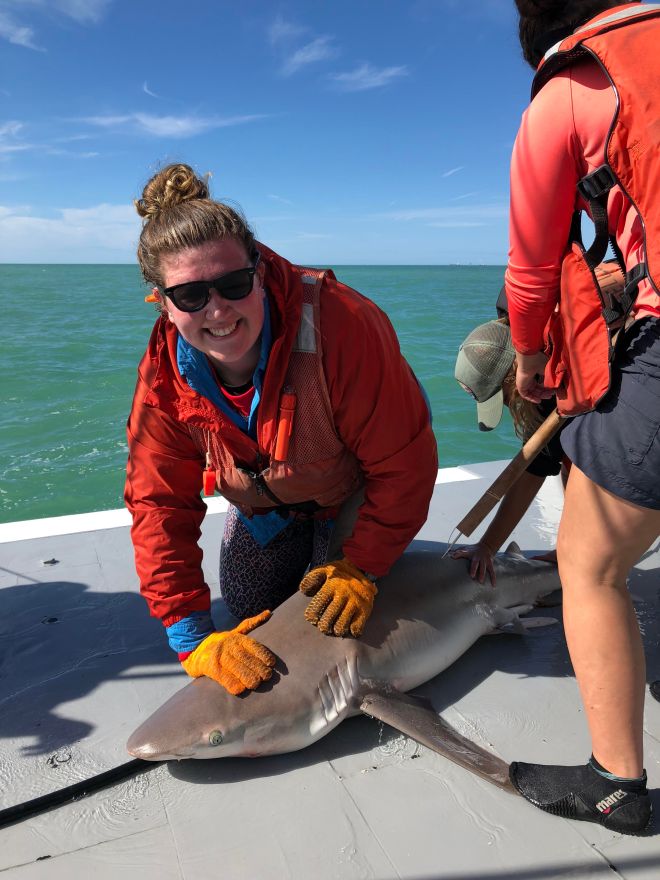
Caitlin Shea-Vantine is a second year Masters student working under Dr. Stephen Kajiura at Florida Atlantic University on the Boca Raton campus. Caitlin attended undergrad at St. Michael’s College in Colchester, VT and previously held positions at the University of Georgia Aquarium in Savannah, GA and the Northeastern Marine Science Center (Nahant, MA). She is very passionate about conservation and getting young girls interested in STEM.

Caitlin will be talking about the Stingray’s in our Waters. She will give an overview of they types of Stingrays to be found here, how they use their defense system and how dangerous they are to humans. Caitlin works with Stephen Kajiura, the shark expert at FAU and the photo is of her helping tag a shark to then monitor where it goes.

Program for June Meeting

This month’s program will be Carole Marshall. The title of her program is “So You Think You Want to Write a Shell Book?” Carole has been writing a shell book on the “Seashells of Peanut Island and the Lake Worth Lagoon”, for about 12 years now and she still isn’t finished. This is a humorous tongue in cheek, informative program on the things she has learned along the way and why she still isn’t finished. There is also a lot of good information for anyone who is interested in learning about mollusks, web sites that are important for everyone to know and how technology has changed Malacology in the last 12 years. There will be a hand out on important web sites as well.

Carole has always been interested in Natural History, collecting fresh water snails along the Rock River in Wisconsin as a child, majoring in Science in High School and later learning about sea shells. Her mother started collecting shells on trips to Ft. Myers Beach in the 1960’s and Carole soon realized how many interesting stories came with the shells. At a small club she gave a talk on shells to the group during hobby night when a woman came and asked her if she would be interested in joining the Chicago Shell Club. (Her response was “They HAVE CLUBS for People who Collect Shells?) For several years Carole and her parents, John and Lorraine Landers made the trip to the city (Chicago) from the suburbs. Shortly after 1969, when her parents moved to Ft. Myers, Carole and family moved to the West Palm Beach area in 1970.
Although she swears it was extreme mental incapacity that made her do it, Carole has been President of 3 different Shell Clubs. She has written many small articles for the clubs, COA magazine and for Of Sea and Shore Magazine as well as having given talks at Jamborees, COA Conventions, at the American Malacological Society, Florida United Malacologists meetings and for many local groups and organizations. She loves to teach about shells and finds the stories about shell use from ancient times to their uses today, of endless fascination.
Carole also discovered that the stories she loves about shells, can also be found on coins and paper money and Carole has an extensive collection of paper money, coins from ancient to modern, other exonumia, poker chips, medals and trade tokens.
Hopefully you will come to the meeting, be amused, laugh a little and learn.

February Program

Our Program for February is Dr. Thomas Annesley,

Thomas Annesley is “Active Professor Emeritus” at the University of Michigan and Deputy Editor of the journal Clinical Chemistry. He has always had an interest in oceanography and spent summers in California, where his uncle dropped Tom off at the coastal tidepools on his way to work and the picked Tom up on his way home.

Tom has been listed in Who’s Who in Medicine Academia, Who’s Who in Science and Engineering, and Who’s Who in America. He has published more than 200 articles and presented more than 175 invited lectures in 10 countries.

At the Bailey-Matthews National Shell Museum Tom does public lectures, beach walks and the live tank talks. He is also President of the Sanibel-Captiva Shell Club.

The title of his talk is “Cone Snails, Tennis Rackets, Pain Medications, and the Broward Shell Show”

Tom’s presentation will focus on scientific discoveries involving cone snails and their toxins. But as with many advances in science, there are elements of luck, happenstance, intrigue, mistakes, and creating lemonade out of lemons that contribute to the story. Dr. Annesley will show us how the supposedly unrelated topics of tennis, pain medications, and even the Broward Shell Show fit into the story of cone snails.

January 2019 Program

OLYMPUS DIGITAL CAMERA

This month we are going to have Gene Everson as our guest speaker. Gene is a past President of the Broward Shell Club.Serving twice in 1978-79 and again 1982-1984 but now living in Louisville, Kentucky.
As an airline pilot Gene got to travel and anytime he got the opportunity he would dive. He has dove in just about every temperate Ocean and Sea, foregoing the Arctic and Antarctic.Gene is a world class shell exhibitor and has won more trophies for his exhibits than any person in history.
This month he will be giving us a program on “Shell Collecting in Mozambique and Madagascar”.
He recently took a trip with Silvard Kool and just his stories dealing with travel will test the patience of the calmest person alive.
Come travel with Gene and Silvard as the shell East Africa.

November Program

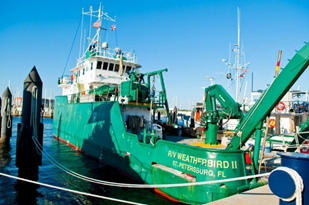
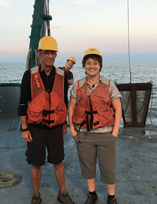
For November, we have one of our favorite malacologists back with us. Dr. Jose Leal. Science Director and Curator of the Bailey-Matthews National Shell Museum on Sanibel Island will be telling us about a wonderful research cruise he worked in September. He worked with Dr. Greg Herbert (the cruise’s Chief Scientist) from the University of South Florida in one of his annual surveys to map molluscan communities on the central part of Florida’s continental shelf in the Gulf of Mexico. The group of four scientists also included Dr. Paul Larson from the Florida Fish and Wildlife Conservation Commission and Rebecca Mensch, National Shell Museum Marine Biologist. The scientists and a group of Dr. Herbert’s USF students sailed on the R/V Weatherbird II, the 115-ft flagship of Florida Institute of Oceanography’s small fleet. From their website: “The Research Vessel (R/V) Weatherbird II is home ported on Bayboro Harbor at the University of South Florida (USF) St. Petersburg Campus. She is equipped with advanced laboratories, oceanographic devices, and sensor technology designed to enable scientists and students to study and learn about various aspects of the ocean’s biological, chemical, geological, and physical characteristics.”

Dr. Leal’s presentation will showcase and discuss a selection of uncommon and unusual mollusks and shells collected in the occasion and incorporated into the USF collection.”

October Program

Our program for October will be Dr. Ed Petuch. Ed recently retired from teaching Geology at Florida Atlantic University. Ed has written over 22 books mainly on the mollusks of Florida and the Caribbean. He is an expert on both Recent and Fossil Shells and named over 1200 mollusks both recent and fossil

Long known by many of the members of the Broward Shell Club, since he was a graduate student at the University of Miami, last year Ed donated many books from his library to the club. Ed has had a close relationship to many of our club members, naming many species of shells for both Alice and Bob Pace, Kevan and Linda Sunderland, Lynda Zylman and myself including others.
He is an expert on both Recent and Fossil shells. He has named over 1200 species of mollusks.

Ed is one of the most vibrant speakers you will ever hear and I know this program will be amazing. He will be presenting “Jewels of the Everglades: The Fossil Cowries of Southern Florida”—-

“The cowrie shells of Pliocene and Pleistocene Florida represent the single largest evolutionary explosion of cypraeids found anywhere on Earth. To date, 105 species of fossil cowries have been found in our local quarries and shell pits, including some of the rarest and most beautiful fossils known from anywhere in the world. Because of the special geology of the Everglades area, our fossil cowries are also the best-preserved in the world, often having the original shine and color pattern. With the exception of two species that are known from the fossil beds of the Carolinas, all the other cowries are found only in southern Florida, making these shells the most desirable fossils in our local area. Specimens of several of the largest and most beautiful species will be on display after the talk.”

Ed’s program will be based on his newly published book:
Jewels of the Everglades: The Fossil Cowries of Southern Florida, by Edward J. Petuch, David P. Berschauer and Robert F. Myers. This is available exclusively through the San Diego Shell Club for $95.00 plus shipping and handling ($5.00 in the USA). The Cypraeidae of Plio-Pleistocene southern Florida produced the single largest radiation of cowrie shells, known from one locality, ever found anywhere on Earth. With the exception of two widespread early Pliocene species, all the rest of the fossil cowries found in southern Florida were completely restricted to that region. Even within this relatively small area, many species and species groups of cowries had very limited geographical ranges, often being restricted to select reef tracts or estuarine environments and having ranges of only a few hundred square miles. This book contains over 350 images of over 100 species of fossil cowries from over four million years (covering the Pliocene to the Holocene) beautifully illustrated on 104 color plates, together with maps and in situ pictures of these unique fossil jewels. Hurry and get your copy while supplies last.

There is still time to order it and have Ed sign it at the club meeting. Here is the address and website or go to San Diego shell club and find the section labeled store.
this is a DO NOT MISS program, so see you Oct. 10.

P.S. If you can bring a refreshment to share that will be appreciated. We will probably have a large crowd this month.