SHELL OF THE MONTH – SEPTEMBER 2019

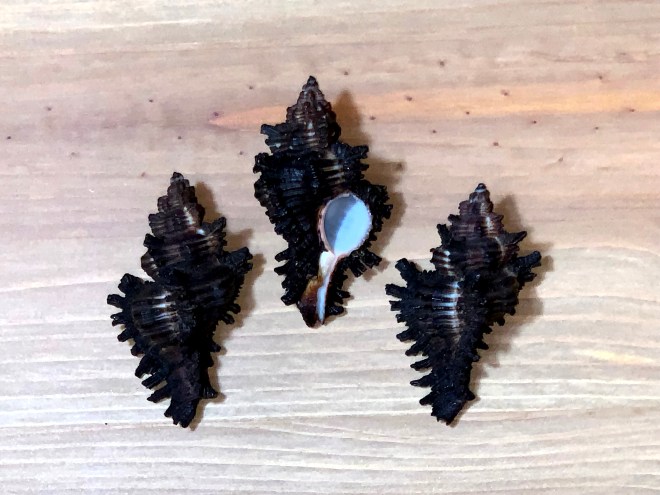
Chicoreus brunneus, Link 1807 by diver at 10m in coral rubble, Mactan Island, Cebu, Philippines 2010

The Muricidae is one of the largest, varied and most confusing of all families of mollusks.  Within Muricidae, Chicoreus is the most popular and widely collected.  Worldwide in tropical waters, we have many here in Florida and the Caribbean.  The Philippines have the greatest number of varieties and of those Chicoreus bruneus is one of the more popular and readily available.  Its popularity comes from its deep brown, almost black color that overlays a white shell.  All black and albino specimens are only moderately scare. Orange specimens are rare and quite likely another Chicoreus mislabeled. A common color variety seen mainly in larger specimens is a predominately white shell with black fronds, quite striking! 

Another factor that makes Chicoreus  so interesting are the the fronds on each varicy.  Sometimes short, sometime long, and sometimes fanned out.  Chicoreus brunneus varies too in adult size from under two inches to giant and now scarce specimens of four inches.

Murex are predators and can be found in any waters where there is an abundance of food.

These three beautiful specimens were obtained from a Philippine dealer. At first glance they may appear identical but further examination will reveal differences.  Sizewise they are on the smaller range, about two and a quarter inches, which seems to be what is most often seen nowadays.  Donated by Richard Kent
August Club Program

Phillip Gillette, Aplysia

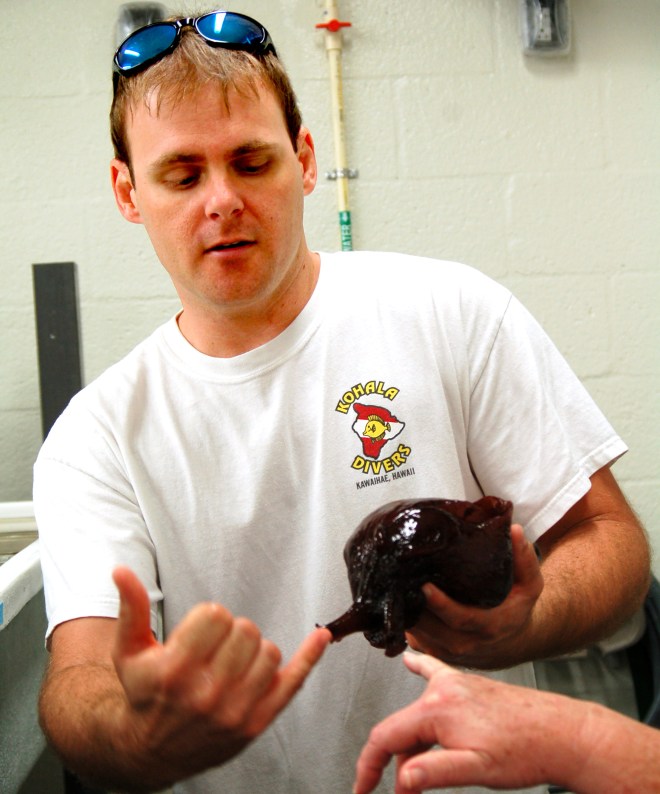
Our program for August is returning Phillip Gillette. He is the resource manager at the University of Miami’s Aplysia Resource Facility. He is originally from Central Florida. He writes, “ I went to the University of Miami for my undergrad degree, graduated in 2004 with a double major BS in Marine Science and Biology.  During undergrad, I interned one year at Harbor Branch working on Queen Conch and Florida fighting conch aquaculture, which got me interested in invertebrate aquaculture.  After graduating, I took a job in the late summer of 2004 at the UM Aplysia Resource Facility (where I’ve worked ever since) as a larval culture technician.  While working, I completed my Master’s in Marine Biology (from UM) in 2012.  My research interests include invertebrate culture, larval culture, coral husbandry, coral reef ecology.

I became interested in Marine Science as a child because of shells actually.  My grandfather was in the Navy, and as a result my dad spent 4 years living in Guam as a teen, and he amassed an impressive shell collection.  I used to make him spend hours in the garage going over all of his shells, identifying them, telling me the stories of how he found them.  We would spend a week every summer in the Keys, snorkeling and shelling, and that fueled my interest.  I have a modest shell collection of my own, with my favorite group being cowries”.

Phillip will be telling us about the work that is being done at the UM facility, the importance of Aplysia californica, the mollusk being studied and used and how important it is to medical research. We will also discuss another possible field trip to the research facility. The club was invited to tour the facility a few years ago and it was a big hit with

SHELL OF THE MONTH – AUGUST 2019

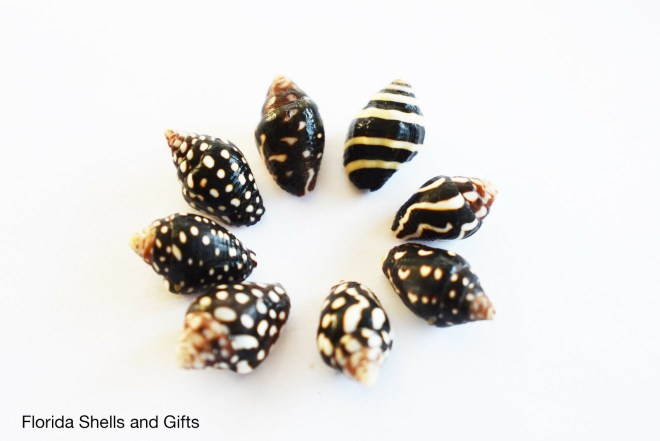
   Dove shells have long been popular among crafters. In fact, they have been strung as beads as far back as ancient history. They are a standard in Sailor’s Valentines and due to their abundance used as filler on shell vases and mirrors. They can also be found cascading in shell mobiles.
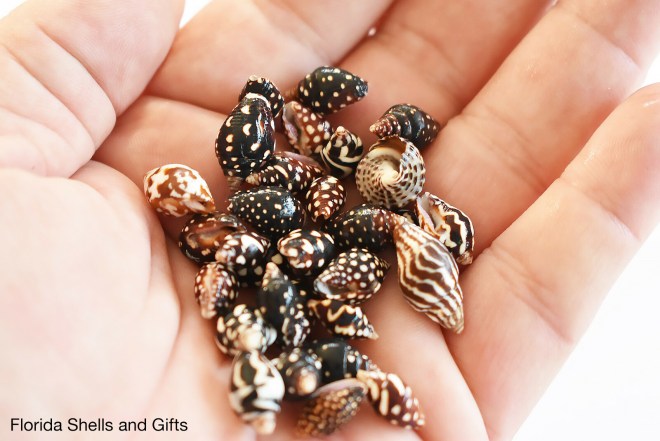
   Dove shells live in huge colonies on rocky shorelines at the tideline and are easily collected. They are small in size, not quite 1/2″. They are found throughout the Indo-Pacific region in tropical waters.
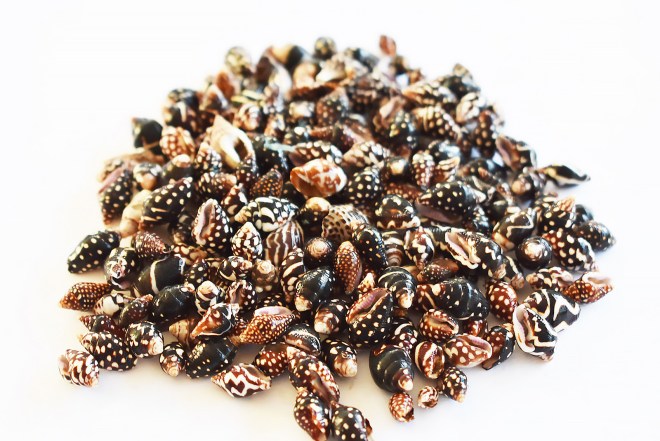
   Known in the trade as Nassa columbella, the proper name is Pictocolumbella ocellata (Link, 1807). They are called Lightning Dove Shells in spite of their Latin name. The lightning stripe is one of three patterns, one being white dots on a black background and the other white bands on a black background. The shells may also be deep dark red instead of black.
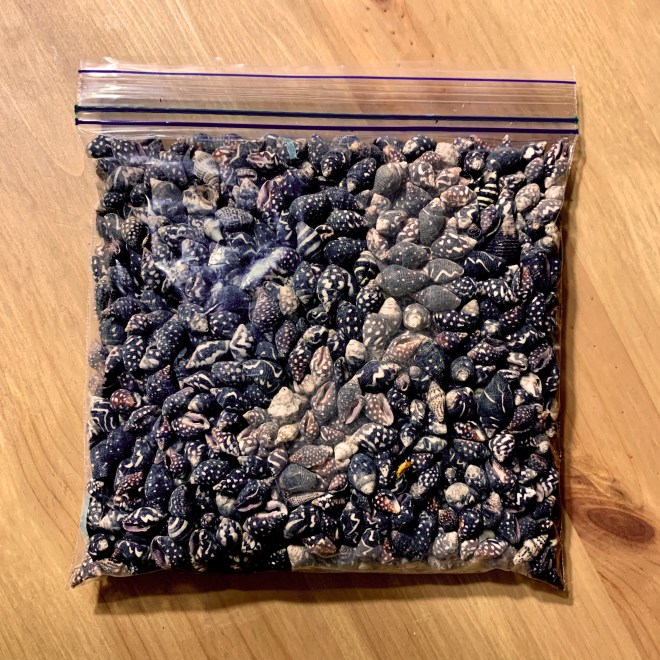
    There is a good chance when sorting through the bag of shells that other similar shells are mixed in as there are dozens of species that share similar habits.
    These shells were purchased especially for the August raffle table and are donated by Richard Kent. Supposedly there are 1000 shells in the zip lock. We are hoping the winner will share with the club photos of their creations.

July Program

Caitlin Shea-Vantine is a second year Masters student working under Dr. Stephen Kajiura at Florida Atlantic University on the Boca Raton campus. Caitlin attended undergrad at St. Michael’s College in Colchester, VT and previously held positions at the University of Georgia Aquarium in Savannah, GA and the Northeastern Marine Science Center (Nahant, MA). She is very passionate about conservation and getting young girls interested in STEM.

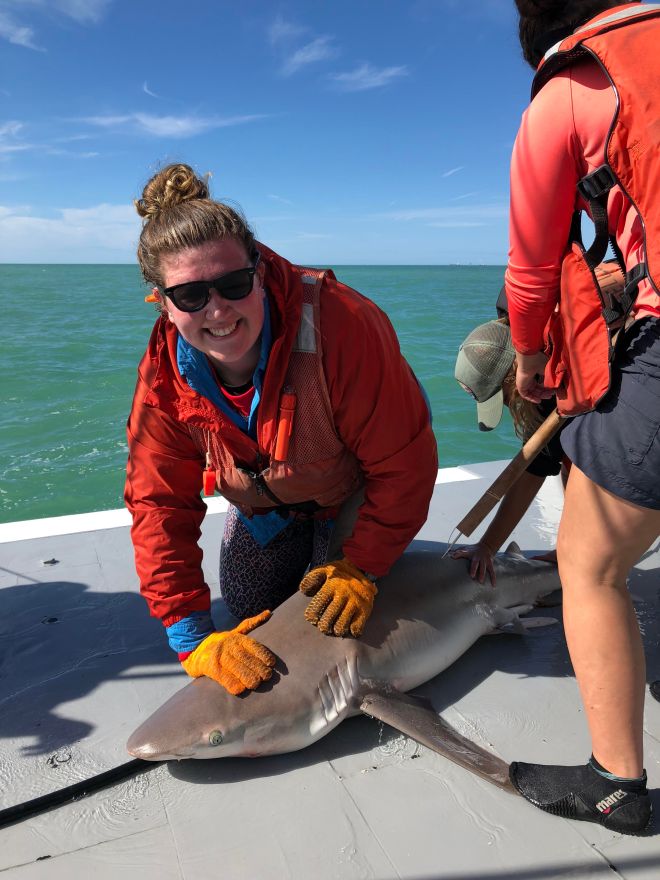
Caitlin will be talking about the Stingray’s in our Waters. She will give an overview of they types of Stingrays to be found here, how they use their defense system and how dangerous they are to humans. Caitlin works with Stephen Kajiura, the shark expert at FAU and the photo is of her helping tag a shark to then monitor where it goes.

SHELL OF THE MONTH – JULY 2019

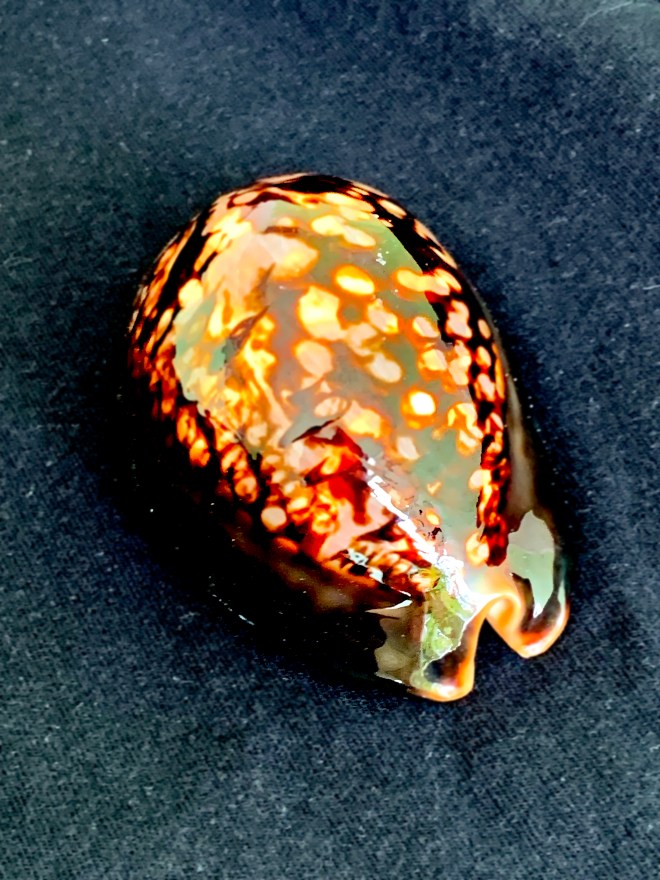
Mauritia mauritania Linn, 1758 is an impressive unmistakable cowry. It grows to over four inches and is decidedly a heavyweight.
It is a member of the Arabian complex although it hardly resembles its siblings. Mauritania is the only specie in the group with a solid color base and a dorsum that lacks all over fine reticuations. Its flanged callus is distinctive as is its tall hump.
Mauritania is brown to black/brown in color on both base and dorsum. The dorsum has large irregular white spots that vary in number with the very rare specimen virtually lacking in spots. Hawaiian specimens are as a rule darker in color than the more readily available Philippine ones. Dwarf specimens are found in the Andaman Sea.
Mauritania has a very wide distribution across the Indo Pacific region but apparently only lives in areas of high surf pounding against a vertical wall. It is nocturnal. In Hawaii it is associated with lava. Although not scarce its habitat makes it difficult to collect and due to the rough surf many specimens have scratches and dings. A true gem from Hawaii is scarce.
This specimen came from the small island of Lanai that sees little collection. It was collected this January and has a gorgeous glassy surface. It is a real treasure. Donated by Richard Kent and obtained from the diver who found it.

Program for June Meeting

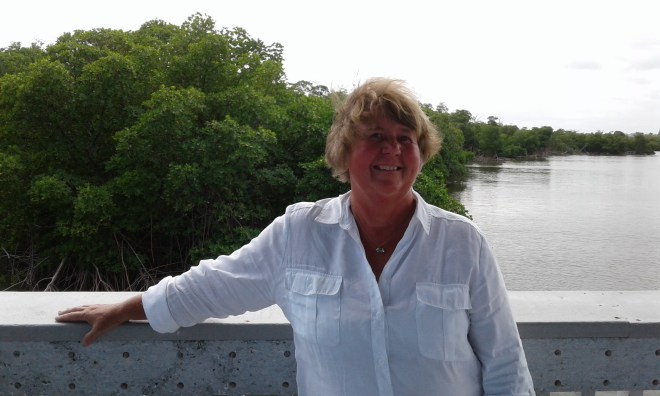
This month’s program will be Carole Marshall. The title of her program is “So You Think You Want to Write a Shell Book?” Carole has been writing a shell book on the “Seashells of Peanut Island and the Lake Worth Lagoon”, for about 12 years now and she still isn’t finished. This is a humorous tongue in cheek, informative program on the things she has learned along the way and why she still isn’t finished. There is also a lot of good information for anyone who is interested in learning about mollusks, web sites that are important for everyone to know and how technology has changed Malacology in the last 12 years. There will be a hand out on important web sites as well.

Carole has always been interested in Natural History, collecting fresh water snails along the Rock River in Wisconsin as a child, majoring in Science in High School and later learning about sea shells. Her mother started collecting shells on trips to Ft. Myers Beach in the 1960’s and Carole soon realized how many interesting stories came with the shells. At a small club she gave a talk on shells to the group during hobby night when a woman came and asked her if she would be interested in joining the Chicago Shell Club. (Her response was “They HAVE CLUBS for People who Collect Shells?) For several years Carole and her parents, John and Lorraine Landers made the trip to the city (Chicago) from the suburbs. Shortly after 1969, when her parents moved to Ft. Myers, Carole and family moved to the West Palm Beach area in 1970.
Although she swears it was extreme mental incapacity that made her do it, Carole has been President of 3 different Shell Clubs. She has written many small articles for the clubs, COA magazine and for Of Sea and Shore Magazine as well as having given talks at Jamborees, COA Conventions, at the American Malacological Society, Florida United Malacologists meetings and for many local groups and organizations. She loves to teach about shells and finds the stories about shell use from ancient times to their uses today, of endless fascination.
Carole also discovered that the stories she loves about shells, can also be found on coins and paper money and Carole has an extensive collection of paper money, coins from ancient to modern, other exonumia, poker chips, medals and trade tokens.
Hopefully you will come to the meeting, be amused, laugh a little and learn.

SHELL OF THE MONTH – JUNE 2019

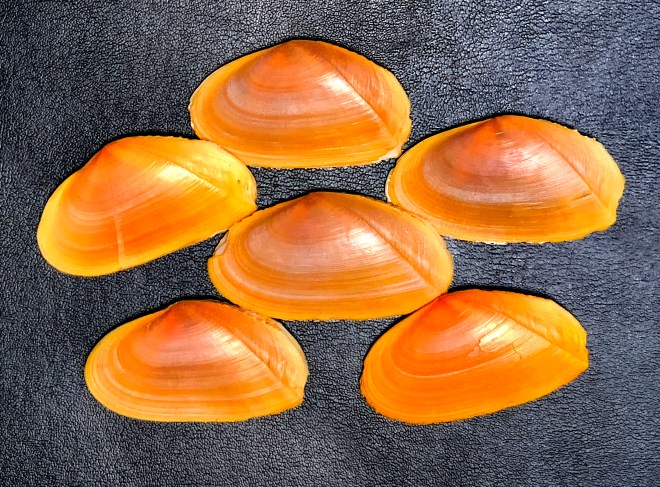
Tellina Foliacea Linne, 1758
netted burrowed in sand at 30 meters deep
Bantayan, Phillipines 2018

The genus Tellina is a widely distributed marine mollusc and a member of the family Tellinida. Tellins are filter feeding bivalves that inhabit tropical waters around the world. They are edible. All together there are about one hundred species, most of which are rather bland, solid whitish in color. Tellina Foliacea Linne, 1758 is one of the few exceptions with its bright uniform orange color.
One of the most beautiful bivalves is Tellina radiata Linne, 1758 which comes from the Caribbean Sea. It is called the Sunrise Tellin because of its colorful radiating bands of purple on a yellow and whitish shell. Unfortunately it is rather hard to come by recently. Large specimens over three inches are impressive.
Here in Florida we have Tellina lineata W. Truton,1819, the Rose Colored Tellin, which is a shell crafters favorite. It is white with rose color overtones and often about an inch and a half in size.. It can be found burrowed in sand bars at low tide in the Keys and on both coasts. Halves often wash up on shore.
The most commonly available Tellin is Tellina virgata Linne, 1758, a Philippine shell widely wholesaled for shell crafting. It is similar to the Sunrise Tellin but the bands lacks the colorful yellows.
We are offering in this raffle a half dozen pairs of Tellina foliacea, large in size of about 3″. They are very fresh specimens, collected by native divers in 2018. Donated by Richard Kent and recently obtained from a Philippine dealer. Tellina foliacea is not an easy shell to obtain, making this a very desirable raffle to win, whether the shells are won by specimen collectors or shell crafters.

May Program notes

Anne K DuPont Bio

Anne DuPont is a Scientific Diver and underwater photographer specializing in opisthobranchs.

She is one of the co-authors of “Caribbean Sea Slugs, a field guide to the opisthobranch mollusks from the tropical northwestern Atlantic.

She has 3 Opisthobranchs named after her.

She is a Museum Associate in Malacology at the Natural History Museum of Los Angeles County.

She is a volunteer with the Florida Natural History Museum,

Anne is a Regular-Service volunteer with the Florida Fish & Wildlife Research Institute.

She is on the Speakers Bureau for Palm Beach county Environmental Resources Management.

Her favorite pastime is diving in Lake Worth Lagoon. She has been diving in the Lagoon for 25 years, and is very knowledgeable on the underwater life found there.

Her photos have been published in numerous books, magazines, educational DVDs and videos.

SHELL OF THE MONTH – MAY 2019

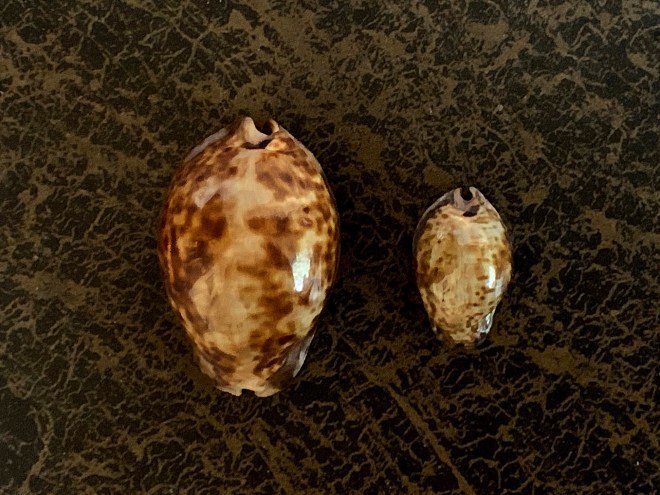
Trona stercoraria (Linnaeus, 1758) by diver at night, low tide in seaweed at 3 meters, M’bour, Senegal
Trona stercoraria (Linnaeus, 1758) dwarf. by diver on rocks at 10 meters, Gulf of Guinae, Limbe, Cameroon

Trona stercoraria (Linnaeus, 1758) is a popular cowrie among collectors due to its extreme variability in size, shape, color and even pattern. Its common name the Rat Cowry or Droppings Cowry. Certain populations have overcastings that make for bizarre specimens which may look as if they were infected by disease (and possibly they are). These are common in some locations.
Even with all the variation stercoraria is easily recognized and can’t be confused with any other cypraea. Its coloration could be considered drab (mousy, hence the name Rat). It is certainly not flashy. Typical specimens have a mocha colored base with dark brown chiseled teeth. The dorsum is similar in color and covered with blurred brown blotches. Some specimens are light, others dark in color. Scarce specimens have a largely clear dorsum, others with an irregular pattern while the occasional one has the blotches fused to almost sold and even scarcer almost black. The margins are calloused and both extremities are rostrate. Sizes run from extreme dwarfs of 1″ to giants of about 3.75”. The majority fall between 2 and 2.5″. While typically rhomboid, sone specimens are oval.
There are populations with an extreme hump that were named Trona stercoraria rattus (Lamarck, 1810). Linnaeus call the dwarfs “minima”. Even with all the variation the vast majority have the patterns and shape of the two offered here.
Trona stercoraria is a West African cowry with a restricted range below the Bulge of Africa. Most specimens come from the Gulf of Guinea. It is fairly common in this area and lives in a variety of shallow water habitats.
The two shells were donated by Richard Kent and were obtained from European dealers. Average sized specimens retail for $20-25, dwarfs though much scarcer somewhat less. Large ones go for over $30. Giants and unusual specimens can be found on eBay from $60 to over $300. In fact there is one very dark 95mm specimen with blueish borders listed for sale at $520!

April Program

TTitle for my presentation: Bivalves; in Sickness and in Health
The talk introduces principles of molluscan pathology, the factors causing pathological changes in mollusks and the different categories of disease.

Biography

Dr. Inke Sunila accomplished her Ph.D. Thesis in Physiological Zoology at the University of Helsinki in Finland in 1987. She lived at the Tvärminne Zoological Station in the northern Baltic archipelago for several years, sampling blue mussels in the field, studying their pathology and exposing mussels to environmental pollutants in the laboratory. She continued her research on bivalve diseases at the Cooperative Oxford Laboratory in Maryland. After that she accepted a position as a post-doc research scientist at George Washington University Medical Center, Department of Pathology in an AIDS research group.
For 20 years Dr. Sunila worked for the State of Connecticut, Department of Agriculture, Bureau of Aquaculture in Milford, CT as the State Shellfish Pathologist/Environmental Laboratory Director. She monitored and managed CT’s bivalves for different shellfish diseases, developed disease-resistant strains and performed health certifications for imported seed. From 2000-2003 she was also Adjunct Assistant Professor at the University of Connecticut, College of Agriculture, Department of Pathobiology and Veterinary Sciences.
After retiring from State service, Dr. Sunila relocated in Lake Worth, Florida, to continue research on southern marine ecosystems. Dr. Sunila is known as a scientist who doesn’t hesitate to get her hands dirty and knows how to retrieve samples from the sea. She is involved in several grant-funded bivalve research programs, has numerous publications and has taught several students from different universities from all over the world.