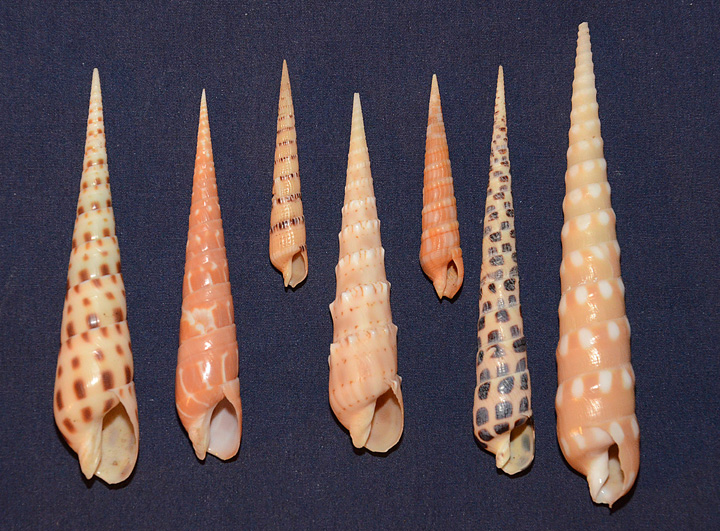
Set of seven Terebra, from left to right
Terebra areolata, Link 1807 off shore shallow water in sand Nha Trang, Viet Nam
Terebra dimidiata, Linné 1758 20′ in sand Nago Bay, Okinawa 1985
Terebra pertusa, Born 1778 diver 7-10m Olango Island, Cebu, Philippines 2008
Terebra crenulata, Linné 1758 40′ in sand night SCUBA Tuamotus, French Polynesia 2000
Terebra nebulosa, Sowerby, 1825 diver 7-10m Olango Island, Cebu, Philippines 2008
Terebra, subulata, Linné 1767 in sand at night Rabaul, Papua New Guinea
Terebra guttata, Roding, 1798 15-10m inside reef by diver Balayon Bay Batangas, Philippines 2007
Terebra are closely related to Conus and Turris. They all have a poison apparatus to kill their prey. Terebra feed mainly marine worms. Terebra live worldwide, with most species in the Indo-Pacific region. Terebra is one of four genera in Terebridae, the others being Hastula, Duplicaria and Impages. Many of the smaller species are near impossible to identify. The largest specimen presented in this group just over 5″ and the smallest is 2 1/2″. Terebra maculata, LInné 1758, not offered here is far and away the largest growing Terebra reaching a size of 10″. In Florida we have Terebra taurinus, Lightfoot 1786 which grows to 5″ and Terebra floridanus, Dall, 1889 which grows to 3″ plus several dozen much smaller species.
 Broward Shell Club
You must be logged in to post a comment.