SHELL OF THE MONTH – OCTOBER 2015

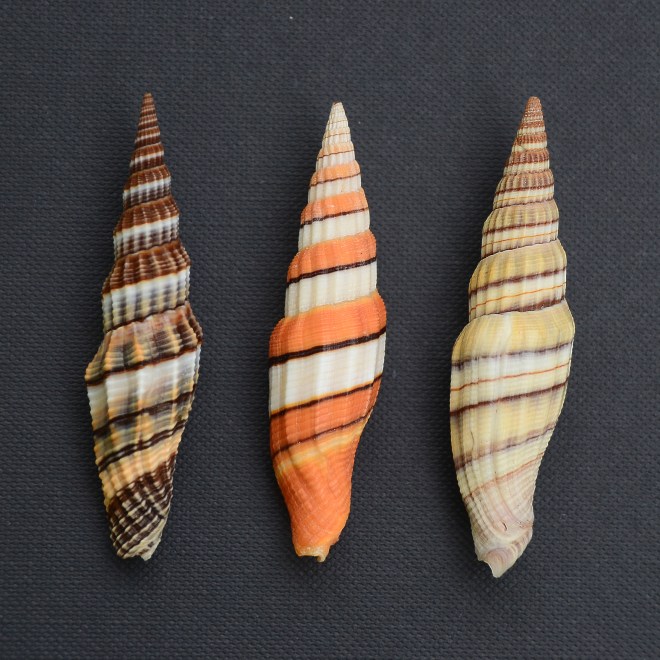
ReginaThe Queen Mitre  – Vexillum regina, Sowerby I, 1825 – 3 varieties
The Queen Mitre is cursed! This beautiful shell is elegantly shaped with a tall spire, sculptured with axial ribs and valleys, and circled with bands of multiple colors. Adult size ranges from 50 to 70mm. Unfortunately the Queen Mitre has a big problem. No one is quite sure what the proper name should be. It was always known as Vexillum regina, Sowerby I, 1825. Then the scientists decided that name was a nomen nudum and the proper name should be Vexillum citrinum, Gmelin 1791. Along came Cate in 1961 who christened the Phillipine shells, Vexillum filliaregina, the Colorful Queen.  Add to this confusion is Vexillium taeniatum, Lamark 1811 which may or may not be the same shell depending on who’s describing it. To make matters even worse, all Vexillum are no longer Mitres, the scientists moved the shells out of the Mitridae and into Costellaridae.

The shells in our raffle represent three of the variations on the market. Even novice collectors will have no problem distinguishing one from the other. Each variety is restricted in locale. Our identification is arbitrary. Even though Vexillum regina is again recognized as valid, there is no consensus as to which shell is which or whether they    share the same name or not.

Specimen #1. Vexillum citrinum, Gmelin 1791 is found only in Madagascar and rarely the African coast. Its colors are earth tones. It has the most sharply chiseled sculpture of the three. Extra large specimens are quite narrow.

Specimen #2. Vexillum filliaregina, Cate 1961 is the colorful orange, white and black variety found in the Philippines. It is quite variable in color but not shape.

SHELL OF THE MONTH – JULY 2015

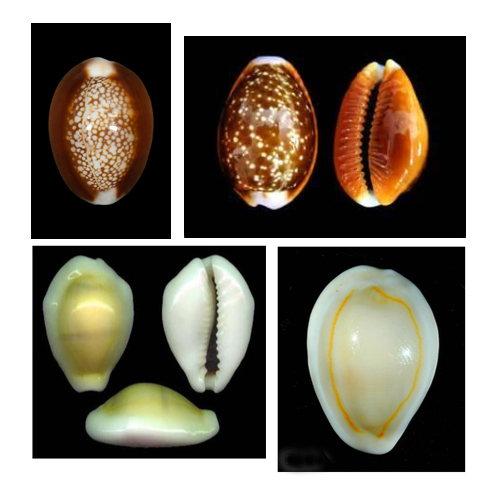
cypraeaCypraea caputserpentis Linne, 1758 – Snake-Head Cowrie. This is one of the commonest yet most beautiful of the Cypraea. It also has the distinction of not varying in its pattern like many other Cowries.
Cypraea helvola Linne, 1758 – The Honey Cowrie. Another common Cowrie, but one that never fails to impress.
Cypraea moneta Linne, 1758 – The Money Cowrie. This is one of the most variable of the genus, even within one location. And, as its name implies, it has been used in many countries as a monetary unit
Cypraea annulus Linne, 1758 – The Gold- Ringer Cowrie. Although this Cypraea can vary in form the gold “ring” is a consistent feature.
Now, you may ask why we have so many Cowries this month….it’s simple. They are all self-collected and donated by our President, Sonny Ogden. In 1967 when she was stationed with her husband at the Navy Base on Kwajalein Island in the Pacific, she collected these from the lagoon in about 20 – 30 feet of water on a rubble bottom. So you see, these are “no ordinary Cowries”!

SHELL OF THE MONTH – JUNE 2015

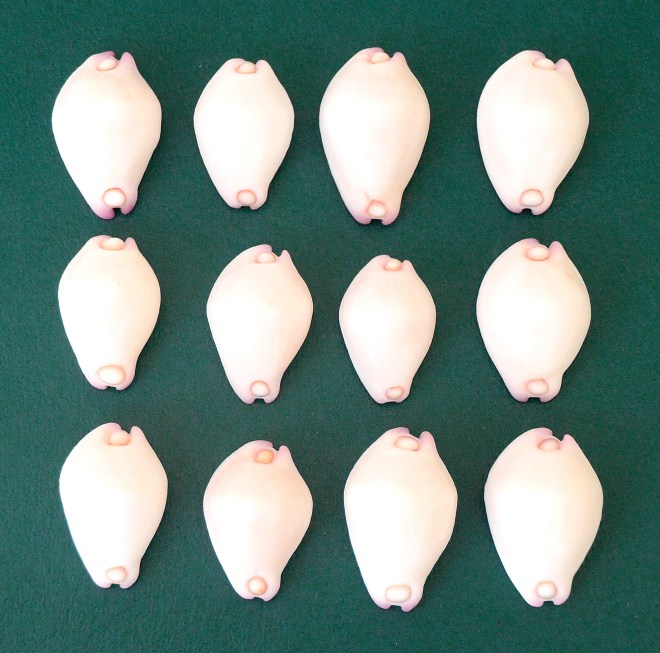
CalpurnusCalpurnus verrucosus (Linnaeus, 1758) 3-5m deep in soft corals and sponges Off Olango Island, Cebu, Philippines

For the June Shell of the Month we offer a set of 12 Calpurnus verrucosus (Linnaeus, 1758). All are high quality specimen shells which may either be used for comparison study or for shell craft.
Calpurnus verrucosus is a member of the family Ovulidae. It is a large family of diverse sizes and shapes. They have in common being white, pinkish or even approaching red, having a smooth often glossy surface, and a long narrow aperture. All members come from warm tropical waters, especially the Pacific. Calpurnus
verrucosus looks like an albino Cypraea with pink tips. In fact, its common name is little egg cowry or warty cowry. The warty is due to the umbilical button near each terminal. All Ovulidae are carnivorous and live on soft corals. In contrast to the solid color shells, the animal is often quite colorful. This one is white with orange leopard spots outlined in black.
The set was donated by Richard Kent. Our thanks also to Alice Lustig for her donation to the Raffle Table at the May meeting.


SHELL OF THE MONTH – APRIL 2015

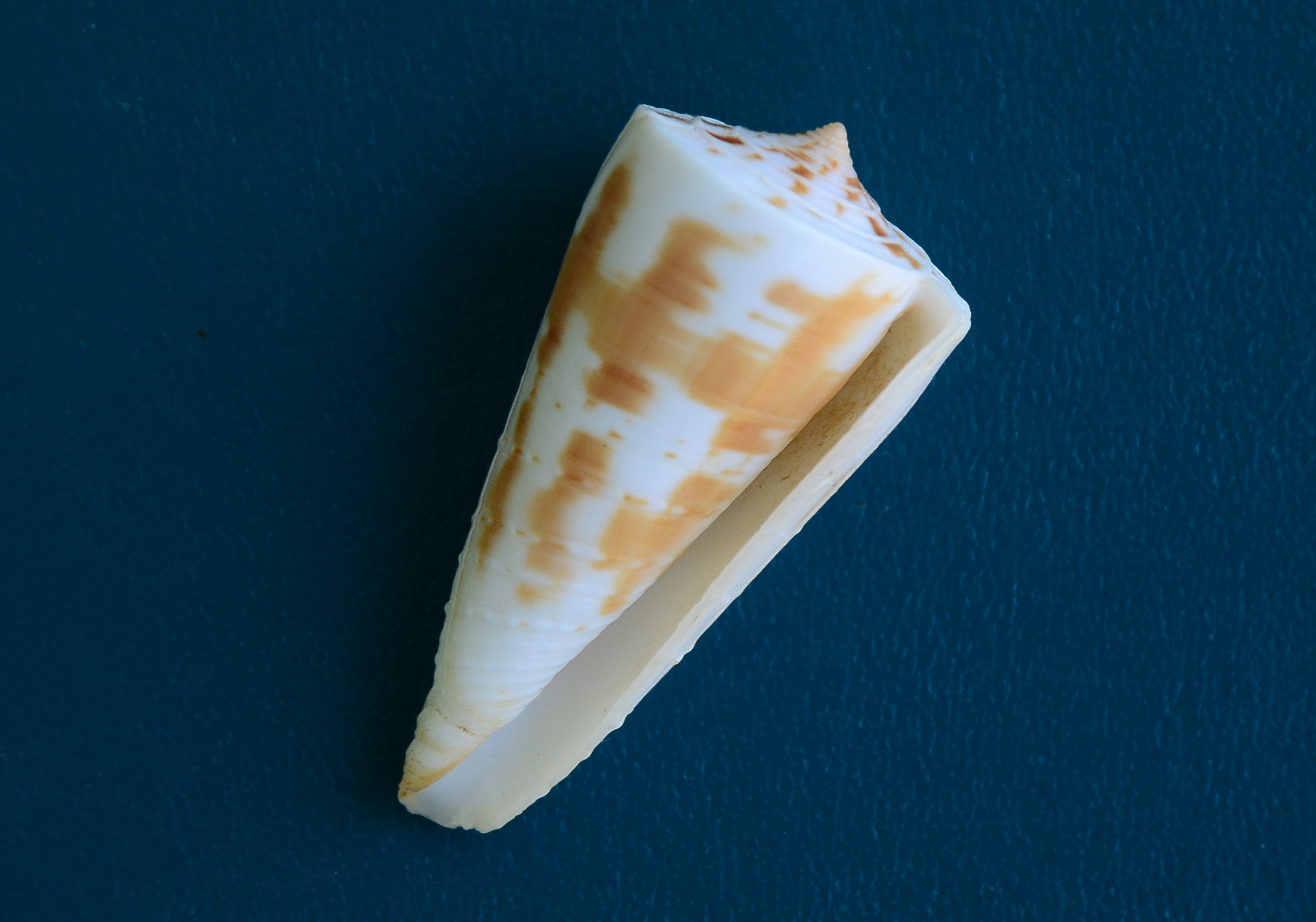
DSC_9646Conus tribblei Walls, 1977
10m deep in coral reef sand pocket
Off Olango Island, Cebu, Philippines
Collected in 2009

Our Shell of the Month, Conus tribblei Walls, 1977 is in memory of Leonard Nimoy – Spock – of the TV series Star Trek. The shell was named by Walls after his pet cat who was in turn named after the “The Trouble with Tribbles” which aired in 1967 and is considered one of the all time best episodes of Star Trek.

Conus tribllei is not a rare shell so it is surprising that it was not named until 1977. One guess is that it was confused with Conus bayani Jousseaume, 1872, Conus recluzianus Bernardi, 1853 and several other similar cones and slipped the attention of the scientists. 

The shell is obconical and elongate, rather elegant is shape. It is white with a pattern of brownish blotches arranged in irregular axial groups. There are typically spiral rows of granules on the bottom third or sometimes more with a the remainder of the shell being smooth. The surface is waxy and glossy.

It is reported that specimens grow to 70mm to 100mm and larger but they don’t seem to grow that large anymore. The only specimen listed on eBay at this moment is a meager 47mm. Specimens of Conus tribblei are difficult to acquire. The few specimens that reach the market come from the Philippines or Taiwan. Our specimen is a choice one, about as near to gem in grade as a cone can be and has a natural lip. Donated by Richard Kent.

SHELL OF THE MONTH – FEBRUARY 2014

festiva
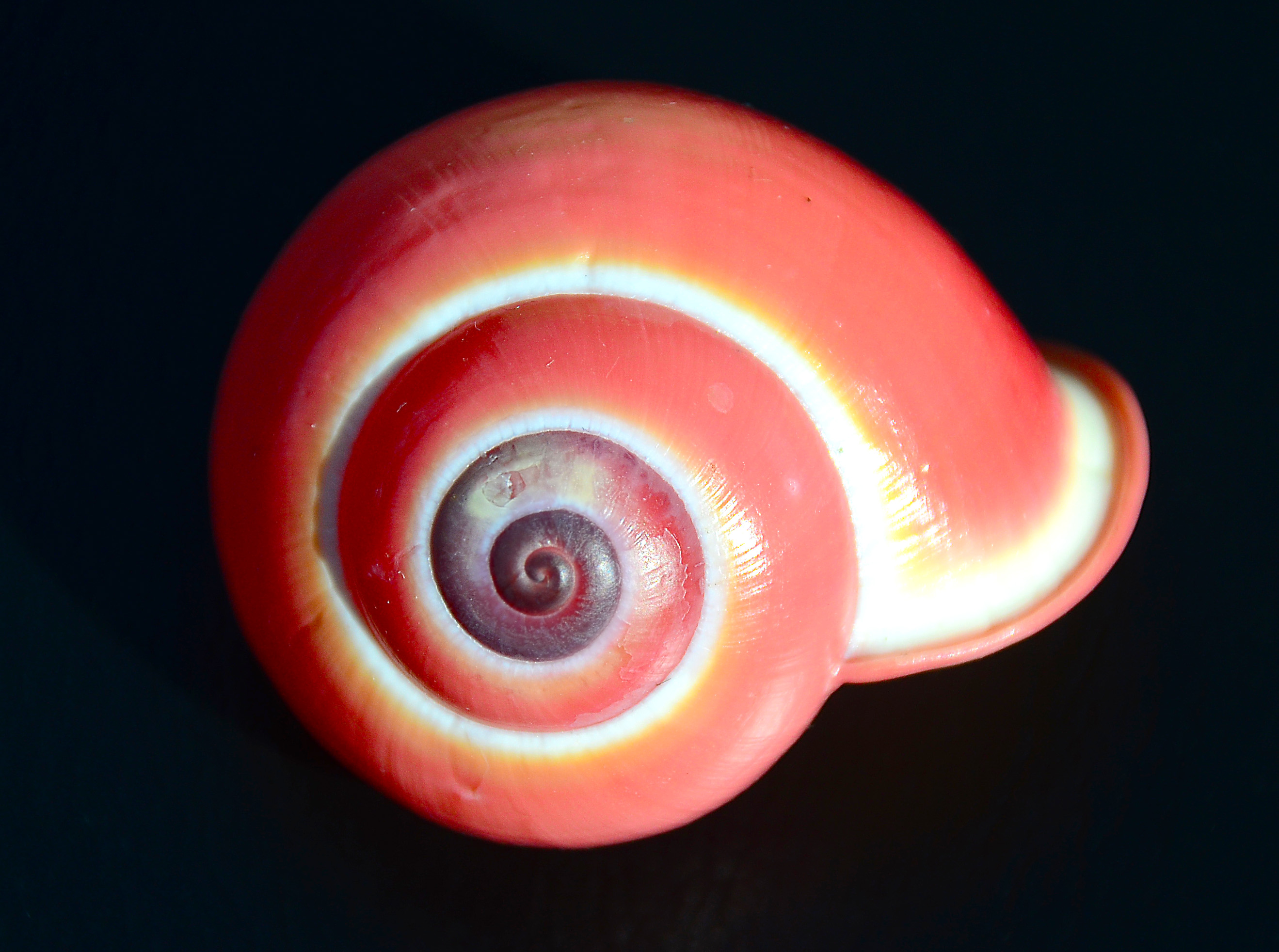
Calocochlia festiva Donovan 1825
Mountains, Cagayon Province,
Northern Luzon Island, Philippines  44mm 1 3/4”

Calocochlia is a genus of large air-breathing land snails, pulmonate gastropod mollusks in the family Bradybaenidae. Tthere are over fifty species of Calocochlia, the vast majority of which the collector will never encounter. A few are particularly large and colorful, notably Calocochlia festiva Donovan 1825, which comes in two color varieties, rose or yellow. C. festiva has only been recorded from Cayagan Province, northern Luzon Island, Philippines and no other information seems to be published. This months specimen is donated by Richard Kent and was purchased from Richard Goldman at the 2015 Broward Shell Club Shell Show.

SHELL OF THE MONTH – JANUARY 2015

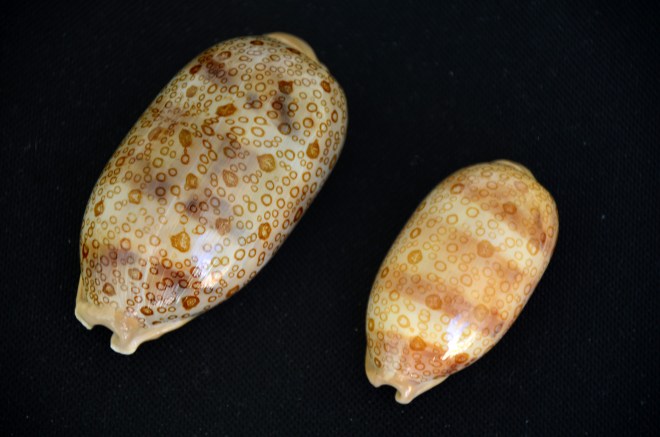
beckiiCypraea (Erosaria) beckii Gaskoin 1836, living inside base of black corals at 50-60m, off Masbate Island, Central Philippines, January 2014.

Cypraea beckii is a beautiful minute cowry growing only to 10-14mm in size. It is moderately rare and lives in deep water at the base of black coral. Until recently it was very difficult to obtain, alive or dead, however modern collection methods have made specimens more readily available. Although its range is widespread across the Pacific, virtually all specimens come from the Philippines.
Cyrpaea beckii is fawn in color with a whitish base, its dorsum spotted randomly with white dots, about one third which are ocellated in black. The extremities are rostrate and the teeth are stained deep brown.
Cyprare Beckii is named after Dr. H Beck, a Danish naturalist, 1799-1863.
The winner of the shell of the month raffle will receive not one but two specimens, both of gem quality, with retail value of $15-$20 each. Please note that due to the small size, this is a representative photo and not of the specimens in the raffle. Donated from the collection of Richard Kent.


SHELL OF THE MONTH – NOVEMBER 2014

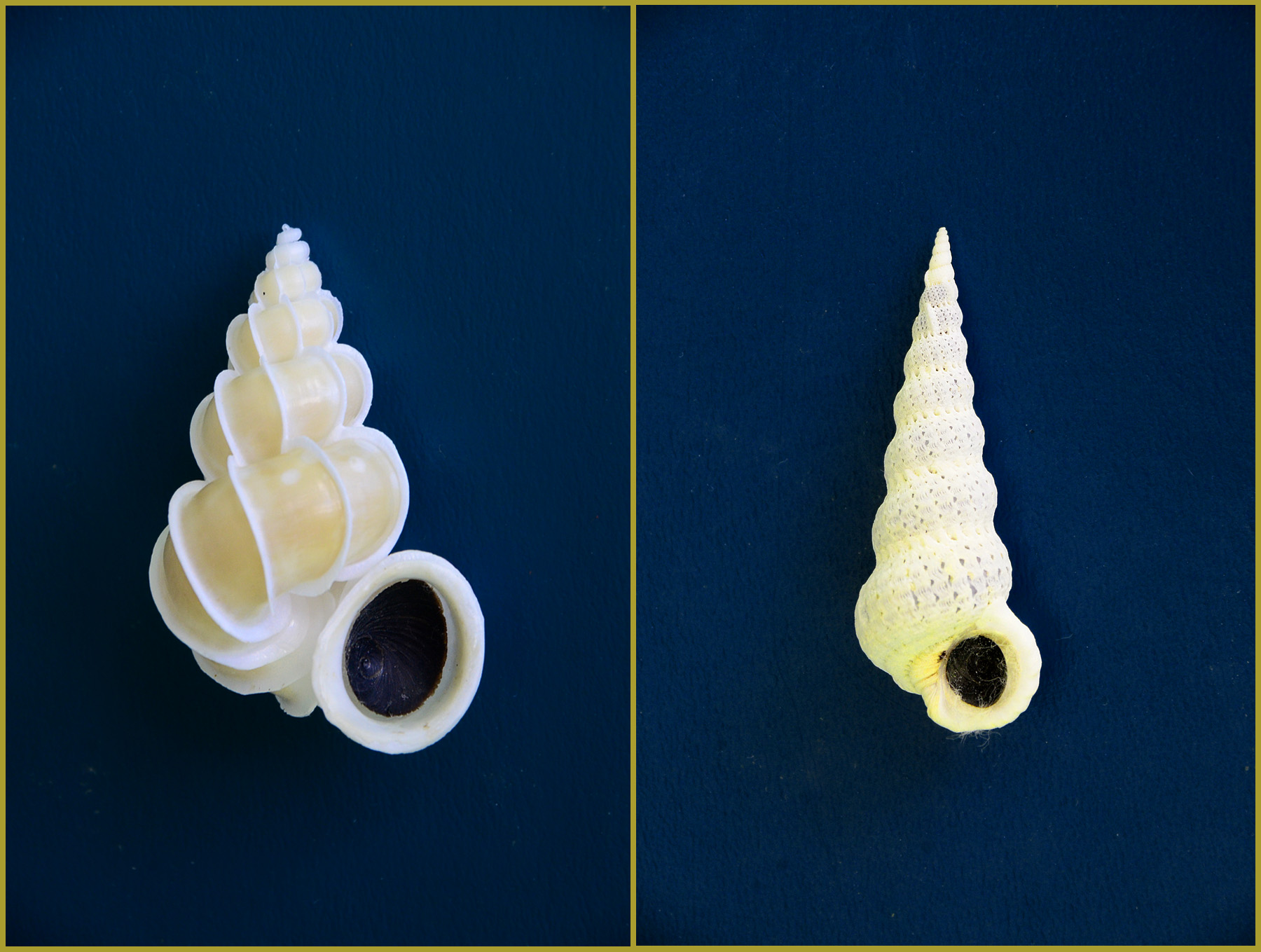
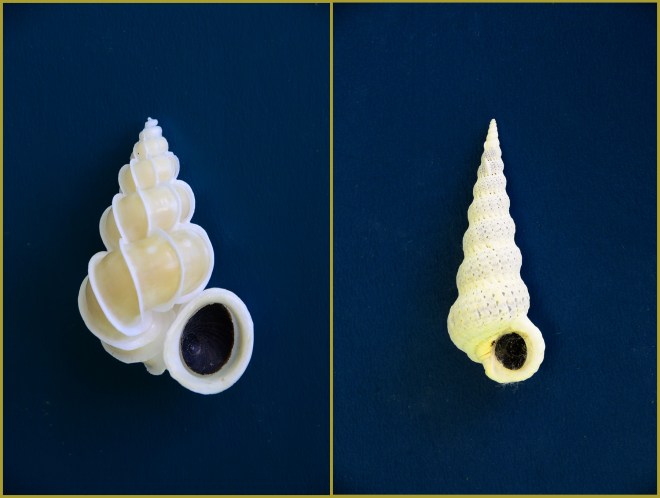
EpitoniumEpitonium scalarae Linnaeus, 1758
Live collected by local fishermen
tangle net 70-100m
Manila Bay, Philippines
January 2014

Epitonium varicosa Lamarck, 1822
Live collected by local fishermen
on reef at 15m
of Masbate Island, Central Philippines
January 2014
For November we have a very special pair of shells, two cousins –  one is very famous and the other quite obscure and seldom seen.  Epitonium scalare, Linne 1758 is the Precious Wentletrap,  a shell of incredible beauty that hundreds of years ago was so precious it graced the cabinets of emperors and queens. It’s extreme rarity led the Chinese to make fabulous fakes from rice paste. The name Wentletrap comes from a Dutch word meaning spiral staircase and it is indeed an accurate description. Epitonium scalare’s whorls do not touch each other while its extended ribs form the the staircase. It has a porcelain surface.

Epitonium varicosa Lamarck, 1822 was a rare shell until modern collecting methods made it more available, however we’re guessing even advanced collectors have never seen a specimen!  It has an amazing surface pattern and texture that photographs do not do justice to.
Wentletraps are predatory foragers and primarily feed on anemones. Most members of the family are quite small. Both specimens are from the Philippines and are of gem quality, live collected with the operculums preserved. Both are 55mm in length and about as large as any freshly collected shells that are likely to found on the market today.
Donated by Richard Kent

The following is reprinted from University of Chicago and is attributed to Penelope. It is fascinating reading.

The first published figure of Epitonium scalare (Precious Wentletrap) appeared in Rumphius’ D’Amboinsche Rariteitkamer (“Ambonese Curiosity Cabinet”) and was added posthumously by the editor, “perhaps because his Honor did not encounter them, or perhaps because they do not occur in those regions.” He comments that 500 guilders had been refused for a specimen, three of which were then known to exist. One was owned by Cosimo de Medici (to whom Rumphius had been obliged to sell his collection some twenty years earlier) and another by Johan de la Faille, a wealthy burgher from Delft and its chief magistrate. There also was a shell said to be somewhere in England. Half a century later, Linnaeus still considered the Precious Wentletrap to be rare (Systema Naturae, 10th ed. p.713, where it is called Turbinis scalaris). Even by the nineteenth century, when the shell had become more common, it still was celebrated for its beauty. One can understand why. The elegant whorls of the wentletrap do not touch as they coil from spire to aperture but are held in place by a flaring set of ribs (costae). These ribs, which are the margins of its former aperture, mark the growth of the shell and enclose it much like the treads of a spiral staircase. It is from this appearance that its popular and scientific names derive: wentletrap from the Middle Dutch wendeltrappe for a winding or spiral staircase, and scalare from the Latin scalae for a ladder or flight of stairs.

Lamarck had called the shell Scalaria pretiosa (from the Latin pretiosus, precious or valuable) because of the high price it fetched, as indeed it did. About 1750, the Emperor Francis I, husband of Maria Theresa, had paid 4000 guilders for a specimen. Three years later, four shells sold in England for more than £75. When the collection of the French ambassador to The Hague was auctioned in 1757, an E. scalare sold for 1611 livres (for comparison, Diderot was paid 3500 livres to edit his Encyclopédie that year). Ten years later, a two-inch specimen sold for 900 livres. The Queen of Sweden, the patron of Linnaeus (who utilized her collection in describing many of the shells in his Systema), owned a wentletrap, as did Catherine the Great (who later purchased Diderot’s library and employed him to care for it) and the Duchess of Portland. Prior to about 1800, the Dutch controlled access to the shell’s habitat. Eventually, specimens began to be imported from China, including cleverly fashioned fakes made of rice paste. Ironically, these fragile counterfeits, of which only a very few are thought to survive, are more rare than the beautiful porcelain-like shells they imitated.

Wentletraps feed primarily on sea anemones, from which they draw nourishment through their proboscis. It has been suggested that the purple dye which is released when the mollusk dies is used as an anesthetizing agent in feeding. But this assumption does not seem to be warranted.